How To Become SEBI Registered Analyst in 2026

SEBI Research Analyst Registration: Eligibility, Fees & Steps

 If you want to know how to become sebi registered analyst, what qualifications are required, how much deposit you need to pay, and how recent amendments have changed the rules — this guide gives you everything in one place.

SEBI has implemented some important updates regarding qualifications, client-based deposit requirements, fees, certification, and applicability. Many people remain confused about these changes, especially after the December 2024 amendment.

This comprehensive guide explains the entire SEBI Research Analyst registration process in simple language, with all the new rules included, compliance requirements, and expert guidance so you can avoid penalties and illegal advisory issues.

⭐ What SEBI Says: Who Must Register as a Research Analyst?

According to the SEBI Research Analyst Regulations:

Any person who prepares research reports or provides stock recommendations, buy/sell calls, trading tips, or investment opinions in exchange for consideration (fees) must obtain SEBI Research Analyst registration.

If you provide stock market advice for money — in any form — you fall under SEBI RA regulations.
Providing research or tips without registration is illegal, and SEBI can take strict action, including penalties, warnings, or even market bans.

⭐ What Is “Consideration” Under SEBI Rules?

The term consideration has legal meaning under the Contract Act, but for practical understanding:

If you receive money, fees, commission, subscription, or anything of value in exchange for stock market advice — it is considered a “consideration”.

That means:

  • Charging for calls
  • Paid stock recommendations
  • Subscription-based advisory
  • Research-based Telegram tips
  • WhatsApp, YouTube, or social media advice for money

ALL require SEBI Research Analyst (RA) registration.

If you are earning from stock tips — registration is mandatory.

⭐ Part-Time Research Analysts Are Also Covered

Many people believe that SEBI RA registration is needed only for full-time analysts.


But this is wrong.

Whether you are:

  • Doing a job
  • Running a business
  • Freelancing
  • Providing evening research services
  • Sharing research part-time

If you are giving advice and charging for it, you must obtain SEBI RA registration.


There is no concept of “small-scale advising” or “side income tips” — SEBI applies uniform rules to all.

⭐ Can NRIs Become SEBI Research Analysts? (Updated Clarification)

A common question is:


“Can an NRI apply for SEBI Research Analyst registration?”

Here’s the clear interpretation:

  • SEBI laws do not explicitly allow NRIs to register.
  • SEBI laws do not explicitly restrict them either.
  • However, SEBI registration is not issued to individuals operating from outside India.

This means:

A person living outside India cannot directly obtain SEBI RA registration.

But that does not mean NRIs cannot work in research.

Under Regulation 4:

Anyone residing outside India who prepares research reports on Indian securities must collaborate with a SEBI-registered Research Analyst or Research Entity based in India.

So NRIs cannot register independently, but they can work through a tie-up with an Indian RA firm.

This is a compliant and legally allowed way for NRIs to participate in the Indian market research ecosystem.

⭐ Qualification Required to Become a SEBI Registered Research Analyst

SEBI has removed the earlier experience requirement.


Now, experience no longer plays any role.

✔ Current Qualification Requirement (2026)

You must have:

A graduate or postgraduate degree, or a professional qualification, in any of the following fields:

  • Finance
  • Accountancy
  • Commerce
  • Business Management
  • Economics
  • Capital Markets
  • Banking
  • Insurance
  • Actuarial Science
  • Or any related financial field

You are eligible if your degree is in any of these subjects.

✔ Alternate Qualification Paths

If you don’t have the above degrees, you can still become a Research Analyst through:

  1. NISM Post Graduate Program (PGP) – 1-year full-time
  2. CFA Charter or CFA Level completion

These are acceptable qualifications under SEBI RA regulations.

⭐ What Changed After December 2024 Amendment?

Earlier, the rules were different:

❌ Earlier:

  • Graduate degrees (any field) + 5 years experience made you eligible
  • Any postgraduate degree qualified you
  • Experience was accepted

✔ Now (After Amendment):

  • Experience requirement removed entirely
  • Only graduates in specific subjects allowed
  • Postgraduate degrees in unrelated fields no longer eligible
  • Professional courses still valid (CFA, PGP)

Also:

Anyone working with you — sales staff, relationship managers, etc. — must also be graduates.

This improves the quality and accountability of research services.

⭐ Mandatory Certification: NISM Series XV (15)

To become a Research Analyst, you must have:

NISM Series XV Research Analyst Certification

This certification:

  • Is compulsory
  • Must be renewed periodically
  • Has a renewal module (no need to take full exam again)

Without NISM Series XV, you cannot apply for registration.

⭐ SEBI RA Deposit Requirement (New Rule Replacing Net Worth)

This is one of the biggest changes.

Earlier, individuals needed:


✔ ₹1 lakh net worth

Now SEBI has replaced this with a client-based deposit system.

  • 0–150 clients: ₹1,00,000 deposit
  • 151–300 clients: ₹2,00,000 deposit
  • 301–1000 clients: ₹5,00,000 deposit
  • 1000+ clients: ₹10,00,000 deposit

Instead of net worth certificates, SEBI now wants an FD or deposit maintained with a scheduled bank.

This ensures capital adequacy based on scaling.

Why This Matters?

Earlier, someone with just ₹1 lakh net worth could serve thousands of clients.


Now, if you want to serve more clients, your deposit must increase.

Many call this “ease of doing business,” but practically:

It feels more like the “fees of doing business.”

Still, it brings more accountability to analysts handling large client bases.

⭐ Validity of SEBI Registration

A major advantage in the new rules:

SEBI RA Registration Certificate is valid forever — unless suspended or cancelled by SEBI.

There is:

  • No expiry period
  • No need to reapply
  • No need to resubmit documents

To keep registration active, you must:

  • Pay renewal fee every 5 years
  • Maintain NISM certification
  • File compliance reports
  • Follow SEBI guidelines

Failing to follow compliance can lead to cancellation or suspension.

⭐ SEBI RA Fees: Application + Registration + Renewal

SEBI has not changed the fee structure.

1. Application Fee (Non-refundable)

  • Individuals: ₹2,000
  • Non-individuals: ₹20,000

2. Registration Fee

  • Individuals: ₹3,000
  • Non-individuals: ₹30,000

3. Renewal Fee (Every 5 Years)

  • Individuals: ₹1,000
  • Non-individuals: ₹5,000
  • Additional administrative fee (non-individuals): ₹5,00,000

Total Cost

  • Individuals: ~₹15,000 + GST
  • Companies/Firms: ~₹5,50,000 + GST

This cost does not include advisory setup, compliance, audit support, or documentation assistance.

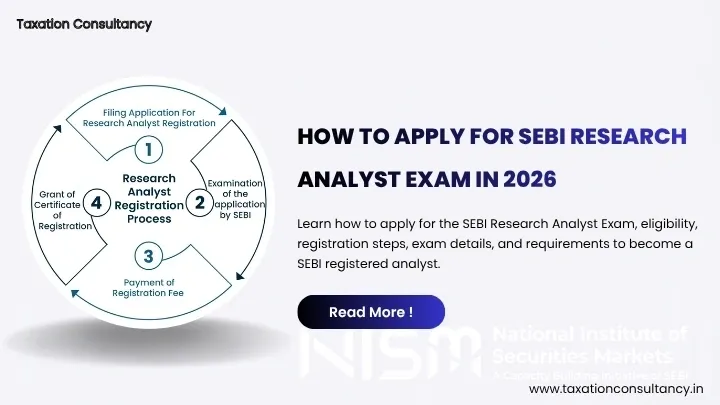
⭐ Step-by-Step Process: How to Become SEBI Registered Analyst

Here is a simplified  step-by-step guide:

Step 1: Check Eligibility

Ensure you meet the qualification criteria or alternative pathways (PGP/CFA).

Step 2: Obtain NISM Series XV Certification

This is mandatory for all RAs.

Step 3: Prepare Documentation

You will need:

  • KYC documents
  • Qualification certificates
  • Experience (if any)
  • NISM certificate
  • Address proof
  • Deposit proof
  • Income tax details

Step 4: Open SEBI Intermediary Portal Account

Register on SEBI SI Portal.

Step 5: Submit Form A (RA Application Form)

Upload documents and pay the application fee.

Step 6: Make Required Deposit (FD/Deposit Slip)

Deposit amount must match your client capacity.

Step 7: SEBI Verification

SEBI examines your documents and may ask for clarifications.

Step 8: Approval & Certificate Issuance

Once approved, SEBI issues the RA Certificate with your registration number.

Step 9: Start Legal Research Activities

After approval, you can legally provide:

  • Research reports
  • Trading/investment analysis
  • Equity/derivative research
  • Buy/sell/hold recommendations

⭐ Consequences of Giving Advice Without Registration

Unregistered advisory is punishable under the SEBI Act.

SEBI may:

  • Send show cause notices
  • Impose penalties
  • Order refunds to clients
  • Ban the advisor from markets
  • Initiate legal action

Never provide paid tips without registration.

⭐ Summary: How to Get SEBI Registered

how to get sebi registered?, you must have a relevant graduate degree, mandatory NISM Series XV certification, and client-based deposit. Submit Form A on SEBI portal, pay fees, and follow compliance norms. Registration is valid permanently unless SEBI cancels it.

⭐ FAQs 

1. What is the main qualification required to become a SEBI RA?

A graduate degree in finance, commerce, economics, business management, or a related field. CFA/PGP also qualify.

2. Is NISM Series XV mandatory?

Yes. Without NISM Series XV, you cannot apply for registration.

3. How much deposit is needed?

₹1 lakh to ₹10 lakh depending on the number of clients.

4. Can NRIs get SEBI RA registration?

No, NRIs living outside India cannot register directly. They may collaborate with an Indian registered RA.

5. How long is SEBI RA registration valid?

It is valid permanently unless SEBI cancels or suspends it.

6. Can part-time analysts apply?

Yes. Even part-time research providers must register.

7. Is experience required?

No. Experience requirement has been removed.

8. How long does SEBI take to approve?

Usually 30–90 days, depending on document accuracy.

9. What happens if someone gives paid tips without registration?

It is illegal, and SEBI can take strict action including penalties and bans.

⭐ Need Professional Help to Get SEBI Registered? (Recommended)

If you want hassle-free SEBI Registration, be it:

  • Research Analyst (RA)
  • Investment Advisor (IA)
  • PMS Registration
  • Post-registration SEBI Compliance
  • Help with SEBI Show Cause Notices
  • Assistance with Unregistered Advisory Cases

Then TaxationConsultancy is your trusted partner.

📞 Contact:

Phone: +91 8928321757


Email: taxationconsultancy997@gmail.com

Why Choose TaxationConsultancy?

  • Expert team specializing in SEBI registrations
  • Zero-error documentation
  • Fast approval assistance
  • Post-registration compliance support
  • Help with SEBI audits and legal notices
  • Support for both registered and unregistered advisory cases

TaxationConsultancy — Your Trusted Partner for SEBI Registrations, Compliance, and Legal Support.

Get Free Consultation

SEBI Eases Educational Criteria for IA & RA 2026

SEBI Eases Educational Criteria for RAs & IAs (2026): Complete Breakdown, Impact & How You Can Benef

In a major update aimed at expanding India’s regulated financial advisory ecosystem, SEBI has officially eased the educational criteria for Investment Advisors (IA) and Research Analysts (RA) effective from 25th November 2025. This change is expected to bring a significant shift in who can enter the financial advisory space, making it far more accessible for graduates across various disciplines.

Earlier, becoming a SEBI-registered IA or RA required specific finance-related degrees — a barrier that kept thousands of capable aspirants out. With the new reforms, graduates from ANY discipline can now apply, provided they complete mandatory certifications and meet regulatory requirements.

As a result, the advisory ecosystem is about to see more diversity, more talent, and more opportunities.

And for aspirants who want to take advantage of this change, we at TaxationConsultancy are already helping individuals navigate the registration process — from documentation to certification guidance — ensuring smoother, faster approvals.

What Triggered SEBI’s New Educational Relaxation?

The Indian investor landscape has transformed rapidly.

  • Millions of young investors entered the market during 2020–2025.
  • The rise of fintech apps increased awareness and accessibility.
  • But the number of SEBI registered advisors remained surprisingly low.

For example, India had fewer than 1,000 active Investment Advisors, despite having more than 10 crore demat accounts.

SEBI realized that the strict eligibility norms — especially the requirement of specific finance backgrounds — were holding back a large pool of talent.

Thus, the 2026 reform was born.

Old Eligibility Criteria for IAs & RAs (Before 2026)

Previously, SEBI required:

For Investment Advisors

  • A graduate or post-graduate degree in
    • Finance
    • Commerce
    • Economics
    • Accounting
    • Business management
    • Capital markets
  • AND mandatory NISM certifications.

For Research Analysts

  • Similar finance-focused degrees OR
  • 5 years of relevant experience.

This created a barrier for graduates of engineering, arts, science, law, hospitality, agriculture, and similar fields.

Even talented market enthusiasts had no official pathway into SEBI-regulated roles — unless they pursued additional degrees.

What Exactly Has SEBI Changed?

As part of the new 2026 regulations:

👉 ANY graduate (in any discipline) is now eligible to apply to become an IA or RA.

Whether you studied:

  • B.A.
  • B.Sc.
  • B.Tech / B.E.
  • BBA / BCA
  • LLB
  • Fine arts
  • Agriculture
  • Hospitality
  • Psychology
  • ANY field…

You will now be considered eligible.

This single change increases India’s IA/RA talent pool by millions.

New Educational Criteria Explained (2026 Onwards)

The updated criteria are straightforward and inclusive:

✔ Graduate degree from ANY recognized university (India or abroad)

No discipline restrictions.


No minimum marks requirement.

✔ Equivalent foreign qualifications accepted

International graduates can also apply.

✔ CFA Charter recognized

A candidate holding the global CFA qualification automatically becomes eligible.

✔ NISM certification remains COMPULSORY

This ensures that even non-finance graduates have standardized knowledge.

Who Benefits the Most?

This reform benefits:

⭐ Students from non-commerce backgrounds

Engineering, arts, science, IT — all now eligible.

⭐ Working professionals wanting a career shift

Many IT employees or corporate professionals want to enter finance — now they can.

⭐ Self-taught stock market enthusiasts

People who have learned through YouTube, courses, books, or experience.

⭐ Tier-2 & Tier-3 aspirants

Where finance-focused degrees may not be easily available.

⭐ Aspirants planning to become independent advisors

Anyone wanting to start an advisory practice will now find the path easier.

Why This Reform Is a Big Win for Aspirants

Here’s the biggest advantage:

Skill matters more than degree now.

If you are good with:

  • Market analysis
  • Understanding stocks
  • Evaluating companies
  • Financial planning
  • Risk management

…you can pursue IA/RA registration irrespective of your academic background.

Earlier, a talented engineer who understood markets better than many commerce graduates was still not eligible.

Now they are.

Impact on Investment Advisors

Investment Advisors (IAs) guide clients on:

  • Financial planning
  • Wealth management
  • Portfolio construction
  • Risk assessment

With the new rules:

  • There will be more registered advisors.
  • Clients will have more choices.
  • Advisory services will become more affordable.
  • Regional growth will multiply—especially in small towns.

Advisory will no longer be a “finance-only club.”

Impact on Research Analysts

Research Analysts prepare:

  • Stock research reports
  • Earnings analysis
  • Sectoral studies
  • Investment recommendations

Now:

  • Math graduates can become analysts.
  • Engineers can use analytical skills for equity research.
  • Arts graduates with good writing skills can excel in report creation.

Expect a significantly larger and more diverse research ecosystem.

Mandatory Certifications Still Required

Relaxed education does NOT mean no certifications.

To ensure professionalism, SEBI still requires:

NISM-Series-XA & XB – for Investment Advisors

NISM-Series-XV – for Research Analysts

This maintains quality and protects investors.

Non-finance graduates will be required to learn core market concepts — that’s where smart preparation matters.

How to Become a SEBI IA or RA Under New Rules

Here’s a simple, actionable roadmap:

Step 1: Check graduation eligibility

Any discipline still qualifies.

Step 2: Complete NISM certification

Choose IA or RA track.

Step 3: Prepare documentation

  • Aadhaar
  • PAN
  • Graduation proof
  • Passport photo
  • Address proof

Step 4: Submit SEBI online application

Step 5: Clear background & fit-and-proper checks

Step 6: Receive registration number

Why SEBI Took This Step — The Real Intent

SEBI clearly wants to:

  • Bring more people into regulated advisory roles
  • Reduce dependence on unregistered “influencers”
  • Give investors safer, professional guidance
  • Expand financial inclusion in rural and semi-urban India
  • Encourage young talent to enter capital markets

This decision aligns with India’s goal of becoming one of the world’s most robust capital markets by 2030.

Market Outlook: How This Reform Will Shape the Industry

Expect these upcoming trends:

📈 More advisory firms opening

Especially in Tier-2 and Tier-3 cities.

🤝 Better investor-advisor ratio

More professional guidance available.

🔍 Higher-quality research

As more analysts join the market, companies will get deeper coverage.

🚀 Rise of niche advisors

  • Retirement planning
  • Tax-efficient investing
  • Small-cap advisory
  • NRI advisory
  • Robo-advisory models

💼 More jobs in fintech, broking, wealth management

The future looks bright for anyone entering the advisory profession now.

How TaxationConsultancy Supports Aspirants

At TaxationConsultancy, we’ve helped thousands of professionals get clarity, confidence, and compliance in regulatory registrations.

And with the new SEBI 2026 guidelines, our support becomes even more valuable.

Here’s how we help:

✔ Eligibility analysis

We evaluate your background to confirm compliance.

✔ NISM certification guidance

We help you choose the right exam, preparation strategy, and timeline.

✔ Documentation support and Business Plan

We prepare and structure documents exactly as SEBI expects.

✔ End-to-end SEBI application filing

No confusion. No rejection due to errors.

✔ Compliance consulting

We help you meet post-registration obligations too.

Whether you’re a fresh graduate, career-shifter, or market enthusiast, we simplify the entire IA/RA registration journey.

Common Mistakes Applicants Make (And How to Avoid Them)

❌ Submitting incomplete documents

Many applications get rejected due to minor errors.

❌ Choosing wrong NISM exam

IA and RA certifications are different.

❌ Not checking “fit and proper” criteria

Defaults, legal issues, or missing information can block approval.

❌ Wrong categorization

Mixing advisory and distribution can cause licensing issues.

✔ With TaxationConsultancy, these mistakes are eliminated.

Final Thoughts 

SEBI’s decision to ease educational criteria for Investment Advisors and SEBI Registered Research Analysts from 2026 marks a transformational moment for the financial industry.

The advisory profession is now open to:

  • Engineers
  • Arts graduates
  • Science students
  • IT professionals
  • Corporate employees
  • Fresh graduates
  • Market enthusiasts

It’s the most inclusive the industry has ever been.

At TaxationConsultancy, we are committed to helping aspiring advisors turn this opportunity into a successful, compliant career path.

FAQs

1. What is the new SEBI rule for educational qualifications?

SEBI now accepts graduates from ANY discipline for IA/RA registration starting 2026.

2. Do I still need NISM certification?

Yes. NISM certifications remain mandatory for both IAs and RAs.

3. Can a B.Tech or engineering graduate become an Investment Advisor?

Yes. Any graduate—engineering, arts, science, etc.—is now eligible.

4. Will this increase competition in advisory roles?

Yes, but it will also expand opportunities due to rising investor demand.

5. Does TaxationConsultancy help with SEBI registration?

Yes. We provide complete guidance—from SEBI Registration,Post Registration Compliances and SEBI Legal Support for Registered and Unregistered Advisory.

Part-Time SEBI Registration as Research Analyst & Investment Advisor

Part-Time SEBI Registration as Research Analyst & Investment Advisor

 If you are planning to start your career as a SEBI Registered Advisor or an Investment Advisor but are unsure whether you should go full-time immediately, the concept of Part-Time SEBI Registration is the perfect starting point. 

Many individuals, especially working professionals, CAs, CSs, or people from non-financial backgrounds, want to test the waters before fully committing to this profession. SEBI has now made this possible through a historic announcement.

At Taxation Consultancy, we specialize in handling every SEBI-related matter, including:

  • SEBI Research Analyst Registration
  • SEBI Investment Advisor Registration
  • SEBI Portfolio Manager Registration
  • Part-Time SEBI Registration support
  • Documentation, NOC drafting & compliance
  • Website & disclosure setup

This guide will walk you through everything you need to know about becoming a Part-Time SEBI Registered Advisor or Part-Time Investment Advisor, even if you are working in a non-finance job or running a separate professional practice.

Why Part-Time SEBI Registration Became Important in 2026

The financial advisory industry in India has been rapidly evolving. With the rising number of retail traders, stock market learners, and people seeking proper guidance, SEBI recognized the need to allow part-time advisors and analysts who are engaged in non-financial sectors.

This led to the release of a major SEBI circular on 8 January 2025, announcing that professionals working in non-financial roles could apply for Part-Time Research Analyst (RA) or Part-Time Investment Advisor (IA) registration.

This change has opened the door for:

  • Employees who want to start advisory work part-time
  • People curious to explore the advisory business before going full-time
  • CA or CS professionals who want an additional income source
  • IT professionals, engineers, doctors, teachers & freelancers
  • Anyone who wants to legally provide research or investment advice without quitting their job

This is one of SEBI’s biggest steps toward democratizing financial advisory services.

Who Can Apply for Part-Time SEBI Registration?

One of the best things about SEBI’s new regulation is that any graduate can now apply for part-time Research Analyst or Investment Advisor registration. There is no restriction on your educational background.

✔ Finance degree not required

Even if you are an engineer, doctor, teacher, IT employee, or from any non-finance background—you are eligible.

✔ Full-time job? No problem

As long as your employer gives you an NOC, you can apply for part-time RA or IA registration.

✔ CA & CS Professionals

You can apply without surrendering your COP, which was a major concern earlier.

✔ Freelancers & consultants

You can apply as an individual and build your own small advisory practice.

This flexibility has encouraged thousands of individuals to explore advisory-related careers.

NISM Certifications Required for SEBI RA & IA Registration

To become a SEBI Registered Advisor, you must clear mandatory NISM exams:

For Research Analyst (RA):

📌 NISM Series 15 – Research Analyst Certification

For Investment Advisor (IA):

📌 NISM Series 10A (Level 1)
📌 NISM Series 10B (Level 2)

These certifications validate your basic understanding of investment advisory processes, ethics, compliance, and wealth management.

Tip: If you want support in completing the exams or preparing the documents afterward, Taxation Consultancy provides complete guidance and even NISM support references.

Client Limit for Part-Time SEBI Registered Advisors

SEBI has imposed a strict limit:

✔ Maximum 75 clients allowed for part-time RA/IA

Once you cross 75 clients, you must either:

  • Apply for full-time registration
  • Upgrade your structure
  • Comply with additional SEBI guidelines

This ensures that part-time advisors maintain focus and do not operate at a scale requiring full-time compliance.

Documents Required for Part-Time SEBI Registration

The documents required for part-time registration are the same as full-time registration, as per SEBI’s guidelines.

Here is the complete list:

✔ Identity & Address Proof

  • PAN Card
  • Aadhaar Card
  • Passport-size photograph

✔ Educational Documents

  • Graduation certificate
  • NISM exam certificates (mandatory)

✔ Financial & Compliance Documents

  • ITR (last 3 years) – Not mandatory as per recent press release; awaiting amendment
  • Net worth certificate (for Investment Advisor applicants)
  • Bank statements
  • Office address proof

✔ Business Declaration

  • Declaration of “Fit & Proper” person
  • Undertaking for compliance
  • Professional conduct confirmation

✔ Mandatory NOC Requirements

If you are working in a company, you must submit:

📌 NOC on official letterhead, signed & stamped

If you are a CA or CS, you can issue an NOC on your own letterhead—no need to surrender your COP.

Taxation Consultancy Advantage

Our team ensures that all documents are:

  • Properly notarized
  • Formatted as per SEBI requirements
  • Uploaded correctly on the BSE portal
  • Free from errors that cause delays

NOC Format & Employer Permission (Most Important Requirement)

One of the most essential requirements for part-time SEBI registration is the NOC (No Objection Certificate) from your employer.

Why is the NOC Important?

Because SEBI wants to ensure:

  • You are not working in a financial services entity
  • Your employer is aware of your additional activity
  • There is no conflict of interest

Who Needs to Submit NOC?

  • Working professionals in IT, design, engineering, healthcare, etc.
  • Corporate employees in any non-financial sector

Who Doesn’t Need to Submit NOC?

  • Self-employed individuals
  • Freelancers
  • CA professionals
  • CS professionals

If you need an NOC format, Taxation Consultancy provides it instantly — call or WhatsApp us anytime.

Compliance Rules After Becoming a Part-Time SEBI Registered Advisor

Compliance is the most important part once you receive your registration number.

Here are your Dos & Don’ts:

✔ Dos After Registration

  1. Maintain Arm’s Length Separation
    Your advisory work must be clearly separate from your job or business.
  2. Disclose All Income Sources to SEBI
    Transparency is mandatory.
  3. Prepare Research Reports Before Giving Recommendations
    No tip-based advisory allowed.
  4. Use the Correct Disclaimer Everywhere
    You must mention “Part-Time Research Analyst / Part-Time Investment Advisor.”
  5. Maintain Records & Audit Reports
    Record every research, recommendation, and client communication.

✘ Don’ts After Registration

  1. ❌ Do not manage client funds
  2. ❌ Do not guarantee profits
  3. ❌ Do not give tip-based calls
  4. ❌ Do not take login credentials of clients
  5. ❌ Do not engage in insider trading

These rules ensure ethical advisory practices.

Mandatory Website Requirement for Part-Time RA/IA

Every SEBI Registered Advisor—including part-time—must have a professional website displaying:

  • SEBI registration number
  • SEBI disclaimers
  • Terms & conditions
  • Privacy policy
  • Conflict of interest statements
  • Fee structure
  • Research methodology

Taxation Consultancy also provides SEBI-compliant website setups, ensuring you meet all mandatory criteria.

Processing Time for SEBI Registration

Typically, SEBI registration takes:

⏳ 2 to 4 months

The duration depends on:

  • BSE application queue
  • Quality of documentation
  • Completeness of NOC
  • SEBI queries & response time

We at Taxation Consultancy ensure your application moves faster and avoids unnecessary delays.

Charges for Part-Time SEBI RA/IA Registration

The official registration fee is:

₹15,000 + GST, divided into 3 stages:

  1. Initial fee: ₹2,000 + GST
  2. Main fee: ₹10,000 + GST
  3. Final fee: ₹3,000 + GST

No hidden charges.
No additional government fees beyond this.

Why Choose Taxation Consultancy?

When it comes to SEBI registration, the biggest challenge for individuals is the complex documentation and strict compliance requirements.

At Taxation Consultancy, we:

  • Handle end-to-end SEBI registration
  • Prepare & format all documents
  • Provide employer NOC formats
  • Ensure SEBI-compliant website setup
  • Review all your disclosures
  • Guide you through NISM certification
  • Respond to BSE/SEBI queries on your behalf
  • Provide post-registration compliance support

We have a 100% success rate for SEBI RA/IA registrations.

Contact Taxation Consultancy

If you want to become a Part-Time SEBI Registered Advisor or Investment Advisor, reach out to us today:

📞 Call: 8928321757


📧 Email: taxationconsultancy997@gmail.com


💬 WhatsApp: Instant SEBI Support Available

We guide you from exam to registration approval.

Final Words

Part-time SEBI registration is a revolutionary step that allows individuals to explore the advisory profession with minimal risk. Whether you want to start small, build a side income, or test your potential before going full-time, this is the ideal path.

At Taxation Consultancy, we take care of everything—from NISM exams to final SEBI approval—so you can focus entirely on your advisory journey.

FAQs

1. What is Part-Time SEBI Registration?

Part-time SEBI registration allows working professionals in non-financial sectors to become a SEBI Registered Research Analyst or Investment Advisor with a limit of 75 clients while continuing their main job.

2. Can anyone become a SEBI Registered Advisor?

Yes. As per SEBI’s latest circularany graduate can apply for RA or IA registration.

3. Is NISM certification mandatory?

Yes.

  • RA requires NISM Series 15
  • IA requires NISM 10A & 10B

4. Do I need a website for SEBI registration?

Yes, a website is mandatory for all RAs and IAs, even part-time.

5. Is NOC required for part-time registration?

Yes, if you are employed in a non-financial sector.
CA and CS professionals can self-issue NOC.

6. What is the client limit for part-time SEBI advisors?

SEBI allows a maximum of 75 clients under part-time registration.

7. How long does SEBI registration take?

Processing time is 2 to 4 months.

8. What are the fees for SEBI RA/IA registration?

The official fee is ₹15,000 + GST, divided into 3 parts.

9. Can I do advisory work while doing a job?

Yes, as long as you have an NOC from your employer.

10. Can social media influencers become part-time advisors?

No. Influencers must take full-time registration only

How to Pay SEBI Penalty Online | Step-by-Step Guide

How to Pay SEBI Penalty Online — Updated Guide (2026)

 When you see a penalty notice from SEBI — maybe linked to PACL-related orders, a compliance violation, or a trading breach — it can feel overwhelming. But here’s good news: paying the penalty online is now fairly straightforward, if you know the right link and follow the right steps. Think of it like paying an electricity or tax bill online — once you get the hang of it, it becomes routine.

In this article, I’ll walk you through how to pay SEBI penalty online (including for PACL or other SEBI orders), what to watch out for, and how to stay compliant in future. I also share tips to avoid scams, and how services such as Taxation Consultancy can help you navigate tricky regulatory-tax compliance.

What is a SEBI Penalty — and Why It Matters

The Securities and Exchange Board of India (SEBI) acts as the gatekeeper of India’s securities markets. When entities or individuals — brokers, companies, investment advisors, investors — flout the rules, SEBI may issue a penalty order.

SEBI penalty is a monetary fine levied as per SEBI’s enforcement powers. Such penalties discourage malpractice (like insider trading, misreporting, illegal fundraising) and help maintain market integrity. Paying the penalty is not optional — failure to comply can invite further legal or regulatory consequences.

In other words: treat a SEBI penalty like a speeding ticket — pay it on time, or risk heavy consequences.

Common Reasons for SEBI Penalties (including PACL-Related Cases)

One might get a SEBI penalty for various reasons. Some of the common causes are:

  • Trading violations: insider trading, market manipulation, front-running, circular trading, wash trades etc.
  • Fraudulent or unauthorised fundraising: running unregistered schemes, collecting money from investors without approval (e.g. schemes like PACL Ltd.).
  • Non-compliance with reporting or disclosure requirements.
  • Misuse of client funds by brokers or intermediaries.
  • Delays or failures to comply with earlier SEBI directives or orders.

Cases related to PACL (and similar money-circulation or collective investment schemes) are especially common. SEBI has issued many orders against such schemes, which often involve disgorgement (refunds) and penalty components under its quasi-judicial powers.

When you receive a SEBI order (whether due to PACL-related issues or any other violation), the order will mention the penalty amount, the section under which penalty is imposed, and payment instructions.

How SEBI Publishes Orders & Penalties (including 2026 Orders)

SEBI makes its orders publicly available on its website. For example:

  • The “Orders” section lists adjudication orders, settlement orders, chairperson orders, etc.
  • Next to each order that involves a penalty or settlement amount, there is often a “PAY NOW” link. This link takes you to SEBI’s payment gateway, enabling online payment.

As of late 2026, SEBI continues to use this process — orders passed recently (e.g. in November 2026) are visible, and payment links (“PAY NOW”) are active for many penalty/settlement orders. 

This ensures transparency and gives you a direct route to settle dues without friction.

Where and How SEBI Accepts Online Penalty Payments

If you need to pay a SEBI penalty or settlement amount, here’s where to go:

  • Go to SEBI’s official website and navigate to the “Orders” page under Enforcement.
  • Orders that require payment will show a “PAY NOW” button or link.
  • Clicking “PAY NOW” directs you to SEBI’s payment gateway/portal (hosted under its intermediary portal or payment module) — e.g. via the link under the “Payment Module” or “Intermediary Portal / Payment Gateway” sections.

When SEBI introduced e-payment facility (for penalties, disgorgement, settlement, legal charges, recovery amounts etc.), it allowed payments via bank transfer (RTGS/NEFT), electronic payment modes, ensuring easier compliance. 

Thus, paying a penalty online is legitimate, accepted, and promoted by SEBI itself.

Step-by-Step: Paying SEBI Penalty Online (2026 Process)

Here’s a walkthrough of exactly how you (or your authorized representative) can pay a SEBI penalty online:

Step 1 — Visit SEBI’s Official Orders Page

Go to SEBI website → Enforcement → Orders. Alternatively, start at SEBI homepage and navigate via “Enforcement / Orders.” 

Step 2 — Find Your Order

Search by date, name, or order number. Once you locate the relevant order (which mentions penalty/settlement amount), click the “PAY NOW” link against it.

Step 3 — Confirm Order & Amount

The payment gateway will present the order details: payee name, order number, amount, due amount. Ensure these match your SEBI notice.

Step 4 — Choose Payment Method

SEBI’s e-payment facility supports payment via bank transfer (RTGS / NEFT), and electronic modes. 

Step 5 — Make the Payment

Use your bank’s net banking / RTGS / NEFT. Enter necessary beneficiary details (populated by portal), and complete the transaction.

Step 6 — Save Transaction Confirmation / Payment Receipt

Once payment is done, you’ll get a confirmation from SEBI (on-screen), and typically an acknowledgement email — download and save this as proof.

Step 7 — Inform SEBI (if required)

In some cases (especially older methods), SEBI asks for transaction details (case name, order number, amount, bank details) forwarded via email or form. 

Alternative (Offline / Bank) Payment Methods & When They Are Used

Not all orders or situations allow online payments. Historically (and even now, in limited cases), SEBI permitted:

  • Demand Draft (DD) in favour of SEBI
  • RTGS / NEFT transfers to specified SEBI bank accounts (especially for disgorgement or settlement amounts)
  • Bank deposit or direct transfer, followed by sending payment confirmation to the concerned SEBI department. 

If SEBI order mentions offline payment instructions, or if you prefer such methods, you can use these — but online gateway is faster, more secure, and avoids paperwork.

What You Need Before Paying — Documents & Info Ready

Before you hit “PAY NOW”, make sure you have:

  • Order number / Reference number (as per SEBI order)
  • Your PAN (or the PAN quoted in the order)
  • Correct name (as in SEBI records)
  • Payment amount (as per SEBI order)
  • Bank account / net-banking credentials (if paying via NEFT/RTGS)
  • Payment proof facility: screenshot of transaction / bank remittance slip / confirmation

It also helps to keep a copy of the SEBI order PDF (for your records).

Double-check all details — wrong PAN or name may cause payment rejection or mismatch.

How to Download/Obtain Payment Receipt & Confirmation

After payment, do the following:

  1. Take a screenshot or print the confirmation page shown by SEBI payment portal.
  2. Check your registered email — SEBI usually sends an electronic receipt or acknowledgement.
  3. If the portal has a “Payment History” or “Transaction Status” section (on SEBI Intermediary Portal), log back to confirm status.
  4. Keep a copy of transaction ID / UTR / bank transfer reference, along with order number and PAN — this helps prove the payment if needed later.

Having proof is important — both for your own records and in case SEBI enforces recovery or audit.

Common Mistakes & Pitfalls to Avoid

Many people make simple errors that create hassles. Here are things to watch out for:

  • Paying from a wrong bank account — use the account details provided by SEBI portal.
  • Typo in PAN / name / order number — leads to mismatches; payment may not get linked to your order.
  • Paying incorrect amount — underpayment may be treated as non-compliance.
  • Not saving payment receipt or transaction references — losing proof can complicate future compliance or audit.
  • Using unofficial or fraudulent payment links (fake emails / notices) — can even lead to scams.

Always check the URL carefully — it should belong to SEBI’s official domain (sebi.gov.in or siportal.sebi.gov.in), not some random site.

What If You Miss the Deadline — Consequences & Options

Some SEBI orders come with a payment deadline (e.g. within 30–45 days). Recent literature highlights that delayed or non-payment can lead to recovery proceedings — sometimes with additional interest or penalty. 

If you anticipate delay, you may:

  • Contact SEBI via the contact info in the order — request extension citing valid reason (health, financial hardship, technical issue).
  • Apply for settlement (if SEBI’s settlement scheme is applicable) — some orders are settled under settlement regulations.
  • Engage a professional compliance / tax consultancy (see next section) to negotiate or liaise on your behalf.

But delaying without valid reason or communication is risky and not recommended.

Extra Concern: Verifying SEBI Notices & Avoiding Frauds

A growing concern lately: fraudulent parties impersonating SEBI, issuing fake penalty notices and demanding payment outside official channels. In fact, SEBI recently issued public warnings against impersonation attempts and illegal use of its letterheads / logos for fake penalty demands. 

To protect yourself:

  • Always verify the order on SEBI’s official Orders page (not just via email or WhatsApp).
  • Do not click random “PAY NOW” links from emails — go directly to sebi.gov.in via browser.
  • Cross-check the order number, name, PAN with SEBI’s published order list.
  • Ensure payment is via SEBI’s official gateway (on siportal.sebi.gov.in or SEBI payment module).

If in doubt — reach out to SEBI’s contact or regional office. Do not rush into payment based on fear or pressure.

Specifics for PACL / SEBI-PACL Related Orders & Payments

Many investors or collectors get SEBI notices because of involvement with PACL or other collective-investment / money-circulation schemes. For such orders:

  • SEBI issues adjudication or settlement orders against individuals/entities involved. These appear on the Orders page under the relevant category (AO orders / settlement / disgorgement).
  • The payment process remains same: locate the order → click “PAY NOW” → use SEBI payment gateway → transfer via RTGS/NEFT or other allowed mode.
  • The penalty or disgorgement amount may be high; proper banking/payment details and documentation is critical.

Even if your order is old, SEBI’s e-payment facility — introduced back in 2016 — remains applicable. 

So, for any SEBI-PACL order, follow the same payment steps — no separate procedure is needed.

How a Service like TaxationConsultancy Can Help You

If you feel overwhelmed by SEBI notices, penalty amounts, or compliance hassles, professional help can make a big difference. Here’s how TaxationConsultancy (or your preferred consultancy) can help:

  • ✅ Review SEBI Order & Payment Instructions — ensure the order is genuine and payment link is accurate.
  • ✅ Assist with Documentation — ensure correct PAN/name mapping, gather necessary affidavits or proofs, help avoid mistakes.
  • ✅ Help with Bank Transfer / RTGS / NEFT — fill beneficiary details, arrange transfer smoothly.
  • ✅ Maintain Record-Keeping & Accounting Compliance — save receipts, maintain books (especially relevant if you’re a broker or firm).
  • ✅ Advise on Legal & Regulatory Compliance — in case of additional queries, appeals, or delays.

For complex PACL-related or large penalties, having a consultant reduces risk of errors or future complications.

Preventive Tips — How to Avoid Future SEBI Penalties

Once you’ve paid your penalty, it’s smart to stay ahead and avoid future trouble. Here are simple habits to adopt:

  • Follow SEBI trading rules, insider trading norms, and compliance guidelines strictly.
  • Avoid dubious investment schemes — especially money-circulation or unregistered collective investments.
  • Maintain transparent books if you’re an intermediary or run a brokerage/firm.
  • Respond promptly to investor complaints, regulatory notices, or SEBI communications.
  • Keep PAN, KYC, and transaction records updated.
  • Periodically audit compliance and get expert help (like TaxationConsultancy) to assess risk.

Think of it like preventive health checkups — better to stay compliant than pay fines later.

Conclusion

Paying a SEBI penalty online is much easier today — just like settling any regular bill online. With SEBI’s official payment gateway, digital banking modes, and transparent orders, the process is quick, safe, and binding.

Whether your penalty arises from PACL-related orders, compliance failures, or trading violations, you now have a clear path to settle dues. All you need is correct order details, PAN, and your bank access.

If you find it daunting — especially for large amounts or complex orders — a consultancy like TaxationConsultancy can smooth the process, ensuring compliance and avoiding mistakes.

Stay compliant, and with a little care, you may never need to pay a penalty again.

FAQs

1. How do I pay my SEBI penalty online?

Visit SEBI’s official website → Enforcement → Orders → locate your order → click “PAY NOW” → enter required details and make payment via RTGS/NEFT or allowed mode through SEBI’s payment gateway.

2. Can I pay a SEBI-PACL related penalty online via the same method?

Yes. PACL-related SEBI orders, like other adjudication or settlement orders, come with a “PAY NOW” link on the SEBI Orders page, and can be paid via the same online portal.

3. What payment methods does SEBI accept for penalties?

SEBI’s e-payment facility allows bank transfers (RTGS/NEFT) and electronic payments via its gateway. For some cases, older offline methods (demand draft, bank deposit) are still valid if specified.

4. What if I don’t get a payment receipt after paying online?

Save the on-screen confirmation immediately — take screenshot and record transaction/UTR details. Also check your email for an acknowledgement from SEBI. If receipt is not received, contact SEBI via details in the order or official contact list.

5. How can a consultancy like TaxationConsultancy help me with SEBI penalty payment and compliance?

Such a consultancy can review your SEBI order for authenticity, help fill payment details correctly, assist with bank transfer, maintain secure records, advise on compliance, and handle follow-up communication with SEBI if needed.

SEBI Show Cause Notice: Meaning, & Latest on PACL| 2026

SEBI Show Cause Notice – What It Means, Latest Trends & How to Protect Yourself

 If you’re reading headlines about a Securities and Exchange Board of India (SEBI) show cause notice and feeling a bit lost — you’re not alone. It sounds serious, but what does it actually mean? For many, it’s like a “notice” saying: “You might have crossed the line. Explain yourself.”

A show cause notice isn’t a final punishment — it’s a chance for the accused to respond. And when it comes from SEBI, it often signals investigations into financial wrongdoing, fraud, or regulatory breaches. Given how common SEC-style scams and schemes have become, knowing what a show cause notice entails can protect you as an investor, a company director, or just a curious citizen.

In this article, we’ll go deep — explaining show cause notices under the SEBI Act, the process, recent trends (including major cases like the PACL Ltd. saga), why you should pay attention, and how you can stay safe. We also throw in practical advice — and a word about how a professional service like TaxationConsultancy can help you stay compliant and avoid trouble.

What is a SEBI Show Cause Notice?

show cause notice (SCN) from SEBI is essentially a formal letter. It says: “We believe you may have violated rules under the SEBI Act or related regulations. Please explain why we should not penalise you.”

It’s not a final verdict or punishment — rather, it’s a chance to respond, to present your side, and to defend yourself before SEBI takes further action. In legal parlance, it ensures natural justice and due process. Without assessing your explanation, SEBI doesn’t immediately impose fines or bans.

In other words: think of it as being asked to step into the ring — not yet judged guilty, but challenged to explain yourself before the referee makes a decision.

Why Does SEBI Issue Show Cause Notices? 

Common Triggers

SEBI doesn’t issue notices randomly. Here are common reasons:

  • Illegal investment schemes or Ponzi-style operations: Companies promising unrealistic returns through dubious collective investment.
  • Misleading or false communication: False promises to attract investors or financial advice without proper registration.
  • Insider trading, price manipulation, or unfair trading practices.
  • Violation of listing or takeover regulations when companies are publicly traded.
  • Non-compliance by market intermediaries — brokers, advisors — such as misuse of client funds or lack of proper disclosures.
  • Failure to comply with SEBI’s orders or previous warnings.

For example, a legal blog explaining how SEBI may issue a show cause notice states that common triggers include giving stock tips without registration, operating illegal WhatsApp/Telegram groups for investment advice, or misusing client funds.

In short, if you or your firm deals with investors, securities, advice, or schemes — you must tread carefully.

Legal Foundation — The SEBI Act & Amendments

The power of SEBI to issue show cause notices comes from the SEBI Act, 1992. Under various sections (like Section 11, Section 11B, Section 15HA/15HB, among others), SEBI is empowered to investigate securities-market irregularities, appoint adjudicating officers, and impose penalties or other orders where necessary. 

Legislative updates — such as the Securities Laws (Amendment) Act, 2014 — have given SEBI more teeth. 

Particularly in cases of fraud, Ponzi-style schemes, or mis-selling, SEBI now has clearer powers to crack down. 

That legal backing ensures that show cause notices — and subsequent actions — stand on firm statutory ground. That said, it also places a high responsibility on people and firms dealing in securities or client funds to stay compliant.

The Process: From Investigation to Final Order

Here’s generally how it unfolds — like a staircase you’d rather not climb:

Investigation Starts

SEBI gathers data, monitors markets, looks into suspicious activity — could be anything from unusual trading patterns, large fund flows, or investor complaints. Their investigations may involve x-rays of trading data, documents, KYC records, communications, etc. 

Show Cause Notice Issued

If SEBI finds sufficient preliminary grounds, it issues an SCN. This document outlines: the allegations, which SEBI Act/regulation is alleged to be violated, evidence gathered, and the time period within which the accused must respond (commonly 15–30 days, but may vary). 

Response from the Accused

The accused needs to respond diligently: addressing each allegation, providing explanations, submitting documents, clarifications, etc. Legal representation is allowed. It’s key to respond — ignorance or silence doesn’t help. 

Hearing / Adjudicating Process

SEBI may schedule a personal hearing or further adjudication if needed. The noticee gets an opportunity to defend themselves or explain mitigating circumstances. 

Final Order

Based on reply, evidence, and proceedings, SEBI passes a final order. This could result in a warning, monetary penalty, disgorgement of profits, ban from markets, cancellation of licenses, or directions to refund investors. 

In some cases, SEBI might even issue supplementary notices if more facts emerge later — a point of controversy among legal experts. 

Because of this rigorous process, a show cause notice should always be taken seriously and acted upon promptly.

Recent Trends: Warning Letters vs Show Cause Notices

SEBI’s approach to enforcement is evolving. In recent years, it has increasingly used warning letters — soft-enforcement tools — before or in place of issuing full-fledged SCNs. These are like “yellow cards”: warnings meant to steer behaviour without immediate heavy penalty. 

According to a recent legal commentary (2025), SEBI issued many more warning letters during 2023–2024 compared to previous years — indicating a push toward compliance via caution first, and heavy enforcement only if warnings are ignored. 

That shift shows two things:

  • SEBI is serious about regulating the market, but also keen to avoid heavy penalties for minor or first-time infractions.
  • As a market participant — whether you’re an investor, broker, or advisor — you may get a warning first. But ignoring that could escalate to a show cause notice.

This evolving enforcement approach means staying compliant — and taking warnings seriously.

Real-World Example: PACL Ltd. Case and Investor Refunds

One of the most massive and long-running enforcement cases by SEBI has been the saga of PACL Ltd. — widely considered one of the largest scams involving public money in India’s securities/collective-investment space. 

What Went Wrong

PACL marketed itself as a bona fide land-investment company. It collected money from millions of investors on the promise of high returns or land allotments. In reality, the scheme lacked substance — no real land allocation, delayed or no returns, and practices typical to Ponzi or collective-investment scams.

SEBI’s Intervention

SEBI triggered investigations, issued show cause notices, and eventually, after protracted legal and regulatory processes — including intervention by the Supreme Court of India — it declared PACL’s schemes illegal. The Court directed sale of PACL properties and refund of investors via a committee headed by Justice R. M. Lodha. 

As of late 2025, the committee reportedly refunded a portion of the investors: over 23 lakh (2.3 million) applications processed, with refunds totalling more than ₹1,300 crore. 

Why It Matters for Everyone

The PACL case stands as a textbook warning: if you trust unsolicited “investment opportunities” or schemes promising high returns with little clarity — you risk being part of a bubble waiting to burst.

It also shows that show cause notices — followed by protracted legal action — can lead to years of delay before justice or refunds. Meanwhile, investors may remain exposed.

For you as an investor or market participant, it’s a reminder: always verify, always be sceptical, and always demand transparency.

Other High-Profile Cases: What They Teach Us

Beyond PACL, SEBI has used show cause notices in several high-profile market-manipulation or scam cases. 

For example:

  • In cases involving brokers of commodity or securities exchanges (mis-selling, client-code misuse) after alleged collapses of trading platforms.
  • In takeover and insider-trading related matters — SEBI’s adjudicating officers have issued SCNs under Takeover Regulations when acquiring shares without proper disclosure.

These show that SEBI monitors a wide variety of risky behaviors: corporate takeovers, mis-selling, trading-code manipulation, insider trading, and fraudulent schemes.

Take-away: if you operate in stock markets, mutual funds, commodity trading, or even give investment advice — SEBI’s gaze may reach you. Thus, staying compliant and transparent is not optional.

Rights & Obligations of the Noticee

Receiving a show cause notice doesn’t mean you’re guilty — you have rights. At the same time, there are obligations and serious responsibilities.

Your Rights:

  • To know the exact allegations, evidence, and laws under which you’re charged.
  • To access the material and documents SEBI relies on.
  • To give a written response, within the stipulated timeframe.
  • To request a hearing or personal hearing (in many cases).
  • To be represented legally — by a lawyer or authorized representative.
  • To appeal against the final SEBI order via appropriate appellate mechanisms (for instance, the Securities Appellate Tribunal (SAT), or even courts, where applicable).

Your Obligations:

  • Respond truthfully and comprehensively — avoid misstatements or omissions.
  • Submit all relevant documents/evidence supporting your response.
  • Attend hearings if called.
  • Respect deadlines.

Failure to respond or negligence can lead to ex-parte orders (decisions made without your input), heavy penalties, bans, or blacklisting from markets. 

Risks of Ignoring the Notice — What Could Happen

Ignoring a show cause notice is risky — like leaving a cracked foundation unchecked. Consequences may include:

  • Ex-parte orders — meaning SEBI can pass orders against you without hearing your side.
  • Heavy fines or disgorgement (i.e. returning illegal gains).
  • Ban or suspension from trading or acting as a market intermediary.
  • Freezing of assets or accounts linked to the alleged offence.
  • Blacklist or permanent prohibition from securities market participation.
  • Legal consequences — sometimes overlapping with criminal or civil liability depending on the nature of violation.

So even if you think “I did nothing wrong” — not responding or ignoring the notice could be far worse than defending yourself.

How To Respond: Practical Steps & Checklist

If you or your firm receives a SEBI show cause notice, here’s a practical, step-by-step checklist:

  1. Read the notice carefully — note allegations, regulations cited, deadlines.
  2. Gather all relevant documents — bank statements, transaction receipts, agreements, correspondence, compliance records, KYC, audit trails.
  3. Prepare a detailed written reply — address every allegation point-by-point. Be honest. Mistakes or omissions can be corrected but transparency helps.
  4. Attach documentary evidence — Don’t just write: “It didn’t happen.” Show proof.
  5. Request a hearing (if not already offered) — personal hearings give a chance to explain nuance, context or misunderstanding.
  6. Get legal or professional help — securities laws are technical. A lawyer or consultant specializing in SEBI law helps you draft stronger responses, avoid mistakes, and protect your interests (see next section).
  7. Review your compliance history — check if prior warnings or notices were ignored by mistake.
  8. Track deadlines carefully — missed deadlines can worsen your case.
  9. If needed, prepare for appeal — In case SEBI passes an adverse order, you may need to appeal to SAT or other courts.

Role of Professional Help — Why TaxationConsultancy Matters

Working through a SEBI show cause notice isn’t trivial. Laws, regulations, evidence, procedures — it’s like playing a complex chess game. This is where a professional firm like TaxationConsultancy becomes very helpful.

What TaxationConsultancy Offers:

  • Expert review of your notice and allegations.
  • Help in gathering and organising all relevant documents, financial records, communications.
  • Drafting a well-structured, compelling reply to SEBI.
  • Representing you in hearings or follow-up proceedings.
  • Providing advice to bring compliance up to mark and avoid future violations.
  • Helping interpret complex sections of the SEBI Act, amendments, and ongoing regulatory updates.

Think of TaxationConsultancy as your guide — helping you navigate a stormy sea (SEBI scrutiny) and steer safely to shore.

Especially if you run an investment advisory firm, a broker-dealer company, or manage client funds — having expert help can make a difference between a heavy penalty and a clean resolution.

Preventive Measures: Staying Compliant and Smart

Prevention is always better than cure. Here are some habits and steps that help safeguard you before any notice arrives:

  • Maintain accurate records — transactions, client funds, communications, KYC, audits.
  • Follow SEBI regulations strictly — especially if you give investment advice, run schemes, or manage funds.
  • Stay updated on regulatory changes — Acts and rules (like SEBI Act amendments) evolve over time.
  • Avoid “get-rich-quick” schemes — if a scheme promises unrealistic returns, investigate.
  • Follow transparency — disclosures, disclaimers, consent, documented agreements.
  • Conduct internal audits & compliance checks periodically.
  • Consult professionals or legal experts before launching schemes or giving advice.

By treating compliance as a culture — not just a paperwork chore — you reduce chances of triggering SEBI’s scrutiny.

What Investors Should Do When They Hear About a Notice

As an investor, you don’t always need to panic when you see headlines about SEBI issuing show cause notices to a company or firm. Here’s a balanced approach:

  • Wait for official orders — a notice is just the start. Until SEBI’s final decision or court verdict, outcomes are uncertain.
  • Avoid panic selling or rash decisions — market over-reaction can cause more harm.
  • Check SEBI’s official website or trusted sources for updates — including public notices or hearing details.
  • Be cautious of schemes promising unrealistic returns — especially if associated with firms under investigation.
  • Seek legal or financial advice — especially before acting on rumours or news.

Smart, informed investors treat such cases as signals — not panic buttons.

How SEBI’s Evolving Enforcement Affects the Market & You

SEBI’s regulatory environment has been changing. Recent years show greater reliance on soft enforcement mechanisms (warning letters), faster investigations, and tougher punishment for large-scale scams. 

Also, courts have started scrutinizing SEBI’s supplementary notices or repeated proceedings in some cases — questioning whether SEBI’s powers are too broad or arbitrary. 

For you as a market participant, this means:

  • Greater risk if compliance is lax.
  • Higher reward for transparency and good governance — reputations matter more than ever.
  • As an investor — more importance on due diligence before trusting schemes or unregulated entities.
  • If you’re giving advice or running a firm — professional compliance support (like TaxationConsultancy) becomes more valuable.

Conclusion & Takeaway Lessons

SEBI show cause notice isn’t automatically a sentence — it’s a call for explanation. But ignoring it? That’s risky. Responding properly, with evidence and clarity — ideally with expert help — can save you from serious consequences.

As the financial markets and regulatory environment become more complex, understanding your rights, obligations, and how to stay compliant is not just for big companies — it’s for anyone interacting with securities, investments, or client funds.

If you’re running investments, schemes, advisory services — or are an investor in such — consider getting help from professionals like TaxationConsultancy to ensure you navigate regulations smoothly, avoid pitfalls, and stay ahead of trouble.

Think of SEBI as a watchful referee — issuing warning letters, pulling out yellow cards, and sometimes red cards. But if you play fair, follow rules, and keep good records — you’re always in the game.

FAQs

1. What exactly triggers a SEBI Show Cause Notice?

A SEBI Show Cause Notice is triggered when SEBI’s investigation finds reasonable grounds to believe there has been a violation — such as illegal investment schemes, mis-selling, insider trading, price manipulation, misuse of client funds, or non-compliance with regulations.

2. Does receiving a Show Cause Notice mean I’m guilty?

Not at all. It simply means SEBI believes there may be a violation and wants an explanation. The final outcome depends on your response, evidence, and SEBI’s adjudication process.

3. How much time do I get to reply to the notice?

Typically, SEBI gives 15–30 days (or as mentioned in the notice) to submit a detailed reply. It’s important to respond within that timeframe or request an extension if needed.

4. What happens if I don’t respond?

If you don’t respond, SEBI may proceed ex-parte — which means it could issue orders without hearing from you. This can lead to penalties, bans, or worse.

5. Why should I engage a service like TaxationConsultancy when dealing with SEBI?

Because compliance involves legal, financial, and procedural complexities. A professional service like TaxationConsultancy helps you draft thorough responses, gather documents, represent you in hearings, ensure you don’t miss deadlines — and significantly improves your chances of a favourable outcome.

Can You Rent Out SEBI RA or IA Licenses? Legal Rules 2026

Can You Rent Out SEBI RA or IA Licenses? Legal Rules Explained (2026 Updated Guide)

 If you’ve searched “Can I rent a SEBI license?”, you’re probably confused about what’s legal, what’s not, and what alternatives exist. With social media “advisory gurus” growing everywhere — Telegram, YouTube, WhatsApp — many people wonder:

  • Can I rent a SEBI RA license?
  • Can I rent a SEBI IA license?
  • Can I use someone else’s SEBI registration number?
  • Can someone operate under my SEBI license?

These questions are extremely common, especially among new analysts, small advisory teams, and content creators who want to monetize market knowledge.

But the truth is simple:

Renting or leasing a SEBI license is 100% illegal — no exceptions.

This article explains everything, using analogies and examples so anyone can understand. It also includes the latest 2026 regulatory updates, penalties, SEBI circular insights, and legal alternatives that keep you fully compliant.

And if you’re looking for legitimate advisory setup help, this article will also show you how agencies like taxation consultancy assist with SEBI registration, compliance, and documentation — without any shortcuts.

Understanding SEBI RA and SEBI IA Licenses

Before talking about renting, you must understand what these licenses actually allow.

SEBI RA License (Research Analyst License)

SEBI RA license legally authorizes someone to:

  • Publish research reports
  • Give stock/commodity research
  • Recommend buy/sell/hold ideas
  • Provide technical or fundamental analysis

It is mostly non-personalized.

SEBI IA License (Investment Adviser License)

SEBI IA license allows:

  • Personalized investment advice
  • Portfolio planning
  • Goal-based financial guidance
  • Recurring advisory services

This is more sensitive because it directly affects someone’s money.

Both licenses require strict qualifications, exams, audits, and compliance.

Why People Try to Rent a SEBI License

Here’s the uncomfortable truth:

Many aspiring analysts find SEBI documentation long, complex, or expensive.
So they look for shortcuts like:

  • Paying monthly to use someone’s license number
  • Running advisory under a “friend’s” SEBI registration
  • Paying a SEBI-registered person to “attach their license”
  • Creating a partnership on paper but running operations independently
  • Letting an unregistered influencer post under someone else’s license

Think of it like someone trying to run a clinic using another doctor’s degree.

Looks easy.


But it’s illegal — and dangerous.

Is Renting a SEBI License Legal in India?

No. Renting a SEBI RA or SEBI IA license is 100% illegal.

SEBI clearly states:

“Registration is personal and non-transferable.”

You cannot:

  • Rent
  • Lease
  • Borrow
  • Share
  • Lend
  • Sublet
  • “Partner” informally
  • Use for franchise
  • Outsource authority

None of these arrangements are allowed.

SEBI’s Official Position (Updated 2026 Guidelines)

SEBI’s 2026 updates include:

✔ Stronger digital monitoring
✔ Stricter penalties for unregistered advisory
✔ Mandatory disclosure protocols
✔ Scrutiny of Telegram, WhatsApp & YouTube channels
✔ Crackdown on “research tie-ups” that mask renting
✔ Restrictions on RA/IA outsourcing
✔ AI-powered monitoring of advisory advertisements

SEBI uses machine-learning tools to detect:

  • Same license used by multiple unrelated people
  • Suspicious digital footprints
  • Unexplained advisory promotions
  • Inconsistent compliance filings

This makes renting nearly impossible to hide.

Real Meaning of “License Renting” & Why SEBI Bans It

License renting includes:

  • Giving someone your license number for a fee
  • Registering a company only to let others operate under it
  • Selling advisory through proxy operators
  • Backdoor partnerships
  • Licensing on Telegram or Instagram pages
  • Using someone’s RA/IA number on your website

Why SEBI bans it:

1. Investors get misled

The public thinks advice is from a licensed professional — but it’s not.

2. No accountability

When something goes wrong, who takes responsibility?

3. No compliance

Untrained people violate advisory standards.

4. High investor risk

Wrong advice = real money loss.

5. Fake credibility

Unregistered operators misuse “SEBI registered” tag for marketing.

Penalties for Renting or Lending SEBI Licenses

If caught, SEBI may impose:

  • ₹5 lakh – ₹1 crore in penalties
  • Suspension of license
  • Permanent cancellation
  • Ban from markets
  • Criminal proceedings in worst cases
  • Income tax scrutiny
  • Public disclosure on SEBI website

SEBI may also freeze bank accounts in severe fraud cases.

SEBI Crackdowns (Real Case Examples)

Case 1: Telegram Tipster Renting License

A licensed RA allowed a Telegram group to use his number.
SEBI traced complaints → suspended license.

Case 2: “Partnership” Masking License Use

A company hired 4 unregistered advisors to operate independently.
SEBI fined them for “unregistered advisory activity.”

Case 3: Influencer Using Someone’s IA Number

Influencer posted videos saying “Advice under XYZ IA number.”
SEBI banned influencer from advisory for 5 years.

The message is clear:
SEBI leaves no loopholes.

Why SEBI Became Stricter After 2024–2026

Three major reasons:

1. Surge in online influencers

Everyone with a YouTube channel calls themselves a “market expert.”

2. Rise in fraud through social groups

Telegram/WhatsApp advisory scams grew rapidly.

3. SEBI’s mission to protect retail investors

Millions of new traders require stronger safeguards.

Can Employees Work Under a SEBI-Registered Entity?

Yes — this is legal.

But conditions apply:

Employees:

  • Cannot give independent advice
  • Cannot use the license number personally
  • Must operate under firm guidelines
  • Must follow internal compliance
  • Cannot promote “personal advisory”

This is the only legal way people can work without having their own license.

What You Can Do Legally Without a SEBI License

Here are legal activities:

✔ Educational content (courses, webinars, market basics)
✔ General market commentary (not personalized)
✔ Trading strategies explanation
✔ Technical analysis education
✔ Historical market study
✔ Journalistic financial content

Illegal without a license:

✘ Giving buy/sell/hold calls
✘ Personalized advisory
✘ Paid tips
✘ Portfolio management
✘ Direct recommendations

Legal Alternatives to Renting a SEBI License

If you don’t want to break the law, here are compliant options:

1. Work Under a SEBI-Registered Firm

Become an analyst, content creator, or research associate.

2. Form a Proper Partnership With a Registered Entity

Not renting — but a valid business collaboration.

3. Apply for SEBI RA or IA License Yourself

The best long-term choice.

4. Start With Non-Advisory Services

Market education, courses, technical analysis training etc.

Step-by-Step: How to Apply for a SEBI IA or RA License

Step 1: Eligibility Check

NECESSARY qualifications:

  • NISM certification
  • Graduate degree
  • Financial domain knowledge

Step 2: Prepare Documents

  • Net worth certificate
  • Business plan
  • Infrastructure proof
  • KYC documents
  • Compliance manuals

Step 3: Register on SEBI Intermediary Portal

Submit forms + fees.

Step 4: SEBI Review

SEBI may ask clarifying questions.

Step 5: Approval + Certificate Issued

This process can take 3–6 months depending on complexity.

Costs, Time & Documentation Required

1. SEBI RA License Cost For Individual

  • Application fee: ₹5,000
  • Registration fee: ₹10,000
  • Net worth requirement: No Net worth Requirement

2. SEBI IA License Cost For Individual

  • Application fee: ₹5,000
  • Registration fee: ₹10,000
  • Net worth requirement: No Net worth Requirement

Time Required:

3–6 months depending on scrutiny.

Documentation:

  • Compliance manual
  • Financial statements
  • Office lease
  • Educational proof
  • NISM certificates
  • AML/KYC documents

How Taxation consultancy Helps With SEBI Licensing

Taxation consultancy is one of the growing compliance assistance brands that helps individuals and companies with:

✔ SEBI RA/IA registration
✔ Documentation & filing
✔ Compliance manual preparation
✔ Audit support
✔ Net-worth certification assistance
✔ Post-registration compliance
✔ Website compliance setup
✔ IA/RA SOP creation

This prevents costly mistakes and ensures your registration is legally strong from Day 1.

If you’re planning to apply for a SEBI IA license or SEBI RA license — Taxation consultancy can streamline the entire process.

Final Verdict: Should You Ever Rent a SEBI License?

The answer is straightforward:

Never rent, borrow, or lend a SEBI RA or IA license — it is illegal and unsafe.

If you want to grow in financial advisory ethically, the only paths are:

  • Get your own license
  • Work under a registered entity
  • Offer education instead of advice
  • Collaborate legally

Shortcuts may seem tempting, but SEBI penalties can end your career permanently.

FAQs

1. Can I rent a SEBI RA license from someone else?

No. Renting a SEBI RA license is illegal and punishable under SEBI regulations.

2. Can I use a friend’s SEBI IA number for my advisory?

No. SEBI numbers are strictly non-transferable.

3. Can I give stock tips without a SEBI license?

You can give educational content, but not actionable advice.

4. Can a company operate advisory with one SEBI license?

Yes, but employees cannot independently use the license.

5. Who can help me apply for a SEBI license legally?

Agencies like taxation consultancy assist with SEBI documentation, filing, and compliance.

SEBI RIA Annual Compliance Audit – Complete Guide 2026

SEBI RIA Annual Compliance Audit: The Complete, Up-to-Date Guide (For Advisors & Investors)

 Did you ever ask yourself how shareholders can be certain that their financial advisers are even playing by their own rules? The solution is the SEBI RIA Annual Compliance Audit, an obligatory, annual test that ensures that Registered Investment Advisers are straightforward, truthful and place the interest of investors in mind. 

Imagine the audit as an annual physical check-up to your advisory practice – it identifies problems at early stages of your health, assists you in maintaining good health and the people who rely on you are also confident. Ready? Let’s get into the details.

What is SEBI and why SEBI Compliance matters

The regulator of the securities markets in India is the SEBI (Securities and Exchange Board of India). It has the mandate of protecting investors and promoting fair practices in capital markets. By SEBI Compliance, we refer to rules and standards that SEBI desires the intermediaries such as RIA to abide by in order to ensure that investors are not deceived or abused.

Why care? Trust is developed through compliance. When an adviser adheres to SEBI regulations, then it will decrease the risk of covert charges, inappropriate guidance, or conflict of interest. Consider SEBI as the traffic lights to the financial market – compliance ensures the traffic flows safely.

(Continuing focus on reporting and compliance in adviser case, confirmed by key official SEBI reporting formate and guideline update). 

Who is a SEBI RIA (Registered Investment Adviser)?

SEBI RIA is an individual or firm registered with SEBI to provide investment advice for a fee. Unlike commission-driven sellers, a SEBI RIA’s model is fee-based — which helps reduce conflicts of interest. They must follow the Investment Advisers Regulations and operational guidelines issued by SEBI.

RIAs must have appropriate disclosures, documented risk profiling, suitability assessments, and maintain records of advice provided to clients. These practices are the core of what auditors will later check.

What exactly is the SEBI RIA Annual Compliance Audit?

The SEBI RIA Annual Compliance Audit is a mandatory, independent review conducted annually to verify that the RIA has complied with SEBI (Investment Advisers) Regulations and circulars. It’s both a legal compliance step and a governance tool that helps firms identify gaps before they become problems.

In plain language: it’s a structured review by an independent professional who validates whether you have followed rules like client onboarding, KYC, risk profiling, fee disclosures, record-keeping, and conflict disclosures.

Legal basis: Which SEBI rules mandate the audit?

The requirement for an annual compliance audit comes from the amended SEBI (Investment Advisers) Regulations and several SEBI circulars and guidelines. 

SEBI has repeatedly clarified the scope of reporting and the need for an annual audit/certificate under Regulation 19(3) and related guidance documents. These documents also explain additional reporting formats and periodic disclosure expectations for advisors. 

Who can conduct the annual compliance audit?

SEBI specifies that the audit must be performed by an independent professional — typically a Chartered Accountant (CA)Company Secretary (CS), or Cost Accountant (CMA). For non-individual RIAs (registered companies or entities), the statutory auditor of the firm may also provide compliance certificates per recent clarifications. 

It’s crucial the auditor is independent and has no conflict of interest with the RIA.

Timeline: When must the audit be completed and filed?

One of the most load-bearing practical rules: the annual compliance audit should be completed before 31st October every year. SEBI’s guidelines and master circulars reinforce that the audit report and related certificates must be retained and made available as required. 

Make sure to track SEBI circulars and any date updates — regulators may refine timelines or reporting formats.

Scope: What the auditor checks (detailed checklist)

Here’s a practical, field-ready checklist auditors use — and what RIAs should prepare for:

A. Client Onboarding & KYC

  • Proof of client identity & KYC records
  • Consent and terms of engagement
  • Client agreements and fee structure documentation

B. Risk Profiling & Suitability

  • Documented risk profile for each client
  • Written rationale showing advice suitability vs. risk profile

C. Fee Disclosure & Billing

  • Transparent fee schedules and invoices

D. Record Keeping

  • Preservation of emails, chat logs, advice notes for the statutory period
  • Records of portfolio recommendations and periodic reviews

E. Conflict of Interest & Disclosures

  • Registers of related-party transactions
  • Proper disclosures on any incentives or referral arrangements

F. Complaint Log & Grievance Redressal

  • Monthly disclosure of investor complaints (if any)
  • Evidence of resolution steps & timelines

G. Client-level Segregation (where applicable)

  • For certain advisory models, segregation of client assets or accounts as required by SEBI rules

H. Cybersecurity & Data Privacy (increasingly important)

  • Controls over client data storage, access logs, and incident response plans

This checklist lines up with SEBI’s emphasis on KYC, suitability, disclosures, and periodic reporting in its recent circulars. 

Client-level segregation and related certificates

SEBI has been explicit about client-level segregation (where required) and the need for annual compliance certificates confirming adherence to those segregation rules. Non-individual RIAs are also required to obtain certificates as part of the periodic reporting cycle. 

In short — if client segregation rules apply to your model, you must get an auditor’s certificate stating compliance. 

Common compliance gaps found in audits

Auditors commonly flag a few recurring issues — here are the ones to watch for:

  • Incomplete risk profiling: missing forms or poorly documented client risk scores.
  • Insufficient advice documentation: verbal advice not recorded or missing suitability notes.
  • Fee disclosure lapses: variations between what’s in the client agreement and what’s invoiced.
  • Poor records retention: deleted chats, emails, or missing historical files.
  • Late or missing complaint disclosures: SEBI looks for consistent monthly disclosure of investor complaints.

Address these early. They’re small fixes but big in regulatory eyes.

Consequences of non-compliance and enforcement

Non-compliance can lead to a range of consequences: monetary penalties, stern compliance directions, suspension, or even cancellation of registration in serious cases. Beyond formal penalties, the reputational cost — losing client trust — can be the most damaging. 

SEBI enforcement has become stricter in recent years, and public filings or enforcement orders are often the final signal that an RIA failed to maintain required standards. Stay proactive.

How RIAs should prepare — step-by-step audit readiness

Follow this practical roadmap to make audits painless:

Step 1: Start early. Don’t wait for year-end. Begin scanning records and checklists quarterly.


Step 2: Maintain a living compliance folder. Keep agreements, KYC, invoices, emails, and suitability notes organised.


Step 3: Use a compliance checklist. Map each SEBI requirement to a document or record.


Step 4: Conduct an internal mock audit. Run an internal review six weeks before the auditor arrives to fix issues.


Step 5: Appoint an independent auditor early. Have a relationship with a CA/CS/CMA who understands RIA rules.


Step 6: Train your team. Ensure staff understand record-keeping, data retention, and complaint handling.


Step 7: Maintain digital backups & logs. Secure, timestamped backups of email, chat, and advice logs make life 

easier for auditors.

Prepared firms treat audits as governance checks, not punitive traps.

How investors can use audit disclosures for due diligence

If you’re an investor hiring an RIA, ask for proof of annual compliance audit or a compliance certificate. Questions you can ask:

  • “Do you have the latest annual compliance audit report or certificate?”
  • “How do you maintain client records and suitability notes?”
  • “Can I see your grievance redressal policy?”

A transparent adviser will share sanitized audit highlights or a compliance certificate. That’s a strong trust signal.

How a Taxation Consultancy & Compliance Partner helps 

Running an advisory business means juggling client portfolios, marketing, taxes, and compliance. A specialist Taxation Consultancy & Compliance Partner can help you:

  • Prepare audit-ready documentation: Organized financial statements, fee registers, and invoices.
  • Draft compliance policies: Grievance redressal, privacy policy, suitability templates.
  • File periodic disclosures: Monthly investor complaint logs and other SEBI-mandated filings.
  • Tax filing & advisory: Correct TDS, GST/Income Tax advice for advisory fees, and tax-efficient structuring.
  • Representation & remediation: Liaison with auditors or SEBI in case of queries or notices.

If you’re building or scaling an RIA practice, outsourcing compliance and taxation to a trusted consultancy saves time, reduces risk, and improves credibility. 

Want help? [Contact our Taxation & Compliance Team] — we prepare RIA audit folders, run mock audits, and provide tax filing support tailored for SEBI-registered advisers. (If you want, I can draft an outreach email or landing page promoting your consultancy.)

Also Read : how to become sebi registered investment advisor

Also Read: how to become sebi registered research analyst

Conclusion & action checklist

Final thought: The SEBI RIA Annual Compliance Audit is more than a regulatory checkbox — it’s a tool for improving investor protection, strengthening governance, and building market credibility. Treat it as an opportunity to systemize your processes and gain a competitive edge.

Quick Action Checklist

  • Organize KYC, risk profiles, and client agreements now.
  • Run a mock audit 6–8 weeks before the deadline.
  • Appoint an independent CA/CS/CMA familiar with SEBI IA rules.
  • Prepare a client-level segregation certificate if applicable.
  • Publish a short, client-facing compliance statement on your website.

Stay proactive — it’s the smartest way to keep both regulators and clients happy.

FAQs

1. What is the deadline for the SEBI RIA Annual Compliance Audit?

SEBI guidance requires that the annual compliance audit be completed within six months from the end of the financial year, i.e., typically by September 30 for the April–March fiscal year. RIAs should verify any further updates from SEBI circulars. 

2. Who is qualified to conduct the SEBI RIA compliance audit?

The audit must be conducted by an independent professional — commonly a Chartered Accountant (CA)Company Secretary (CS), or Cost Accountant (CMA). For non-individual RIAs, the statutory auditor may provide required certificates as clarified by SEBI.

3. What are the most commonly flagged issues in audits?

Common issues include incomplete risk profiling, poor documentation of advice and suitability, fee disclosure lapses, and inconsistent complaint reporting. Addressing these early reduces audit friction. 

4. Does the audit cover tax compliance too?

The SEBI audit focuses on regulatory compliance under the Investment Advisers Regulations, but tax records and proper invoicing are often reviewed as part of financial documentation. A taxation consultancy helps ensure both regulatory and tax readiness. 

5. How can small RIAs stay audit-ready on a tight budget?

Start with simple systems: digitize KYC and advice notes, maintain a standard fee template, and schedule quarterly internal reviews. Use a trusted CA/CS for periodic spot checks rather than only year-end work. Partnering with a taxation & compliance consultancy can also be cost-effective over time.

How to Surrender SEBI RA/IA Registration – Step-by-Step 2026

How to Surrender SEBI RA/IA Registration – Complete 2026 Guide (Step-by-Step)

 Are you a SEBI Registered Research Analyst (RA) or Investment Adviser (IA) and thinking of closing or exiting your registration? You’re not alone. Many professionals reach a stage where compliance costs feel heavy, business priorities change, or they simply want a clean and legal exit.

The good news? SEBI allows voluntary surrender of RA/IA registration, provided you follow the correct process.

Think of SEBI registration like a long-term subscription. If you no longer use it, you don’t just stop paying—you formally cancel it. In the same way, SEBI RA/IA registration cancellation must be done properly to avoid future legal or regulatory trouble.

In this detailed guide, you’ll learn:

  • How to Surrender SEBI RA/IA Registration
  • Step-by-step surrender process
  • Documents required
  • Common mistakes to avoid
  • How professionals handle surrender smoothly
  • FAQs for quick clarity

👉 Highly Recommended: Watch this practical YouTube guide that visually explains the entire process:


🔗 YouTube Video: How to Surrender SEBI RA/IA Registration – https://www.youtube.com/watch?v=XOTOufMc-N4

What Is SEBI RA and IA Registration?

Before discussing how to surrender SEBI registration, let’s get clarity.

SEBI Research Analyst (RA)

  • Provides stock recommendations
  • Publishes research reports
  • Gives market views for a fee

SEBI Investment Adviser (IA)

  • Gives personalized investment advice
  • Manages client portfolios (non-discretionary)
  • Charges advisory fees

Both registrations are regulated by SEBI (Securities and Exchange Board of India) and come with:

  • Regular audits
  • Compliance filings
  • Client grievance redressal
  • Net worth requirements

What Does It Mean to Surrender SEBI Registration?

Surrendering SEBI RA/IA registration means voluntarily informing SEBI that you no longer wish to operate as a registered intermediary.

✔ It is legal
✔ It is voluntary
✔ It is not a penalty

Once approved:

  • Your registration becomes inactive
  • You must stop advisory/research activities
  • Your name is removed from SEBI’s active list

Why Professionals Choose SEBI RA/IA Registration Cancellation

There are many practical reasons why people opt for SEBI IA registration cancellation or SEBI RA registration cancellation:

  • Rising compliance and audit costs
  • Low or inconsistent client revenue
  • Shift to content creation or education
  • Moving abroad or career change
  • Business merger or restructuring
  • Regulatory workload becoming overwhelming

Remember: Surrendering is a strategic decision, not a failure.

Surrender vs Suspension vs Cancellation

This confusion often leads to fear, so let’s simplify.

Aspect

  • Surrender
  • Suspension

Nature

  • Surrender: Voluntary
  • Suspension: Forced

Initiated by

  • Surrender: You
  • Suspension: SEBI

Reason

  • Surrender: Business decision
  • Suspension: Violation

Reversible

  • Surrender: No
  • Suspension: Yes

Surrender is like closing a business peacefully, while suspension is like being locked out.

Eligibility Criteria to Surrender SEBI Registration

Before applying for How to surrender SEBI registration, ensure:

  • No pending investor complaints
  • No active SEBI inspection
  • All compliance filings completed
  • No unpaid penalties
  • No misleading advisory activities ongoing

If any issue exists, SEBI may first ask for resolution.

Things to Do Before Applying for Surrender

This step is critical and often ignored.

Mandatory Pre-Surrender Actions

  • Stop advisory or research services
  • Inform all clients via email/letter
  • Remove “SEBI Registered” claims from website
  • Close client agreements
  • Clear all compliance dues

💡 Analogy: You don’t vacate a rented house without informing the landlord and paying dues.

Documents Required for SEBI RA/IA Registration Cancellation

Prepare these documents carefully:

  • Formal Surrender Application Letter
  • Declaration of No Ongoing Business
  • Undertaking of No Pending Complaints
  • Board Resolution (Company/LLP)
  • Compliance & Audit Reports
  • Client Closure Confirmation (if required)

Missing documents = delays.

🎥 Watch the step-by-step video explanation here:
👉 https://www.youtube.com/watch?v=XOTOufMc-N4

Timeline for SEBI Registration Cancellation

On average:

  • 30 to 90 days

Delays occur due to:

  • Incomplete compliance
  • Pending complaints
  • Slow query responses

Professional assistance significantly reduces delays.

Fees, Costs, and Financial Closure

There is no SEBI surrender fee.

However, you must:

  • Pay pending audit fees
  • Clear compliance consultant dues
  • Settle penalties (if any)

Once surrendered, future compliance costs stop.

Common Mistakes That Delay Approval

Avoid these errors:

  • Continuing advisory after surrender request
  • Incomplete disclosures
  • Ignoring SEBI emails
  • Not informing clients
  • Using outdated formats

These mistakes can stretch a 30-day process into 6 months.

Role of TaxationConsultancy in SEBI Surrender

TaxationConsultancy plays a crucial role in ensuring:

  • Error-free documentation
  • Proper compliance closure
  • Faster SEBI approvals
  • Zero future regulatory risk

Why Professionals Trust TaxationConsultancy

  • Expertise in SEBI RA/IA regulations
  • End-to-end surrender handling
  • Client communication support
  • Audit and compliance closure
  • Peace of mind

If you want a smooth, stress-free SEBI registration surrender, professional help makes all the difference.

Life After Surrendering SEBI Registration

After surrender:

  • No compliance filings
  • No audits
  • No SEBI reporting
  • No advisory activities allowed

You can still:

  • Educate (non-advisory)
  • Create financial content
  • Work in non-regulated roles

Can You Reapply for SEBI Registration in Future?

Yes.

But:

  • You must apply afresh
  • Meet updated SEBI norms
  • Past compliance history is reviewed

A clean surrender helps future approval chances.

How to Surrender SEBI RA/IA Registration

  1. Close all advisory activities
  2. Clear compliance and audits
  3. Submit surrender application on SEBI portal
  4. Respond to SEBI queries
  5. Receive confirmation

Final Checklist Before Submission

✔ No pending complaints
✔ Compliance filings complete
✔ Documents uploaded
✔ Clients informed
✔ Website disclosures removed

Conclusion

Surrendering your SEBI registration is not an end—it’s a responsible transition. Whether you’re exiting due to cost, career change, or business restructuring, following the correct process ensures peace of mind.

By understanding How to Surrender SEBI RA/IA Registration, avoiding mistakes, and seeking expert help from TaxationConsultancy, you protect yourself from future regulatory trouble.

🎥 Don’t miss the practical walkthrough video:
👉 https://www.youtube.com/watch?v=XOTOufMc-N4

FAQs

1. How to surrender SEBI RA/IA registration online?

You must apply through the SEBI intermediary portal with a surrender letter and compliance declarations.

2. Is SEBI RA registration cancellation taxable?

No tax applies on surrender, but ensure all financial dues are settled.

3. How long does SEBI IA registration cancellation take?

Usually 30–90 days depending on compliance status.

4. Can I give free stock tips after surrender?

No. Even free advisory content may attract SEBI action.

5. Is professional help necessary for SEBI surrender?

Not mandatory, but firms like TaxationConsultancy significantly reduce risk and delays.

SEBI Registered IA vs RA | Which One Should You Choose 2026

SEBI Registered IA vs RA: Which One Should You Choose and Why? (With SEBI Compliance Insights)

Introduction

Choosing between a SEBI Registered Investment Advisor (IA) and a SEBI Registered Research Analyst (RA) is not just an investor’s dilemma anymore—it’s also a critical decision for finance professionals, educators, and advisory businesses.

Why?


Because SEBI regulations are becoming stricter every year. Whether you are seeking advice or planning to become a registered advisor or analyst, understanding the difference between SEBI Registered IA vs RA is essential.

Think of SEBI compliance like a driving license. You may know how to drive, but without the right license, you’re always at risk of penalties. This is where professional SEBI registration and compliance support becomes crucial.

This guide explains:

  • IA vs RA in simple terms
  • Which one you should choose and why
  • How Taxation Consultancy helps with SEBI registrations, post-registration compliances, and legal support

Why SEBI Registration is Critical Today

Securities and Exchange Board of India (SEBI) is aggressively cracking down on:

  • Unregistered tip providers
  • Telegram/WhatsApp advisors
  • Misleading stock recommendations

Whether you are an investor or a market professionalSEBI registration is no longer optional—it’s mandatory and enforceable.

What is a SEBI Registered Investment Advisor (IA)?

SEBI Registered Investment Advisor (IA) is authorized to provide personalized investment advice based on a client’s financial profile.

They assess:

  • Income & liabilities
  • Financial goals
  • Risk tolerance
  • Time horizon

sebi registered investment advisor follows a fiduciary duty, meaning client interest always comes first.

What is a SEBI Registered Research Analyst (RA)?

SEBI Registered Research Analyst (RA) focuses on market research and analysis, not individual financial planning.

They provide:

  • Stock recommendations
  • Buy/Sell/Hold calls
  • Target prices
  • Research reports

sebi registered research analyst gives general advice, applicable to the public at large.

SEBI Registered IA vs RA: The Core Difference

The simplest way to understand this:

👉 IA = Advice based on the client
👉 RA = Advice based on the market

This difference determines registration type, compliance load, and legal responsibility.

Key Differences Between Investment Advisor (RIA) and Research Analyst (RA)

Investment Advisor (RIA)

  • Provides personalized investment advice
  • Mandatory risk profiling of the client
  • Has a fiduciary duty to act in the client’s best interest
  • Not allowed to earn commission from products
  • Builds a long-term relationship with the client

Research Analyst (RA)

  • Provides general market or stock recommendations
  • Risk profiling is not required
  • No fiduciary duty toward the client
  • Commission is not allowed, but subscription fees are charged
  • Relationship with clients is transactional and short-term

Choosing the wrong category can lead to SEBI penalties.

Compliance Burden: IA vs RA

Compliance is where many professionals struggle.

IA Compliance Includes:

  • Mandatory client agreements
  • Risk profiling documentation
  • Annual audits
  • Record maintenance

RA Compliance Includes:

  • Research disclosures
  • Conflict of interest statements
  • Proper report formats
  • Mandatory client agreements

This is why expert compliance support is critical.

Risk Profiling, Suitability & Legal Responsibility

IA (Mandatory):

  • Risk profiling is compulsory
  • Advice must match suitability
  • High legal accountability

RA (Not Mandatory):

  • No risk profiling
  • Responsibility ends with disclosure

Fee Structure & Revenue Model

IA:

  • Fixed or AUM-based fee
  • No commissions allowed

RA:

  • Subscription-based revenue
  • Per-report pricing

SEBI strictly monitors both models.

Penalties for Non-Compliance & Unregistered Advisory

SEBI penalties can include:

  • Heavy monetary fines
  • License suspension
  • Legal notices
  • Business shutdown

Many unregistered advisors are already under scrutiny. Proactive compliance is cheaper than penalties.

Video Guide: IA vs RA Explained Clearly

🎥 Watch This Before Choosing IA or RA

👉 https://www.youtube.com/watch?v=74-854OfSxA

This video explains:

  • IA vs RA with real examples
  • Common compliance mistakes
  • How SEBI treats violations

📌 Highly recommended for both investors and finance professionals.

SEBI Registration Process: Where Most People Get Stuck

Common challenges:

  • Choosing wrong registration category
  • Net worth requirements
  • Qualification mismatches
  • Documentation errors
  • Ongoing compliance confusion

This is where expert guidance saves time, money, and legal trouble.

How TaxationConsultancy Helps with SEBI Registrations

TaxationConsultancy provides end-to-end SEBI compliance solutions, including:

SEBI Registrations

✔ Research Analysts (RA)
✔ Investment Advisors (IA)
✔ Portfolio Managers (PMS)
✔ Alternative Investment Funds (AIF)

Who They Help

  • Individuals
  • Firms
  • Startups
  • Fintech platforms
  • Unregistered advisory entities

Post-Registration Compliances You Cannot Ignore

Getting registered is only the first step.

Taxation Consultancy also supports:

  • Ongoing SEBI compliances
  • Audit coordination
  • Reporting & disclosures
  • Legal support for SEBI notices
  • Assistance for unregistered advisory regularization

💡 Most penalties happen after registration due to ignored compliances.

Who Should Choose IA vs RA (Investors & Professionals)

Choose IA if you:

  • Want to provide personalized advice
  • Aim for long-term client relationships
  • Are building a compliant advisory business

Choose RA if you:

  • Focus on stock research
  • Offer market reports or subscriptions
  • Don’t want fiduciary responsibility

Final Verdict: Choose Right, Stay Compliant, Grow Safely

So, SEBI Registered IA vs RA—Which One Should You Choose and Why?

✔ Choose based on your business model
✔ Register correctly from day one
✔ Stay compliant with expert support

With SEBI tightening regulations, professional compliance partners like TaxationConsultancy are no longer optional—they are essential.

Conclusion

Understanding the difference between a sebi registered investment advisor and a sebi registered research analyst is critical for both investors and finance professionals. The right choice protects your money, your business, and your reputation.

If you’re planning SEBI registration—or already registered—Taxation Consultancy helps you stay compliant, protected, and focused on growth.

Frequently Asked Questions (FAQs)

1. Can Taxation Consultancy help with SEBI registration from scratch?

Yes, they offer complete end-to-end SEBI registration support.

2. Do they support PMS and AIF registrations as well?

Yes, PMS and AIF registrations are part of their services.

3. What if I am already giving advice without registration?

Taxation Consultancy provides legal guidance and regularization support.

4. Is post-registration compliance mandatory under SEBI?

Yes, ignoring compliances can lead to heavy penalties.

5. Should I consult before choosing IA or RA registration?

Absolutely. Choosing the wrong category can cause long-term legal issues.

Get Free Consultation

How to Clear NISM Series 15 & Become SEBI Registered Research Analyst

 Becoming a SEBI Registered Research Analyst isn’t just about passing an exam — it’s about stepping into a legitimate, credible, and law-abiding career in financial markets. Whether you’re a finance student, content creator, YouTuber giving market opinions, or an aspiring market professional, this roadmap will guide you to success in 2026.

Introduction: Why This Matters

Are you someone who loves markets and wants to publish research, give advice, or build credibility online? Perhaps you’ve watched the video above and thought, “This looks doable, but where do I start?”

In India, you cannot legally give advice or research reports on stocks, funds, or securities without SEBI approval. That’s where NISM Series 15 and SEBI Registered Research Analyst status come in.

Think of SEBI registration like getting your driving license. You might know how to drive, but without the license, you can’t legally drive on public roads. Similarly, without SEBI registration, you cannot publish research or recommendations — even if thousands of people follow your content.

What Is NISM Series 15?

NISM Series 15 — officially called the Research Analyst Certification Examination — is a certification exam by the National Institute of Securities Markets (NISM). It tests your understanding of:

  • Research analysis fundamentals
  • Financial and industry analysis
  • Valuation and forecasting
  • SEBI compliance rules
  • Ethics and conflict management

Clearing this exam is mandatory for SEBI Research Analyst registration process

Who Is a SEBI Registered Research Analyst?

SEBI Registered Research Analyst is someone legally allowed to:

  • Publish research reports
  • Provide market outlooks
  • Issue buy/sell/hold recommendations
  • Influence investor decisions

Whether you write blogs, make videos, or run newsletters — if your content influences investment decisions, SEBI registration is required. 

SEBI Regulations & Why It’s Important

SEBI (Securities and Exchange Board of India) enforces strict regulations to protect retail investors. Under the SEBI (Research Analysts) Regulations:

  • Only registered analysts can publish investment research
  • All public recommendations must meet quality and disclosure norms
  • SEBI monitors compliance, ethics, and conflict of interest

This means you can’t just “give tips” — you must be registered and certified. 

Eligibility Criteria for NISM Series 15

Good news: Almost anyone above 18 can sit for NISM Series 15.

Basic Requirements:

  • No specific degree required
  • Anyone who wants to be a research analyst can take it or for general awareness

However — for SEBI registration post-exam, you need to be:

  • Just a graduate in any domain and You can call Taxation Consultancy For your registration.

NISM Series 15 Exam Pattern & Syllabus

Here’s a snapshot:

Number of Questions: 100 MCQs

Duration: 2 hours

Passing Marks: 60%

Negative Marking: Yes

Mode: Online / Computer-based

Key Topics Include:

  • Industry & economy insights
  • Financial statement reading
  • Valuation models
  • SEBI code of conduct
  • Research methodology

This exam isn’t about memorization — it’s about understanding how markets think.

Effective Preparation Strategy

Want to clear it in your first attempt?

⭐ Step-by-Step Plan:

  1. Start with the official NISM guidebook
  2. Break the syllabus into weekly goals
  3. Practice mock tests regularly
  4. Focus on ethics & SEBI regulations
  5. Review financial statement topics deeply

💡Pro Tip: Track your weak areas early and revise them every 3–4 days. Testing yourself repeatedly builds confidence far faster than just reading pages.

Common Mistakes Candidates Make

Here’s what to avoid:

❌ Ignoring ethics and compliance questions
❌ Not attempting mock papers
❌ Guessing too much (negative marking hurts!)
❌ Waiting till the last week to begin serious study

Remember: quality of study > hours of study.

Passing Marks & Certificate Validity

  • Passing Score: 60%
  • Certificate Validity: Until updated SEBI guidelines or renewal requirements

Once you clear this, you hold a key credential required for SEBI registration.

How to Become SEBI Registered Research Analyst — The Process

Once you have the NISM Series 15 certificate, the step-by-step is:

  1. Ensure you are a graduate
  2. There is no networth requirement,Deposit Criteria has been started.
  3. Prepare professional documentation
  4. File application with SEBI
  5. Await SEBI approval

This process may look daunting — but you don’t have to do it alone.

Taxation Consultancy: Your Registration Partner

Here’s where Taxation Consultancy can literally transform your journey. They help with:

 👉 SEBI Registrations for Research Analysts (RA), Investment Advisors (IA), Portfolio Managers (PMS), and AIFs
👉 Full post-registration compliance support
👉 SEBI legal support for both registered and unregistered advisory entities
👉 Documentation, structuring, filing, and regulatory liaison

Their expertise ensures:

✔️ Faster approvals
✔️ Zero errors in documentation
✔️ Ongoing compliance calendar management
✔️ Legal defense if SEBI issues notices

Working with experts means you focus on your craft — while they handle SEBI compliance. 

Documents Required for SEBI RA Registration

For a smooth application, you’ll need:

 ✅ NISM Series 15 certificate
✅ Qualifications (degree)
✅ Identity & address proofs
✅ Professional declarations
✅ Compliance manuals / SOPs

Taxation Consultancy will help you prepare each document exactly the way SEBI expects it — drastically reducing rejection chances.

Fees, Timeline & Real-World Costs

One of the most common questions people ask is:


“How much does it actually cost to become a SEBI Registered Research Analyst?”

Let’s break this down transparently, without hidden surprises.

A. NISM Series 15 Exam Fees

  • Exam fee: ₹1,500 + GST
  • Study material (optional): ₹500–₹2,000

B. SEBI Registration Fees

  • Application fee (Individual RA): ₹5,000
  • Registration fee (after approval): ₹10,000

C. Professional Consultancy (Optional 

but Recommended)

This is where Taxation Consultancy becomes extremely valuable.

They help you avoid rejections, delays, and compliance mistakes, which can otherwise cost you months of lost income.

Timeline (Realistic Expectation)

  • NISM Series 15 preparation + exam: 4–6 weeks
  • SEBI application review & approval: 30–60 days

⏳ Total time: ~2 to 3 months end-to-end.

Post-Registration Compliance: The Legal Side

This is the part most people ignore, and later regret.

Getting registered as a SEBI Registered Research Analyst is just the beginning. SEBI expects continuous compliance.

Mandatory Post-Registration Compliances

  • Annual SEBI filings
  • Regular disclosures on reports
  • Conflict of interest declarations
  • Record keeping of research rationale
  • Compliance officer responsibilities
  • Code of conduct adherence

Failing to comply can result in:


❌ Heavy penalties
❌ Suspension or cancellation
❌ Legal notices from SEBI

How Taxation Consultancy Helps Here

This is where Taxation Consultancy truly stands out.

They provide:

  • Ongoing post-registration compliance management
  • SEBI audit & inspection handling
  • Legal replies to SEBI notices
  • Support for unregistered advisors facing SEBI scrutiny
  • End-to-end regulatory peace of mind

👉 This allows you to focus on research, content, and clients, while experts handle SEBI law.

Career Opportunities & Earning Potential

Now let’s talk about what everyone really wants to know.

Career Paths After Becoming SEBI Registered Research Analyst

You can legally:

  • Start your own research advisory firm
  • Run Telegram / WhatsApp advisory services
  • Publish paid research reports
  • Monetize YouTube, blogs, and newsletters
  • Work with brokerages, PMS, or fintech platforms
  • Transition into IA, PMS, or AIF roles later

Earning Potential (Realistic Numbers)

  • Beginner (0–1 year): ₹30,000 – ₹75,000 per month
  • Intermediate Level: ₹1 lakh – ₹3 lakh per month
  • Established Brand: ₹5 lakh+ per month

💡 Registered professionals earn more trust, more clients, and more scalable income than unregistered tipsters.

Conclusion

Clearing NISM Series 15 and becoming a SEBI Registered Research Analyst is no longer optional — it’s essential if you want a serious, long-term career in the Indian financial markets.

This journey is not just about passing an exam. It’s about:

  • Trust
  • Legality
  • Scalability
  • Sustainability

With expert support from Taxation Consultancy, you don’t just get registered — you stay compliant, protected, and future-ready.

If you’re serious about markets, do it the right way — once.

Frequently Asked Questions (FAQs)

1. Is NISM Series 15 compulsory to become a SEBI Registered Research Analyst?

Yes, NISM Series 15 is mandatory for SEBI RA registration.

2. Can I give stock tips on YouTube or Telegram without SEBI registration?

No. Even free or indirect recommendations require SEBI registration.

3. How long does SEBI take to approve Research Analyst registration?

Usually between 30 to 60 days, depending on documentation quality.

4. Can Taxation Consultancy help after registration as well?

Yes. They provide complete post-registration compliance, audits, and legal SEBI support.

5. Can unregistered advisors get SEBI legal help?

Yes. Taxation Consultancy also assists unregistered advisory entities facing SEBI notices or compliance issues.