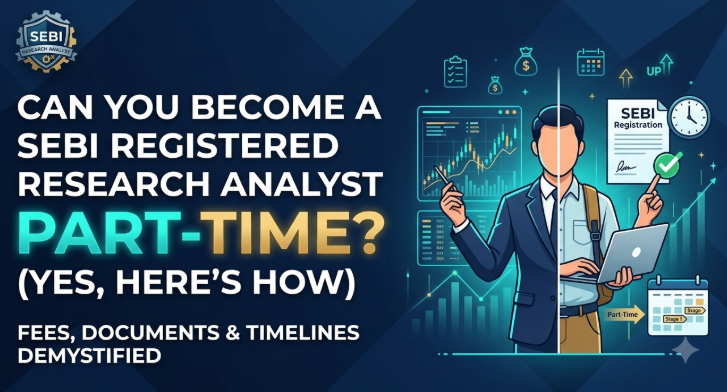
Can You Become a SEBI Registered Research Analyst Part-Time? (Yes, Here’s How)

Sebi Registrations and Legal Support - Taxation Counsultancy

Yes. What used to be the main reason for keeping working professionals away from research was, “I have a job/ practice, do I need to leave it to become a SEBI Registered Research Analyst?”

Until now, this answer would have been rather inconvenient. However, according to the regulatory reforms implemented by SEBI in December 2024 and January 2025,

There is now an officially defined part-time Research Analyst designation.

A practising Chartered Accountant, a college lecturer, a doctor, a lawyer, an IT employee on salary – all these professionals can now have SEBI RA registration alongside their core profession, but on certain terms and conditions.

Our guide explains in full detail who can be registered, under what conditions this will happen (the client limit is among the conditions, along with the employer NOC), who can’t be registered, and how to go about registering.

(This article focuses on the part-time route specifically. For the complete registration journey, read our pillar guide: [How to Become a SEBI Registered Research Analyst in 2026]. For exact costs and paperwork, see: [SEBI RA Registration: Fees, Documents & Timelines].)

Not sure whether your job or practice qualifies for part-time RA registration? Contact Taxation Consultancy at [WhatsApp or Call : 8928321757 ] for a quick eligibility review before you spend anything.

Quick Answer: Part-Time SEBI RA Registration at a Glance

Is it allowed? Yes — SEBI formally recognises part-time Research Analysts under the current framework (introduced via the December 2024 amendments and January 2025 guidelines).

Who qualifies? Individuals engaged in another business or employment that is unrelated to securities markets — professionals like CAs, CSs, CMAs, lawyers, doctors, architects, teachers/professors, and salaried employees in non-financial roles.

Key conditions: A client limit (currently 75 clients), an NOC from your employer (if employed), mandatory disclosure of your other activity, and a prescribed disclaimer clarifying that your non-RA work is outside SEBI’s purview.

Who cannot apply part-time? Anyone whose other activity involves securities, handling client money, or advising on investment assets — including those advising on gold, real estate, or cryptocurrency.

Everything else stays the same: graduation (any discipline), NISM Series XV, the BSE RAASB application process, the ₹1 lakh deposit, fees, website, and full compliance obligations.

Why SEBI Introduced the Part-Time RA Category

SEBI’s problem was straightforward: India’s appetite for stock market research far exceeded the number of registered analysts, and a large share of recommendations was flowing through unregistered channels — Telegram groups, WhatsApp communities, social media “tips.”

Rather than only punishing the unregistered space (which SEBI is also doing — penalties, bans, and refund orders are real), the regulator simultaneously lowered the entry barriers: any-discipline graduation, simpler documentation, a deposit instead of net worth — and, crucially, a part-time category so that qualified professionals no longer face an all-or-nothing career decision.

The logic is sound. A practising CA who understands financial statements, or a finance professor who has taught valuation for a decade, is exactly the kind of person SEBI wants inside the regulated framework — even if research will only ever be their second profession.

For aspirants, this changes the risk equation completely: you can now build and test a research business alongside your existing income, instead of quitting first and hoping the subscriptions follow.

Who Is Eligible for Part-Time RA Registration?

Eligibility criterion for this category in one go:

The other work/business you are engaged in should not have anything to do with the securities market, should not involve management of client’s money/ funds, and should not be involved with any advisory services regarding investments.

Pass the above mentioned eligibility criteria, and the general RA eligibility will apply for you: graduation in any subject, a valid NISM Series XV certificate, fit-and-properness and deposit capacity.

Some professions which can normally fulfill this criterion (indicative, based on existing framework):

• CA, CS, Cost Accounting (ICAI/ ICSI/ ICMAI members) in practice or employment

• Doctors and lawyers

• Architects and other professionals

• Professors & teachers – with NOC from institute

• Insurance agents (insurance being outside purview of SEBI’s securities)

• Salaried professionals in other non-financial professions – IT, engineering, marketing, operations and others – with employer NOC

The key here is: your other work/business is not connected in anyway with the securities market. Thus, a software engineer becomes eligible. A professor becomes eligible. The only thing is that profession should be irrelevant to the securities market.


Who Is NOT Eligible (Read This Carefully)

This is where aspirants most often misjudge their own position:

1.          Anyone whose other activity touches securities. If your existing job or business involves securities markets — broking, distribution, execution, fund operations — the part-time route is not designed for you. (Recall from our process guide: applicants from mutual fund and execution backgrounds already face deeper scrutiny even in the standard route.)

2.          Anyone handling or managing client money. If your other role involves managing funds for clients in any capacity, you fail the core test.

3.          Anyone advising on other investment assets. SEBI has been explicit: persons advising on gold, real estate, or cryptocurrency are not eligible for part-time RA registration. The regulator does not want an adviser mixing SEBI-regulated research with unregulated asset advice under one part-time umbrella.

Employed persons who cannot obtain an NOC. If your employer refuses the no-objection certificate, the part-time route is closed while that employment continues. 

Practical warning: do not “reframe” your other activity to squeeze through — describing a crypto-advisory side hustle as “technology consulting,” for instance. Your other activity must be disclosed in the application, and inconsistencies between your declared activity and your public footprint (LinkedIn, website, social media) surface at the clarification stage — or worse, in a later inspection.


The Conditions: Client Limit, NOC, Disclosures & Disclaimer

Part-time registration comes with four attached conditions that full-time RAs don’t carry:

1. Client limit

Currently, part-time registration works within a client limit of 75. That is the defining constraint for this classification. Once you surpass that threshold, you will enter the full-time paradigm.

(The client limit and the exact nature of the requirement may vary according to the SEBI circulars. Refer to the latest Master Circular for Research Analysts to verify your client limit.)

2. Employer’s NOC

In case you are working for some employer, No Objection Certificate from him/her would be required. Your employer needs to issue NOC for the fact that he/she has no objection to your providing research services in addition to your work.

Independent professional practitioners of research services like a CA (in independent practice) do not fit into the same category but the other activity disclosure rule is applicable in full swing for them.

Talk to your employer before starting the procedure since that is the only piece of paper which will be out of your control and not issuing it by your employer after your NISM preparation will only waste your efforts.

3. Disclosing other activities 

You must disclose the other business/ employment to SEBI/RAASB and keep the two activities separate i.e. separate records, separate communications and do not combine your professional services with research services. 

4. Mandatory disclaimer 

You are required to disclose in a prominent way that your other activities are outside the purview of SEBI and any complaints related to such services cannot be filed with SEBI. 

Invoices and other customer facing documentation must contain this disclaimer in minimum 10 font size. Your clients should not get confused whether you are wearing one hat or the other.


Part-Time vs Full-Time RA: What Actually Differs?

Less than most people expect. Here is the honest comparison:

AspectFull-Time RAPart-Time RA
Eligibility (education)Graduation, any disciplineSame
NISM Series XVMandatorySame
Other occupationResearch is the primary activityPermitted — if unrelated to securities
Client limitStandard framework (deposit slabs scale to 1,000+)Capped (currently 75 clients)
Employer NOCNot applicableRequired if employed
Other-activity disclaimerNot applicableMandatory, prescribed format
Application routeBSE RAASB portalSame
Fees₹15,000 + GST (individual)Same structure
Deposit₹1 lakh (up to 150 clients slab)Same — ₹1 lakh slab comfortably covers the 75-client cap
WebsiteMandatoryMandatory — even part-time
Fee cap (individual/HUF clients)₹1,51,000 per annum per familySame
Reporting, audit, record-keepingFull complianceFull compliance — no relaxation

Read the last row twice. The registration is part-time; the compliance is not.


The Process of Registration for Part-Time Applicants

It follows the exact BSE RAASB procedure, with the part-time elements added on top:

1. Check if you’re eligible – the unrelated activity test plus (if you have one) whether your employer will provide an NOC.

2. Clear NISM Series XV – it’s the same test as for full-timers: passing score 60/100, negative marking 0.25, centre-based test, 1-1.5 months of preparation with some market understanding.

3. Collect documentation – the same individual set (PAN, Aadhaar, degree certificates, NISM certification, proof of address, declarations, business plan, standard disclosures, internal policies) along with the NOC from your employer and information on your other activities. The business plan you will submit should clearly show the nature of your business as part-time – a business plan for 75 clients rather than a massive subscription scheme in contradiction with the category.

4. File your application via BSE RAASB website – the same 11-12 sections form and OTP-authenticated account.

5. Deal with clarifications – expect detailed questions on your other activity, segregation and time allocation. The clarity and consistency of your answers is the factor differentiating quick approval from lengthy process.

6. Stage-wise payment of fees – same process as individual clients (₹15,000 + GST ≈ ₹17,700)

7. Making the deposit – same process of deposit of ₹1 lakh in your own FD, marked lien for RAASB, release of your registration number.

8. Finalising post registration arrangements – SCORES, Smart ODR, KRA, FIU, and website, with all disclosures, including part time disclaimer, before taking your first client.

Time frame: same realistic 3-4 months for processing of application; end-to-end 4-5 months. Part time status will not speed up or slow down your process.


Compliance Is Not Part-Time

This deserves its own section, because it’s where part-time RAs get into trouble.

As soon as you are registered, all compliance requirements apply to you in full measure:

• Reporting to RAASB on a half-yearly basis irrespective of whether you have onboarded any clients during the year. Reporting nil is still reporting.

• Conducting an annual compliance audit with a certified auditor and uploading it on the BSE website along with the status of any corrective action taken for any adverse observations, and publishing the audit report and its status on your website.

• Preparation of research reports with the reasoning for all recommendations with documentation.

• On boarding discipline – KYC of KRA first, terms and conditions signed before receiving any fee, only verifiable modes of payments.

• Documentation – register of clients, communication, recommendations for the required time period.

• The fee cap – ₹1,51,000 per annum per family for individual/HUF clients – applies to you in exactly the same way as it applies to full-time RAs.

The part-timer’s trap is clear – you’re designed to be distracted. We stress the point from the complete guide even more here – do your compliance as you go, one item at a time. A part-time RA putting off six months’ compliance due to being busy with his or her primary profession will receive the same regulatory treatment as everyone else. SEBI provides an appropriate period within which corrections can be made after your auditor raises red flags – but only if you’ve had your audit done in time.

And if your primary profession doesn’t allow for this, then either get compliance help right from the beginning or rethink your timing on registration altogether.

Is the Part-Time Route Right for You?

The part-time route fits you well if:

•             You have a stable profession or job (unrelated to securities) and want to build a research practice without abandoning your income.

•             Your realistic near-term ambition fits within a limited client base — a focused, premium research service rather than a mass-market subscription.

•             You value the credibility of an INH number for your content and want to monetise legally from day one.

•             Your employer is supportive (or you’re an independent professional).

Think harder before choosing it if:

•             Your growth plan clearly exceeds the client cap within a year or two — you may be better served going full-time (or structuring properly) from the start, since category transitions mean fresh regulatory work.

•             Your other work brushes against investment advice in any form — the disqualification rules are strict, and grey areas invite scrutiny.

•             You genuinely cannot commit to the compliance calendar. A suspended registration damages your professional reputation in both careers.

The honest bottom line: the part-time category is one of SEBI’s most practical reforms — it lets India’s qualified professionals enter research on a de-risked basis. But it is a full licence with a smaller client book, not a “lite” licence. Treat it with the same seriousness and it will serve you well.


How We Assist Part-time RA Applications

There are two additional ways in which part-time applications can fail that normal applications cannot: the “other activity” analysis (does your job qualify as unrelated enough?), and the NOC and disclosure step. Failure at either point will result in clarification loops — or an application that shouldn’t even have been filed as such.

If you want to be certain before investing time and money, professional help can protect you against category errors, documentation issues, and regulatory inquiries.

At [Taxation Consultancy], we support part-time RA aspirants with:

•             Category eligibility review — an honest assessment of whether your profession qualifies for the part-time route, before you spend a rupee

•             NOC and disclosure drafting — employer NOC formats and other-activity disclosures that anticipate scrutiny

•             Complete documentation and filing — declarations, a business plan aligned to the part-time model, and BSE RAASB submission

•             Clarification handling — precise responses on segregation, time commitment, and conflict-of-interest questions

•             Post-registration compliance — the disclaimer framework, website setup, reporting calendar, and annual audit coordination, designed for professionals with limited bandwidth

📞 [WhatsApp/Contact: +91 8928321757 ] | ✉️ [Email: taxationconsultancy997@gmail.com ] | 🌐 [Website URL: https://taxationconsultancy.in/] 


 Frequently Asked Questions (FAQs)

1. Can I become a SEBI Registered Research Analyst part-time? Yes. SEBI formally recognises part-time Research Analysts under the current framework. You can hold RA registration while continuing another business or employment, provided that other activity is unrelated to securities markets and you meet the attached conditions (client limit, NOC if employed, disclosures, and disclaimer).

2. Can a working professional with a full-time job become an RA? Yes — if the job is in a non-financial, non-securities role and the employer issues a No Objection Certificate. IT professionals, engineers, marketers, and similar salaried employees can apply through the part-time route with an NOC.

3. Can a practising CA become a part-time Research Analyst? Yes. Members of ICAI, ICSI, and ICMAI are among the professionals recognised for the part-time category. A CA in full-time research (not in practice) would simply take the standard registration; a CA continuing practice takes the part-time route with the required disclosures.

4. What is the client limit for a part-time Research Analyst? The part-time category currently operates with a cap of 75 clients. Verify the current limit from the latest SEBI Master Circular before applying, as such thresholds can be revised.

5. Is an employer NOC mandatory for part-time RA registration? If you are employed, yes — your employer must formally state no objection to you providing research services. Independent practising professionals are positioned differently, but the other-activity disclosure requirement applies to everyone in the part-time category.

6. Who cannot apply for part-time RA registration? Anyone whose other activity involves securities markets, handling or managing client money, or advising on investment products/assets. SEBI has specifically stated that persons advising on gold, real estate, or cryptocurrency are not eligible for part-time RA registration.

7. Are the fees and process different for part-time applicants? No. The same BSE RAASB application route, the same ₹15,000 + GST (≈ ₹17,700) fee structure for individuals, the same NISM Series XV requirement, and the same ₹1 lakh deposit apply. The additions are the NOC, the other-activity disclosure, and the part-time disclaimer.

8. Do part-time RAs need a website? Yes. The website requirement — with registration details, investor charter, grievance data, audit status, and disclaimers — applies to part-time RAs in full, plus the specific disclaimer that your other activities are outside SEBI’s purview.

9. Is compliance lighter for part-time RAs? No. Half-yearly reporting, the annual compliance audit, research-report record-keeping, KYC-first onboarding, and the ₹1,51,000 per-family fee cap for individual/HUF clients all apply at full strength. Only the client count is smaller — not the obligations.

10. Can a teacher or professor become a part-time RA? Yes — professors and teachers are among the recognised categories, subject to an NOC from their institution and the standard eligibility (graduation plus NISM Series XV).

11. What happens if my client base grows beyond the part-time limit? You cannot simply exceed the cap. You would need to transition to the standard (full-time) framework in the prescribed manner. If you expect rapid growth, factor this into your initial category choice — take professional advice on the transition mechanics for your situation.

12. Can I do part-time RA along with crypto or real estate advisory? No. Advising on gold, real estate, or cryptocurrency specifically disqualifies you from the part-time RA category. SEBI does not permit mixing regulated securities research with unregulated asset advisory under a part-time registration.


Disclaimer

This article is for educational and informational purposes only. SEBI regulations, eligibility criteria, client limits, fees, and process requirements may change from time to time. Applicants should verify the latest requirements from official SEBI, NISM, and BSE/RAASB sources or consult a qualified professional before applying.

SEBI RA Registration: Fees, Documents & Timelines (2026)

Sebi Registrations and Legal Support - Taxation Counsultancy

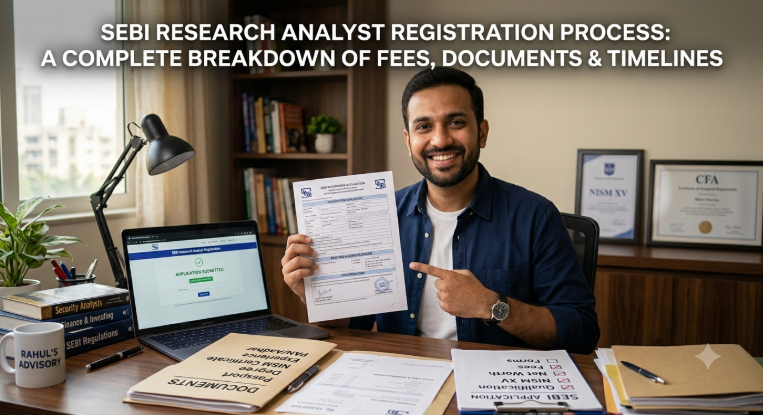
SEBI Research Analyst Registration Process: A Complete Breakdown of Fees, Documents & Timelines

Most articles on SEBI Research Analyst (RA) registration tell you that you need to register. Very few tell you exactly what it costs, which documents you need, and how long each stage actually takes — with the 2024–25 regulatory changes factored in.

This is where the problem lies. The data available online tends to be very obsolete since they contain information on the net worth certificates, the SEBI SI portal, the requirement for postgraduate qualifications, and the fee structure. By following the information given, one will run into many problems.

This article is the practical reference. It covers the current fee structure (with the exact bifurcation), the complete document checklist, the deposit requirement that replaced net worth, and a realistic stage-by-stage timeline — all based on how applications are actually processed through BSE RAASB today.

(New to the topic? Start with our complete guide: [How to Become a SEBI Registered Research Analyst in 2026], then come back here for the detailed cost and document planning.)

Quick Answer: What Does SEBI RA Registration Involve in 2026?

 Eligibility: Graduation in any discipline + a valid NISM Series XV certificate. (The earlier postgraduate/5-year-experience requirement has been relaxed              

•             Where to apply: The BSE RAASB portal — not the old SEBI SI portal. BSE administers RA registrations and forwards applications to SEBI.

•             Total regulatory fees (individual): ₹15,000 + GST ≈ ₹17,700, paid in stages via challans.

•             Deposit: An FD in your own name, lien-marked to RAASB — starting at ₹1 lakh (up to 150 clients), maximum ₹10 lakh (above 1,000 clients). This replaced the net worth requirement.

•             Timeline: Realistically 3–4 months of processing after filing; 4–5 months end to end including NISM preparation.

 What Changed in 2024–25 (Why Old Guides Mislead You)

Before getting into fees and documents, understand the four structural changes that made most older content obsolete:

1. RAASB now administers registrations. SEBI created a dedicated body — the Research Analyst Administration and Supervisory Body (RAASB), operated by BSE Limited. Applications, compliance communication, and periodic reporting now flow through BSE, which forwards to SEBI. The licence itself is still granted by SEBI, but the old SI-portal-first route described in older videos and blogs no longer reflects the process.

2. The deposit replaced net worth. Applicants no longer need a CA-certified net worth certificate (₹1 lakh individual / ₹25 lakh corporate under the old regime). Instead, a fixed deposit in the applicant’s own name, lien-marked in favour of RAASB, is required — scaled to client count.

3. Eligibility was relaxed. The postgraduate-in-finance requirement and the “graduate + 5 years’ experience” alternative have given way to a far simpler standard: graduation in any discipline plus the NISM certification. (Details in the next section.)

4. Model portfolios moved under the RA licence. Earlier, selling model portfolios pushed you toward Investment Adviser registration. Following the 2024 amendments, model portfolio services fall within the RA framework (with prescribed disclosures), so a separate IA licence is not required just for model portfolios.

The direction of all four changes is the same: SEBI wants recommendation providers inside the regulated system, not outside it. The regulator has simultaneously made non-compliance expensive — enforcement against unregistered tip providers now includes penalties, bans, and even orders to refund fees collected from clients. The message is clear: registering has become easier precisely so that operating unregistered has no excuse.

Eligibility in 2026: Simpler Than You Think

The current eligibility standard for an individual applicant:

1.          A graduate degree in any discipline. B.Com, B.Sc, BA, B.Tech, LLB, M.Sc — the field no longer matters. Earlier, only finance/commerce-linked postgraduates qualified directly, and plain graduates needed five years of relevant experience. Both restrictions have been eased under the recent amendments.

2.          A valid NISM Series XV certificate (covered in the next section).

3.          Fit and proper status — no disqualifying regulatory or criminal history.

4.          Ability to meet the deposit requirement (Section 5).

Check eligibility first, before spending on anything else. If the foundation isn’t in place, understanding the rest of the process has no practical value.

Practical note: eligibility norms have moved quickly over 2024–26. Before filing, confirm the currently effective text of Regulation 7 of the SEBI (Research Analysts) Regulations, 2014 on the SEBI website, or have a professional confirm it for your specific profile.


 ## The NISM Series XV Exam: Cost, Pattern & Preparation

The NISM Series XV: Research Analyst Certification Examination is the single mandatory exam. Key facts:

ParameterDetail
Conducted byNISM (SEBI-established certification institute)
Passing requirement60 marks out of 100
Negative markingYes — 0.25 per wrong answer
Study materialOne official NISM workbook (roughly 300–400 pages)
ModeCentre-based only (the COVID-era online option has been discontinued); centres available in most cities
Realistic preparation time1 to 1.5 months for someone with basic market knowledge
Certificate validity3 years
RenewalVia NISM Series XV-B — a lighter renewal route, so the full exam is effectively a one-time hurdle

Two things aspirants routinely get wrong:

•             The NISM certificate is not a licence. Clearing Series XV does not permit you to give recommendations. It is only a pre-requisite for the SEBI registration.

•             Apply within the certificate’s validity. The registration application must be made while your NISM certificate is valid, so don’t clear the exam and then sit on it for years.


 ## The Complete Fee Breakdown

Here is the part everyone searches for. For an individual applicant, the total regulatory fee is:

₹15,000 + 18% GST = ₹17,700 (total)

But it is not paid in one shot. It is collected in stages through challans generated on the portal as your application progresses:

StageComponentAmount (indicative)
After application clears scrutinyApplication fee challan₹2,000 + GST
On SEBI approvalSEBI registration fee₹10,000 + GST
RAASB stageBSE/RAASB administrative fee₹3,000 + GST
Total ₹15,000 + GST ≈ ₹17,700

Three practical notes:

1.          The first ₹2,000 challan is a good sign. In practice, when the application-fee challan link arrives, the application has cleared scrutiny and the probability of approval from that point is very high. Further clarifications after this stage are uncommon.

2.          The staging has changed, the total hasn’t. Under the old regime, fees were collected differently (a ₹5,000 + ₹10,000 pattern). Today the same overall amount is split across the stages above. If you only remember one number, remember ₹17,700 all-in for an individual.

3.          Ongoing fees exist. Registration continues subject to payment of the prescribed fees every five years (a renewal-fee cycle). Budget for this as a recurring cost, not a one-time expense.

Non-individual (company/LLP) applicants pay a substantially higher fee structure — if you’re applying as a corporate, verify the current non-individual amounts 5,50,000 Plus GST

(All amounts are as per the currently applicable structure and are revised by SEBI from time to time — verify against the latest SEBI Master Circular for Research Analysts and BSE RAASB notices before filing.)


 ## The Deposit Requirement (What Replaced Net Worth)

This is the biggest financial change from the 2024 amendments, and the one older guides get completely wrong.

Old regime: CA-certified net worth certificate — ₹1 lakh for individuals, ₹25 lakh for private limited companies.

Current regime: A fixed deposit in the applicant’s own name, lien-marked in favour of RAASB (BSE), scaled to your client base:

Maximum clientsDeposit amount
Up to 150₹1,00,000
151 – 300₹2,00,000
301 – 1,000₹5,00,000
Above 1,000₹10,00,000 (maximum)

How it works in practice:

•             The FD stays in your name — you are not handing money to SEBI. Only a lien is marked in RAASB’s favour, and the FD continues to earn interest.

•             New applicants start at ₹1 lakh (assuming a fresh client base under 150) and top up as the client count crosses slab boundaries, with an annual review.

•             The registration number is released only after the deposit formality is complete. Even after approval, you will not receive your number until the FD is placed and the original FD receipt/lien documents are submitted as prescribed.

So while the deposit is not a “fee,” treat it as committed capital in your budgeting — ₹1 lakh minimum on day one.


 ## Complete Document Checklist

For an individual applicant, the BSE RAASB application form runs through roughly 11–12 sections, each with its own uploads. Here is the full set to prepare before you begin:

A. Identity and basics

•             PAN card

•             Aadhaar card

•             Contact details — use a dedicated business email and mobile number, since these become your permanent regulatory contact points

B. Qualification

•             Graduation degree certificate (any discipline) with mark sheets

•             Valid NISM Series XV certificate

C. Office address proof

•             Proof of your place of business. Helpfully relaxed: if you’re operating from home as an individual, Aadhaar with the matching address can suffice in many cases — the heavy documentation of earlier years has been eased. (A state-specific trade licence / Shops & Establishment certificate may still apply depending on your setup and state — confirm for your case.)

D. Declarations (the underestimated part)

Around 7–8 formal declarations in prescribed formats, including: – Infrastructure declaration (confirming you have adequate office, IT systems, and setup to run research operations) – Fit and proper declarations – Other undertakings per the BSE RAASB checklist

E. The three “quality” documents

These are where applications are genuinely evaluated:

1.          Business plan. SEBI/RAASB wants a 3–4 year forward view: where will your clients come from, projected revenue, expected expenses, and a basic P&L outlook. The purpose is to establish that your model is legitimate and thought-through — not an afterthought. Weak, generic business plans are a leading cause of clarification rounds.

2.          Standard disclosures. The disclosure framework you will attach to your research.

3.          Internal policies. Your internal compliance/procedure documents.

Preparation tip: every document should tell the same story. If your business plan says “subscription research services” but your social media promises “guaranteed multibagger calls,” the mismatch will surface at the clarification stage.


 ## The BSE RAASB Application Process, Stage by Stage

The full flow, in the order it actually happens:

Stage 1 — Portal account creation. Go to the BSE RAASB portal, register with name, email, and mobile; complete OTP verification. Your applicant portal is now live.

Stage 2 — Form filling and uploads. Complete the 11–12 section form: personal details, PAN/Aadhaar uploads, address proof, qualification certificates, NISM certificate, declarations, business plan, standard disclosures, and internal policies. Fill this carefully — this single form is the foundation of everything that follows.

Stage 3 — BSE scrutiny. BSE (as RAASB) verifies every element and raises clarifications where anything is missing or inconsistent (next section).

Stage 4 — Fee challans. Once scrutiny clears, the application-fee challan (₹2,000 + GST) is generated. Payment moves the application forward, with BSE forwarding it to SEBI. The SEBI registration fee (₹10,000 + GST) and RAASB administrative fee (₹3,000 + GST) follow at their respective stages.

Stage 5 — SEBI approval. SEBI processes the forwarded application. Any residual queries typically flow back through BSE.

Stage 6 — Deposit and number. Post-approval, you place the ₹1 lakh FD (lien to RAASB), submit the original documents as prescribed — and your SEBI registration number (INH…) and certificate are released.

Stage 7 — Post-registration setup. The number alone isn’t business-ready: SCORES, Smart ODR, KRA, and FIU registrations, plus a compliant website, come before client onboarding. (We cover this in detail in [our complete RA guide].)


 ## The Clarification Stage: Where Applications Are Won or Lost

If there is one stage that decides how smooth (or painful) your registration is, it’s this one.

After you submit, BSE scrutinises everything and raises clarifications — requests to fix gaps, explain inconsistencies, or provide additional documents. What to expect:

•             Multiple rounds are normal. Don’t panic at the second or third query — it’s routine, not rejection.

•             Certain profiles attract deeper scrutiny. Applicants currently working in mutual funds, broking/execution roles, or other market-linked jobs typically face more declarations and sharper questions — on their business plan, on conflict of interest, on their standard disclosures. If this is you, prepare those answers before filing, not after the query lands.

•             Answers must be thought through. A careless clarification response creates the next query. A precise one closes the loop. This is where professional assistance earns its fee — but if your documentation is genuinely in order and you’re comfortable with paperwork, a well-prepared applicant can handle it independently too.

•             The turning point: once the fee challan is generated after scrutiny, the hard part is over — approval from there is overwhelmingly likely.


 ## Realistic Timeline: Stage-by-Stage Breakdown

StageRealistic duration
NISM Series XV preparation + exam1 – 1.5 months
Document + declaration + business plan preparation1 – 3 weeks
BSE RAASB portal filingA few days (if documents are ready)
BSE scrutiny + clarification roundsThe bulk of the wait — several weeks to a couple of months, driven by query volume and your response speed
SEBI processing + fee stagesIncluded in the overall processing window
Deposit placement + certificate issuance1 – 2 weeks after approval
Regulatory processing overall (filing → certificate)≈ 3 – 4 months
End to end (decision day → business-ready)≈ 4 – 5 months

Two honest caveats:

1.          The regulator’s queue is not in your control. Applications at BSE/SEBI may vary; no one can guarantee a definite fast-track process. But there are a few things that you can do: document yourself properly right from day one and also ensure that all questions get answered within the same week. Slow responders tend to increase their timelines by 4-8 weeks!

2.          Post-registration setup adds time before revenue. Even after the certificate arrives, the SCORES/ODR/KRA/FIU registrations and website compliance (typically 1–2 weeks) must be completed before you legally onboard your first paying client.


 ## Total Cost of Becoming an RA: The Full Picture

Putting the whole financial picture in one place for an individual applicant:

Cost headNatureIndicative amount
NISM Series XV exam fee + materialOne-time (renewal every 3 years via XV-B)Exam fee per NISM’s current schedule
SEBI + RAASB regulatory feesStaged, one-time (renewal cycle every 5 years)₹15,000 + GST ≈ ₹17,700
Deposit (FD, lien to RAASB)Committed capital — stays in your name, earns interest₹1,00,000 minimum
Professional/consultancy assistanceOptionalVaries by scope
Website + compliance setupMandatory infrastructureVaries
Annual compliance auditRecurring, mandatoryAuditor’s fee

Bottom line: the pure regulatory cost of an individual RA registration is under ₹18,000 — remarkably accessible for a licence that legitimises an entire research business. The real financial commitments are the ₹1 lakh deposit capital and the ongoing compliance infrastructure. Anyone quoting you a large “SEBI fee” beyond this should be able to show you exactly which official fee schedule it comes from.


 ## How We Help With SEBI RA Registration

The process is genuinely simpler than it used to be — but “simpler” is not “effortless.” The 11–12 section form, the 7–8 declarations, the business plan, and above all the clarification stage are where self-filed applications lose months.

If you want to avoid documentation errors, weak business plans, and repeated clarification cycles, professional assistance can save time and reduce mistakes.

At Taxation Consultancy, we handle:

•             Eligibility confirmation against the currently effective norms

•             Complete documentation — declarations, business plan, standard disclosures, and internal policies drafted to withstand scrutiny

•             BSE RAASB filing and challan/fee-stage coordination

•             Clarification handling — precise, well-framed responses at the stage that matters most

•             Deposit formalities and certificate follow-through

•             Post-registration setup: SCORES, Smart ODR, KRA, FIU, and website compliance

📞 [8928321757] | ✉️ [taxationconsultancy997@gmail.com] | 🌐 [https://taxationconsultancy.in/] [SEBI Registration/Consultant Details, if applicable]


 ## Frequently Asked Questions (FAQs)

1. What is the total fee for SEBI Research Analyst registration? For individual applicants, the total regulatory fee is ₹15,000 + GST (≈ ₹17,700), collected in stages: an application-fee challan of ₹2,000 + GST, a SEBI registration fee of ₹10,000 + GST, and a RAASB administrative fee of ₹3,000 + GST. Corporate applicants pay a higher structure. Verify current amounts from official SEBI/BSE RAASB sources before filing.

2. Is a net worth certificate still required for SEBI RA registration? No. The net worth requirement (₹1 lakh individual / ₹25 lakh corporate) has been replaced by a deposit: an FD in your own name, lien-marked to RAASB — ₹1 lakh for up to 150 clients, scaling to a maximum of ₹10 lakh above 1,000 clients.

3. Can any graduate apply for SEBI RA registration in 2026? Under the relaxed norms, a graduate degree in any discipline — commerce, science, arts, engineering, or law — plus a valid NISM Series XV certificate makes you eligible. The earlier 5-year experience requirement for plain graduates has been removed. Confirm the currently effective regulation text before applying.

4. What documents are required for SEBI RA registration? PAN, Aadhaar, graduation certificates, valid NISM Series XV certificate, dedicated contact details, around 7–8 prescribed declarations (including infrastructure), a 3–4 year business plan, standard disclosures, and internal policy documents.

5. How long does SEBI RA registration take in 2026? Regulatory processing takes roughly 3–4 months from filing to certificate. Including NISM preparation and post-registration setup, plan 4–5 months end to end. Your query-response speed is the biggest controllable factor.

6. Where do I apply — SEBI portal or BSE? On the BSE RAASB portal. BSE Limited operates RAASB, which administers RA registrations, scrutinises applications, and forwards them to SEBI. The licence itself is granted by SEBI. The old SEBI SI-portal-first route in older guides no longer applies.

7. Is the NISM Series XV exam difficult? It’s manageable: one official workbook of roughly 300–400 pages, a 60/100 passing score, and 0.25 negative marking. With basic market knowledge, 1–1.5 months of preparation is typically enough. The exam is centre-based only.

8. What happens if the deposit FD is not submitted? Your registration number is released only after the deposit formality is complete. Approval alone is not enough — the FD (lien-marked to RAASB) and its original documentation must be submitted as prescribed.

9. Do model portfolios require an Investment Adviser licence? Following the 2024 amendments, model portfolio services fall within the Research Analyst framework (with prescribed disclosures), so a separate IA licence is not required just for offering model portfolios. Personalised, client-specific advice remains IA territory.

10. What are the penalties for giving stock tips without registration? SEBI enforcement against unregistered recommendation providers includes monetary penalties, market bans, and orders to refund fees collected from clients — potentially covering earnings from prior years. Registration is dramatically cheaper than enforcement.

11. Is the SEBI RA registration fee refundable if my application is rejected? Application and registration fees are non-refundable. This is another reason to file a complete, consistent application the first time — or have a professional review it before submission.

12. Can working professionals in mutual funds or broking apply? They can, but such profiles typically face deeper scrutiny — additional declarations and sharper questions on conflict of interest, business plans, and disclosures during the clarification stage. Prepare those answers before filing. Certain roles also have structural restrictions; verify your specific situation.

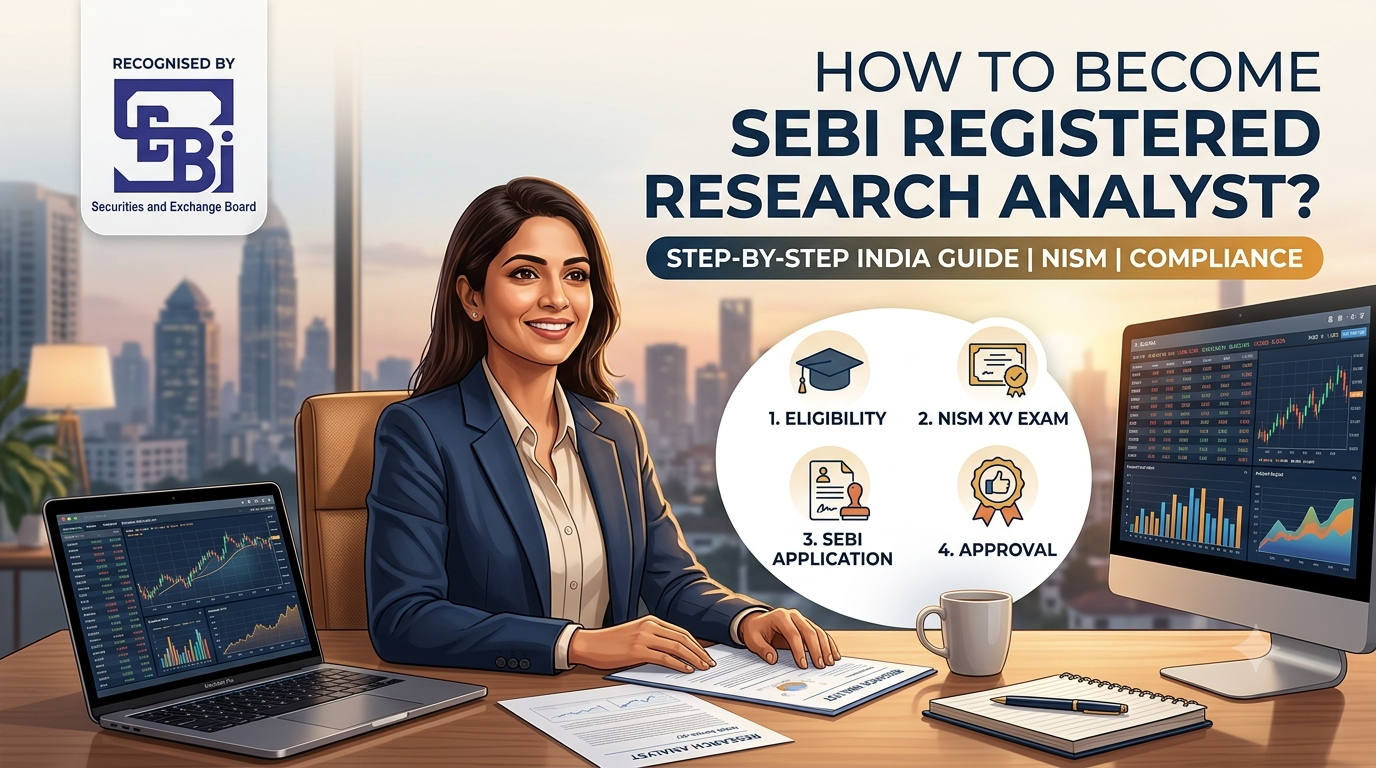
How to Become SEBI Registered Research Analyst-2026

Sebi Registrations and Legal Support - Taxation Counsultancy

If you give stock recommendations, sell research reports, run a paid Telegram or WhatsApp community, or plan to build a serious equity research business in India, this guide is for you.

Over the last two years, SEBI has significantly tightened its oversight of anyone providing stock market recommendations for consideration. Unregistered “tips providers” are facing enforcement action, payment gateways and platforms are asking for registration numbers, and clients themselves have started checking whether the person charging them a fee is actually a SEBI Registered Research Analyst (RA).

At the same time, SEBI has made genuine efforts to make registration more accessible — a new administrative body (RAASB), a deposit-based capital requirement instead of the old net worth certificate, relaxed qualification norms, and even a part-time RA category. In short: 2026 is arguably the best time to get registered, and the worst time to operate without registration.

This guide walks you through the entire journey — from checking your eligibility and clearing the NISM exam, to filing with BSE RAASB, receiving your SEBI registration number, completing the five post-licence registrations, and staying compliant after you start onboarding clients. It is based on practical experience with actual RA applications, not just a reading of the regulations.

Need help with SEBI RA registration — eligibility review, documentation, BSE RAASB filing, and compliance setup?

What is a SEBI Registered Research Analyst?

A SEBI Registered Research Analyst is a person or entity that has been granted a certificate of registration by the Securities and Exchange Board of India under the SEBI (Research Analysts) Regulations, 2014, to provide research services for consideration.

In plain terms: if you analyse stocks or securities and give buy, sell, or hold views — whether through research reports, model portfolios, subscription services, or paid communities — and you charge for it (directly or indirectly), SEBI treats you as a research analyst. And a research analyst must be registered.

Once registered, you receive:

• A SEBI registration number in the format INH0000XXXXX, which must be displayed on your website, research reports, and marketing material.

Enlistment with RAASB (the Research Analyst Administration and Supervisory Body — currently BSE Limited), which administers and supervises RAs on SEBI’s behalf.

What an RA can broadly do: prepare and distribute research reports, give securities-specific recommendations with rationale, offer model portfolios (with prescribed disclosures), and charge subscription fees within SEBI’s fee framework.

What should be avoided without registration: giving stock-specific recommendations for any form of consideration. This applies whether you call it “education,” “premium community access,” or “market view sharing” — if the substance is a recommendation and there is consideration involved, the registration requirement can apply. When in doubt, take professional advice before monetising.

One important clarification that trips up many aspirants: clearing the NISM exam alone does not make you a Research Analyst. The NISM Series XV certificate is only a pre-requisite. Until your SEBI registration number is granted, you cannot give recommendations for consideration.

Who Needs SEBI RA Registration in 2026?

Step 1: Prepare the Required Documents

Registration is not just for “full-time professional analysts.” Under the current framework, the definition of a research analyst covers anyone receiving consideration — cash or non-cash — for research services. In practice, this typically includes:

•         Stock market research providers selling reports or recommendations.

•         Paid recommendation providers running subscription-based calls (intraday, swing, positional, long-term).

•         Finance influencers and creators who give specific stock calls in paid groups, courses, or communities.

•         Research report sellers distributing equity research for a fee.

•         Model portfolio providers offering curated baskets with entry/exit guidance.

•         Individuals or companies giving buy/sell/hold views on securities for consideration.

•         Businesses planning to monetise equity research in any structured way — websites, apps, broadcast channels, newsletters.

If you are earning (or plan to earn) from stock recommendations in any of these forms, assume registration is required and verify your specific model against the regulations. There is no “small-scale” exemption for side-income tips.

SEBI Research Analyst vs Investment Adviser: What’s the Difference?

This is the single most common point of confusion for new applicants. Both are SEBI registrations, but they serve different business models.

AspectResearch Analyst (RA)Investment Adviser (IA)
Governing regulationSEBI (Research Analysts) Regulations, 2014SEBI (Investment Advisers) Regulations, 2013
Nature of serviceResearch reports and securities recommendations to a general subscriber basePersonalised investment advice based on the client’s risk profile and financial situation
PersonalisationOne-to-many; same recommendation can go to all subscribersOne-to-one; advice tailored to each client after risk profiling
Typical outputResearch reports, stock calls, model portfoliosFinancial planning, personalised portfolio advice
Risk profiling of clientNot the core requirementMandatory before advising
Registration number formatINH…INA…
Administered byRAASB (BSE Limited)IAASB

The simple test: if you give the same recommendation to all your subscribers, you are operating like an RA. If you assess an individual’s finances and goals and then advise them specifically, that is IA territory.

Choose based on your actual business model, not on which registration looks easier. Operating an advisory-style business on an RA licence (or vice versa) is a compliance risk that surfaces during audits and inspections.

Note: Individuals and partnership firms can, subject to conditions, hold both RA and IA registrations with an arm’s-length separation between the two activities. Verify the current conditions before planning a dual-registration structure.

Eligibility Criteria for SEBI Research Analyst Registration

Eligibility is where most applications fail, so check this carefully before spending money on anything else.

1. Entity type

You can apply as an individual (including sole proprietor), partnership firm, LLP, or body corporate. This choice affects fees, deposit expectations, compliance structure, and future flexibility — more on this in the step-by-step section.

2. Educational qualification

Historically, SEBI required a professional qualification or postgraduate degree/diploma in fields such as finance, accountancy, business management, commerce, economics, capital markets, banking, insurance, or actuarial science — or a graduate degree with relevant experience in financial services.

Important 2025–26 update: SEBI has moved to relax these norms — recent amendments and circulars indicate acceptance of a graduate degree in any discipline for new applicants, opening the door for candidates from engineering, law, science, and arts backgrounds. However, because the implementation status and exact conditions of this relaxation directly affect whether your application is accepted, verify the currently effective qualification requirement on the SEBI website or with a professional before filing. Do not rely on YouTube videos or blog posts (including this one) for this specific point — check the regulation text and latest circulars.

3. NISM certification

The NISM Series XV: Research Analyst Certification Examination is mandatory. Key points:

•  The certificate is valid for 3 years. You must apply for registration within its validity.

•   Renewal is through the NISM Series XV-B examination.

•  For non-individual applicants, the Principal Officer must meet the qualification and certification requirements, and the compliance officer role has its own NISM certification expectations.

4. Deposit requirement (replaced net worth)

This is one of the biggest structural changes from the December 2024 amendments. The old net worth certificate requirement has been replaced by a client-based deposit, maintained with a scheduled bank (or, per later circulars, in specified liquid/overnight fund units) and marked under lien in favour of RAASB:

Maximum number of clientsDeposit amount
Up to 150₹1,00,000
151 – 300₹2,00,000
301 – 1,000₹5,00,000
Above 1,000₹10,00,000

The deposit must be topped up as your client count crosses slab boundaries, reviewed annually. New applicants must meet the deposit requirement at registration. (Verify the current slabs against the latest SEBI Master Circular before filing — SEBI reviews these periodically.)

5. Fit and proper criteria

The applicant (and connected persons) must satisfy the fit and proper criteria under the SEBI (Intermediaries) Regulations — no disqualifying regulatory or criminal history.

Documents Required for SEBI RA Registration

Documentation is where applications get stuck in query loops. Prepare everything before you file — not while you file.

Individual applicant documents

•         PAN and Aadhaar (with name matching exactly across all documents)

•         Educational qualification certificates (degree, mark sheets)

•         NISM Series XV certificate (valid)

•         Dedicated contact number and email ID (see practical tip below)

•         Bank account details

•         Deposit-related documents (FD receipt / lien marking as prescribed)

Partnership / LLP / Company documents

•         Certificate of incorporation / partnership deed / LLP agreement

•         MoA & AoA (for companies)

•         PAN of the entity

•         Details of directors/partners, shareholding pattern

•         Principal Officer’s qualification and NISM certification documents

•         Compliance Officer details

•         Board resolution authorising the application

Qualification and certification documents

•         Degree certificates and mark sheets

•         NISM Series XV certificate (and Series III-A / XV-B where applicable for compliance/renewal roles)

Business plan and declarations

•         A clear business plan: services offered, target clients, fee model, research methodology

•         The full set of declarations and undertakings in BSE RAASB’s prescribed formats — these run into multiple documents, and errors here are the most common source of queries

Compliance-related documents

•         Draft investor grievance mechanism

•         Proposed website details / disclosures plan

•         KYC and record-keeping process outline

Practical tip: set up a dedicated business email ID and phone number before you apply. Many applicants register with their personal email/number, and once the registration is live, that inbox gets flooded with regulatory, exchange, and client communication. Changing contact details on the portal later is avoidable friction — get it right on day one.

Step-by-Step SEBI RA Registration Process in 2026

Here is the full journey, in the sequence it actually happens.

Step 1: Decide your applicant type — individual or corporate

This decision matters far more than most applicants realise.

Choose individual RA if: you only want to do research work, as yourself, without other regulated business activities.

Choose corporate/non-individual if: you plan a larger organisation — for example, combining research with other business lines, building a team, or eventually adding other licences (broking, distribution, and so on) under one entity.

Two practical constraints seen in real cases:

•         An individual RA faces restrictions on simultaneously holding certain other positions/registrations (for instance, directorships in certain companies or broking roles). Evaluate your five-year plan, not just today’s plan.

•         There is no “upgrade” path. If you take an individual licence and later realise you needed a corporate one, it is a fresh application from scratch — another 3–4 months, fresh fees, and business disruption. Deciding correctly the first time is the single cheapest compliance decision you will make.

Step 2: Check your eligibility

Confirm your qualification against the currently effective norms (see the eligibility section), confirm you meet fit-and-proper criteria, and plan for the deposit requirement.

Step 3: Clear the NISM Series XV examination

Register on the NISM website, choose an exam date, and clear the NISM Series XV: Research Analyst Certification Examination. The certificate is valid for 3 years. Remember: this exam is a pre-requisite, not a licence — you cannot give recommendations on the strength of the NISM certificate alone.

Step 4: Prepare your documents

Assemble everything in the documents section. Pay special attention to:

•         Name consistency across PAN, Aadhaar, degree certificates, and application forms

•         Finalising your place of business before filing — changing it mid-application invites queries

Step 5: Prepare declarations and your business plan

Complete BSE RAASB’s full declaration set and checklist. Your business plan should be coherent: the services you describe, the fees you propose, and your public claims (website, social media) should all tell the same story. Inconsistencies here are a classic query trigger.

Step 6: File the application on the BSE RAASB portal

The application goes first to BSE (as RAASB), not directly to SEBI. BSE scrutinises the application against its checklist.

Step 7: Respond to BSE/RAASB queries

Expect multiple query rounds — three to four is normal, not a sign that something is wrong. Respond precisely and promptly; slow or incomplete responses are the biggest self-inflicted delay. Once satisfied, BSE grants an in-principle approval and generates Form A, which you sign and return. BSE then forwards the application to SEBI through the SEBI Intermediary (SI) portal.

Step 8: Pay the applicable fees

•         A challan is generated for the SEBI application fee at the BSE-to-SEBI stage.

•         If SEBI has queries, these typically flow through BSE, which coordinates the response.

•         Once SEBI approves, further challans are generated for the SEBI registration fee and the RAASB administrative/membership fee (the membership component is typically valid for a 5-year period, after which renewal fees apply).

Step 9: Complete the deposit and receive your registration

After fee payments, you place the prescribed deposit under lien to RAASB and submit the deposit proof (with physical copies to BSE where required). SEBI’s registration number may be communicated first, with the registration certificate and enlistment letter issued after the deposit formalities are completed. Only then is your registration fully complete.

Step 10: Complete post-licence registrations before starting business

The SEBI number alone is not “business-ready.” Before onboarding a single client, complete the post-licence registrations (detailed later): SCORES, Smart ODR, KRA, FIU-IND, and DLT (TRAI) if you plan bulk SMS marketing. Set up your compliant website. Then — and only then — start onboarding clients.

This is exactly the stage where most self-filed applications get stuck — query loops, document mismatches, and missed declarations. If you want to avoid delays, documentation errors, and repeated regulatory queries, professional assistance can save months. Contact [Brand Name] at [WhatsApp/Contact Link] for an eligibility review and end-to-end filing support.

Timeline for SEBI RA Registration

Based on current practical experience:

•         NISM preparation and exam: depends on you — typically 2–6 weeks of preparation.

•         Document preparation: 1–3 weeks if organised; longer if the trade licence or office finalisation is pending.

•         BSE RAASB + SEBI processing: approximately 3–4 months is the realistic current range, driven largely by application volumes at the regulator’s end and how quickly you respond to queries.

•         Post-licence registrations (SCORES, ODR, KRA, FIU, DLT): usually completed within 1–2 weeks, barring technical glitches (FIU registration is a known source of occasional technical delays).

Realistic end-to-end planning number: 4–5 months from the day you decide to pursue the licence to the day you are fully operational. Some applications close faster; some take longer. Anyone promising a fixed fast-track timeline is overpromising — the regulator’s queue is not in anyone’s control.

SEBI RA Registration Fees and Cost

Think of the total cost in four buckets:

1. Regulatory fees. These include the SEBI application fee, the SEBI registration fee, and the RAASB administrative/membership fee. For individual applicants these have been modest (indicatively, application and registration fees in the low thousands of rupees plus GST, and a RAASB membership fee around ₹15,000 plus GST valid for a 5-year period). Non-individual/corporate applicants pay substantially higher regulatory fees.i.e-5,50,000 Plus GST

2. Certification cost. The NISM Series XV exam fee, plus study material if you buy any. Renewal (Series XV-B) recurs every 3 years.

3. Deposit (capital) requirement. Not a fee, but capital you must set aside: ₹1 lakh and upward depending on client count, held under lien to RAASB. Later circulars permit holding this in specified liquid/overnight fund units, so the amount is not entirely idle.

4. Documentation, professional assistance, and compliance setup. Consultant/professional fees if you engage one, website development with SEBI-mandated disclosures, audit fees (annual compliance audit is mandatory), and ongoing compliance support.

Budget for the whole picture — the regulatory fees are the smallest part; the deposit and the ongoing compliance infrastructure are the real financial commitment.

Common Mistakes That Delay SEBI RA Registration

From real application experience, these are the delays that keep repeating:

1.       Wrong entity structure. Taking an individual licence in a hurry, then realising the business plan needed a corporate licence — and having to file fresh.

2.       Incomplete or incorrect declarations. BSE’s declaration set is extensive; missing even one triggers a query cycle.

3.       Name mismatch between PAN, Aadhaar, degree certificates, and the application.

4.       Qualification mismatch — applying with a background that doesn’t meet the currently effective norms.

5.       Personal email/phone used for registration — creating a lifetime of inbox chaos and later change requests.

6.       Place of business not finalised before filing — address changes mid-application invite queries.

7.       Inconsistent website/social media claims. If your public content promises “guaranteed returns” or advisory-style services while your application says “research reports,” expect trouble.

8.       Unclear research methodology in the business plan.

9.       Missing the state-specific Shops & Establishment certificate.

10.   Slow or sloppy query responses. Three to four query rounds are normal; each slow response adds weeks.

11.   Starting client onboarding before completing post-licence registrations — a compliance breach from day one.

What Happens After SEBI RA Registration?

Getting the number is the halfway mark. Here is what running a compliant RA business actually involves.

A. The five post-licence registrations

1.       SCORES (SEBI Complaints Redress System). Mandatory. If a client is dissatisfied, they have the right to file a complaint against you on SCORES. Registration involves submitting the prescribed form with your SEBI certificate; login credentials are issued within a few days.

2.       Smart ODR (Online Dispute Resolution). Mandatory. If a SCORES complaint isn’t resolved to the client’s satisfaction, the dispute can escalate to the ODR mechanism — conciliation and arbitration through the online portal, culminating in a hearing and a binding outcome.

3.       KRA registration (KYC Registration Agency). Mandatory before onboarding any client, because all client KYC must be done through a registered KRA. Multiple KRAs exist; register with one and use its credentials for KYC fetch/upload.

4.       FIU-IND registration (Financial Intelligence Unit). Mandatory. Linked to anti-money-laundering obligations under the PMLA framework. Day-to-day interaction is minimal unless a reportable event arises, but the registration and credentials must be in place and on record.

5.       DLT/TRAI registration (conditional). Required only if you plan bulk SMS marketing or transactional messages. WhatsApp-based communication follows its own platform rules.

Most of these close within a week or two if done systematically.

B. Mandatory website

A functional website is not optional, even if you haven’t started charging clients. It must carry, among other things:

•         Your name, SEBI registration number, registered office address, and the details exactly matching your SEBI application (any mismatch between the application and the website is itself a compliance issue)

•         SEBI’s regional/head office address relevant to you

•         The Investor Charter

•         Investor grievance data — a running record of complaints received and their status

•         Grievance redressal escalation matrix (complain to the RA first, then SCORES, then ODR)

•         Mandatory standard disclaimers (market risk, no assured returns)

•         Your annual compliance audit status — whether completed, for which financial year, and any adverse observations

C. Client onboarding — in the right order

The sequence matters and is enforced:

1.       KYC first — fetch/verify the client’s KYC via your KRA credentials (PAN + date of birth), and retain records.

2.       Terms & Conditions signed — the client must sign/accept the prescribed terms (the “Most Important Terms and Conditions” framework). You cannot charge a single rupee of fees until the T&C are executed.

3.       Collect fees — through traceable modes only (cheque, bank transfer, UPI). Cash is prohibited.

4.       Deliver research — with every recommendation backed by a documented rationale and sources: charts referenced for technical calls, financial data sources for fundamental calls, plus the prescribed disclosures and your registration details on every report.

D. Fee restrictions

For individual and HUF clients (who are not accredited investors), the fee is capped — currently ₹1,51,000 per annum per family, across all your research services, excluding statutory charges like GST. This cap does not apply to non-individual clients or accredited investors, where fees are contractual. Advance fee collection is restricted to prescribed limits, and proportionate refunds apply on early termination with no breakage fee. (The cap is reviewed periodically — verify the current figure and advance-fee limit before setting your pricing.)

E. Records to maintain

•         Register of clients — who they are, PAN, what was recommended, fees charged

•         Research reports with rationale and source documents for every recommendation

•         Client communications (emails, messages, call recordings where applicable) — retained for the prescribed period (currently five years or until dispute resolution, whichever is later)

F. Reporting and audit calendar

•         Half-yearly periodic reporting to RAASB (BSE portal): for April–September, report by end-October; for October–March, report by end-April. It covers client counts, fees charged, NISM certification status, complaints, bank accounts used for fee collection, and similar data. This applies even if your licence arrived one day before the period ended and you did zero business — nil reporting is still reporting.

•         Annual compliance audit: mandatory every year, conducted by a qualified auditor (CA/CS/CMA), with the report uploaded on the BSE portal and the status published on your website. If the auditor flags non-compliances, you must submit an Action Taken Report describing corrective steps within the prescribed window. SEBI’s approach here is constructive — flagged issues fixed within the corrective window are treated far more leniently than issues discovered untouched during an inspection.

The golden rule of post-registration life: do compliance as you go, item by item, from day one. Analysts who ignore it for six months and then try to fix everything at once find it overwhelming — and inspections do not wait for you to catch up. If non-compliance is discovered, demonstrating that you corrected it promptly on discovery materially changes how the regulator views it; letting the damage compound does the opposite.

Can You Become a Part-Time SEBI Registered Research Analyst?

Yes — the current framework recognises part-time research analysts, which is a meaningful opening for professionals who want to run research alongside another (unrelated) profession.

Broad contours, subject to verification of current conditions:

•         Professionals such as CAs, CSs, CMAs, teachers/professors (with employer NOC), lawyers, doctors, and architects may be eligible for part-time RA registration.

•         The other activity must be unrelated to securities markets, disclosed, and kept clearly segregated, with a prescribed disclaimer clarifying that the non-RA activity is outside SEBI’s purview.

•         Persons advising on assets like gold, real estate, or cryptocurrency are specifically not eligible for the part-time category.

Do not structure your business around the part-time route without first verifying the current eligibility conditions, disclosure requirements, and any client-count limits from the latest SEBI Master Circular — this is a newer category and the fine print matters.

Is SEBI RA Registration Worth It in 2026?

The case for yes:

•         Legal standing. You can monetise research openly — subscriptions, reports, model portfolios — without the constant risk of enforcement action that unregistered tip-sellers now face.

•         Credibility and trust. An INH number on your reports and website is a genuine trust signal. Clients, platforms, and payment partners increasingly ask for it.

•         A real business, not a workaround. Registration lets you build a durable brand — with proper onboarding, invoicing, and scale — rather than a Telegram channel that could vanish overnight.

•         Long-term brand value. As SEBI keeps cleaning up the recommendation space, registered analysts inherit the market that unregistered players are being pushed out of.

The honest other side:

•         Compliance is a permanent operating cost — website disclosures, record-keeping, half-yearly reporting, annual audits, fee caps for individual clients, and the discipline of documenting rationale for every single call.

•         The fee cap of ₹1,51,000 per family per year for individual/HUF clients shapes your revenue model — scale comes from client count and non-individual/accredited clients, not from charging a few clients heavily.

•         You are accountable to a regulator, with inspections and enforcement as real possibilities.

If you are serious about research as a business, the answer in 2026 is clearly yes. If you were hoping registration would be a rubber stamp on an advisory-style tips operation, the compliance framework will be an uncomfortable fit — and that’s by design.

How We Help With SEBI RA Registration

The registration process is manageable — but it is long, document-heavy, and unforgiving of small errors. Most delays come from avoidable issues: a missed declaration, a name mismatch, an entity-type decision made in haste, or a query answered incompletely.

If you want to avoid delays, documentation errors, compliance mistakes, and repeated regulatory queries, professional assistance can save time and reduce mistakes.

At Taxation Consultancy, we support RA and IA applicants end-to-end:

•         Eligibility review — before you spend a rupee, we confirm whether and how you qualify under the currently effective norms

•         Entity structure advice — individual vs corporate, evaluated against your actual business plan

•         Complete documentation — declaration sets, business plan, and BSE RAASB checklist preparation

•         Application filing and query handling — through in-principle approval, Form A, and SEBI processing

•         Post-licence setup — SCORES, Smart ODR, KRA, FIU-IND, DLT registrations, and website compliance

•         Ongoing compliance — half-yearly reporting, annual audit coordination, and record-keeping frameworks

CTA 3: [WhatsApp/Contact Link]  |  [Email]  |  [Website URL][SEBI Registration/Consultant Details, if applicable]

Final Checklist Before Applying

☐  Eligibility verified against the currently effective SEBI qualification norms

☐  NISM Series XV certification completed and valid

☐  Entity type decided (individual vs corporate) against a 5-year business plan

☐  All documents ready — PAN/Aadhaar matched, ITRs, degree certificates, trade licence

☐  Place of business finalised

☐  Dedicated business email and phone number created

☐  Deposit capital arranged (₹1 lakh+, per client slab)

☐  Business model and fee structure clear (within the individual-client fee cap)

☐  Research methodology documented

☐  Website and social media reviewed for consistency with the application

☐  Declarations and business plan prepared per BSE RAASB formats

☐  Compliance framework planned (reporting calendar, audit, record-keeping)

☐  Application filed correctly on the BSE RAASB portal

Frequently Asked Questions (FAQs)

1. How can I become a SEBI Registered Research Analyst in 2026?

Check your eligibility, clear the NISM Series XV exam, prepare your documents, file through the BSE RAASB portal, respond to queries, pay SEBI/RAASB fees, place the client-based deposit under lien to RAASB, and complete post-licence registrations (SCORES, ODR, KRA, FIU) before onboarding clients. Realistic end-to-end timeline: 4–5 months.

2. Is NISM certification mandatory for SEBI RA registration?

Yes. The NISM Series XV: Research Analyst Certification Examination is mandatory and valid for 3 years. But clearing it alone does not permit you to give recommendations — it is only a pre-requisite for registration.

3. Can a stock market YouTuber apply for SEBI RA registration?

Yes, provided they meet the eligibility criteria. In fact, creators who give stock-specific calls for any consideration generally need registration. Note that your public content will need to be consistent with RA regulations — no assured-return claims, proper disclosures, and clear separation of general education from recommendations.

4. What is the difference between a Research Analyst and an Investment Adviser?

An RA gives one-to-many securities research and recommendations; an IA gives one-to-one personalised advice after risk-profiling the client. RA numbers start with INH; IA numbers with INA. Choose based on your business model.

5. How long does SEBI RA registration take?

The BSE RAASB + SEBI processing stage currently takes around 3–4 months in practice. Including NISM preparation, documentation, and post-licence registrations, plan for 4–5 months end to end.

6. What documents are required for SEBI RA registration?

For individuals: PAN, Aadhaar, 3 years’ ITRs, degree certificates, valid NISM Series XV certificate, Shops & Establishment certificate, office address proof, dedicated contact details, deposit documents, and the full BSE RAASB declaration set. Non-individuals additionally need incorporation documents, Principal Officer credentials, and board resolutions.

7. Can I give stock recommendations without SEBI RA registration?

If you receive any consideration for stock-specific recommendations, registration is required. Operating without it exposes you to SEBI enforcement action. Genuine general education without securities-specific recommendations stands on different footing, but the line is thinner than most creators assume — take professional advice on your specific model.

8. Can a company apply for SEBI Research Analyst registration?

Yes. Body corporates, LLPs, and partnership firms can apply as non-individual RAs. They must appoint a qualified Principal Officer and a Compliance Officer, and pay the higher non-individual fee structure.

9. What are common reasons for SEBI RA application rejection or delay?

Qualification mismatch, incomplete declarations, name mismatches across documents, unclear business plans, inconsistent website/social media claims, missing trade licence, and slow query responses.

10. Do I need a website before applying for SEBI RA registration?

A compliant website is a mandatory requirement for registered RAs — with registration details, Investor Charter, grievance data, audit status, and disclaimers. Practically, plan and build it during the application process so you are ready the moment registration is granted, and ensure its details exactly match your application.

11. What compliance is required after becoming a SEBI Registered Research Analyst?

Five post-licence registrations (SCORES, Smart ODR, KRA, FIU-IND, plus DLT if doing bulk SMS), website disclosures, KYC-first client onboarding with signed T&C before charging fees, rationale-backed research reports, client registers, half-yearly reporting to RAASB, and an annual compliance audit with corrective-action reporting.

12. Is SEBI RA registration useful for finance creators?

Very. It converts a legally grey monetisation model into a legitimate research business, adds a strong trust signal (your INH number), and future-proofs you as SEBI tightens enforcement against unregistered recommendation providers. 

How to Become SEBI Registered Research Analyst: A Step-by-Step Guide to a Legal, High-Income Career

Sebi Registrations and Legal Support - Taxation Counsultancy

There is a lot of happening in the Indian stock market, which currently has more than 5 crores of investors taking part in it. This unprecedented growth in the stock market has created a huge need for quality and reliable stock advice.

 As a working professional who wants to work in the field of finance or is pursuing his/her CAs and MBA from any other university, if you wonder how to become a SEBI Registered Research Analyst, then this article can prove to be very useful.

With only2000  SEBI Registered Research Analysts in India, there is a great opportunity for becoming successful in this profession.

1. Understand the Legal Mandate

According to the SEBI (Research Analyst) Regulations, 2014, every person or firm that gives any kind of recommendation, targets prices, or writes research reports on listed stocks shall be required to have SEBI registration.

There are many financial influencers and teachers who try to cover themselves under the general disclaimer “for educational purposes only.” But SEBI has always made it clear that these disclaimers don’t provide legal protection. And if your material ends up influencing investors, you are technically performing as a research analyst and need to get yourself registered. Not having SEBI registration can result in serious penalties like:

●       Strict financial penalties

●       Legal proceedings and asset freezing

●       Permanent blacklisting from the financial markets

2. The Step-by-Step SEBI Registration Process

Step 1: Prepare the Required Documents

Documentation is the most important—and most difficult—aspect of the entire process. Incomplete or incorrect documentation is usually the main cause of applications being rejected. The following documents will be needed:

● Identity and Address Proof: Valid government-issued identification (such as a PAN Card or Adhar Card along with that as the infrastructure criteria is removed a declaration for the infra would be enough.

● Educational Certificates: Graduation or Post-Graduation degree(Any graduate can apply now). Crucially, you must have cleared the NISM Series-XV: Research Analyst Certification Examination.

● Deposit Requirement / RAASB Lien Confirmation: As per the amended SEBI (Research Analysts) Regulations, 2014, applicants are required to maintain the applicable deposit instead of the earlier capital adequacy / net-worth certificate requirement. The deposit may be maintained as a scheduled bank deposit or in permitted liquid / overnight mutual fund units, marked as lien in favour of RAASB, based on the maximum number of clients — ₹1 lakh up to 150 clients, ₹2 lakhs for 151–300 clients, ₹5 lakhs for 301–1,000 clients, and ₹10 lakhs for 1,001 or more clients.

● Internal Policies & Business Plan: A comprehensive, professionally drafted business roadmap alongside internal compliance and conflict-of-interest policies and other all important declarations as per SEBI regulations.

Step 2: Apply on the SEBI Intermediary Portal

Once all the required documents are ready, you will have to apply (Form A) through the online SEBI Intermediary Portal (run by BSE). Select “Research Analyst” from the drop-down menu and attach clear scans of all the documents.(iara.sebi.gov.in)

Step 3: Pay the Required Fees

The application process will only get into motion after the payment of relevant amounts. The latest rates of payment are:

Applicant TypeApplication FeeRegistration Fee (Upon Approval)
Individuals / Partnerships₹5,000₹10,000
Body Corporates / LLPs₹50,000₹5,00,000

SEBI officers will meticulously review your submissions to ensure you meet the strict “fit and proper” person criteria. In certain circumstances, regulatory authorities may conduct an official physical inspection of your declared office infrastructure to verify the authenticity of your details.

Step 5: Approval and Certification

Once SEBI approves your profile and your final registration fee is processed, you will be issued your official Certificate of Registration. This certificate remains valid for five years and can be systematically renewed.

3. Why You Need a Consultant for This Process

Though the procedure may seem simple at face value, there is nothing short of technicalities involved in going through regulatory websites. Even one little mistake in structuring your internal policies or your business model could mean instant disqualification or long-winding processes.

At Taxation Consultancy, we know exactly how to go about the SEBI compliance process. Our team of professionals, headed by CA’s, can make sure that all your registration requirements are met smoothly. Let us do the hard work for you:

● Application Drafting & Filing: We cross-verify and assemble your Form A alongside all supporting exhibits to ensure they perfectly meet SEBI specifications.

● Professional Business Plan Preparation: We help you formulate a compliant, professional business roadmap that satisfies regulatory expectations.

● Expert Legal Consultation: Our specialists provide continuous guidance to ensure your operations align with corporate governance guidelines.

● Post-Registration Compliance Support: We don’t just stop at approval; we help you maintain your compliance calendar so you can focus entirely on market research and client growth.

4. Conclusion

Becoming a SEBI Registered Research Analyst is a high-yield, strategic career move that establishes you as a trusted authority in a booming market. While the registration pathway requires meticulous attention to detail, the long-term rewards—unmatched credibility, legal immunity, and access to millions of investors—are invaluable.

Ready to launch your professional advisory career? Do not let documentation errors or compliance confusion delay your professional growth. Let industry experts handle the regulatory complexities while you focus on analyzing the markets.

Click Here to Speak to a SEBI Registration Expert at Taxation Consultancy Now!

Can a SEBI Registered Analyst Provide Educational Courses?

Is It Legal for SEBI Registered Analysts to Run Courses

Is It Legal for SEBI Registered Analysts to Run Courses?

Have you ever wondered if a SEBI Registered Analyst can legally offer stock market courses in India? It’s a question that’s becoming more relevant today because so many individuals rely on registered analysts for investment advice — and increasingly, education.

In fact, if you’re planning to learn stock market trading, you may want your trainer to not just have expertise but also some kind of regulatory backing. That’s where SEBI registration comes in. But can someone who’s registered with SEBI as an analyst actually teach, or are they restricted to only giving investment advice? Let’s dive right in and uncover the truth in a simple, human-friendly way.

If you’ve ever searched for courses on stock market education, you’ve likely come across the term SEBI Registered Analyst. It sounds authoritative — and it is. Analysts registered with SEBI (Securities and Exchange Board of India) have proven their competence and ethics, which is why people often trust them more than self-proclaimed gurus.


Start Your Research Analyst Process Now

But here’s the real question:

Can a SEBI Registered Analyst legally teach? 

Or are they restricted only to giving investment advice?

Let’s clear the doubt once and for all — in simple language.

Who is a SEBI Registered Analyst?

A sebi registered research analyst is a professional who has obtained an official license from SEBI to provide research, recommendations, and analysis regarding stocks, mutual funds, or other financial securities. SEBI registration ensures the analyst follows ethical, transparent, and professional standards.

They must:

  • Have relevant financial qualifications.
  • Pass SEBI-approved certifications (like NISM).
  • Maintain records, disclosures, and audit compliance.

Simply put: A SEBI Registered Analyst is like a doctor for your investments — trained and trusted.

Types of SEBI Registrations

Before diving into their teaching permissions, let’s distinguish between different SEBI-registered roles:

  • Research Analysts (RA): These professionals publish reports, recommendations, or opinions about securities.
  • Investment Advisors (IA): These experts provide personalized investment advice to clients.
  • Portfolio Managers: They manage investment portfolios on behalf of clients.

The focus of this article is primarily on Research Analysts, who are more likely to offer educational content.

Role and Responsibilities of a SEBI Registered Analyst

A registered analyst’s primary duty is to analyze and communicate insights about the stock market or a specific company or sector. They typically:

  • Prepare research reports.
  • Offer investment opinions.
  • Provide market insights.

However, these services come with strict compliance rules — no false guarantees, no misrepresentation, and definitely no influencing inappropriately.

Can a SEBI Registered Analyst Offer Courses?

Yes, they can!

A SEBI Registered Analyst is allowed to offer educational courses, workshops, or webinars, as long as:

  • They do not offer personalized investment advice without an investment advisory license.
  • They do not make guaranteed return claims.
  • They stay within the boundaries of education vs advice.

Think of it like this: A doctor can teach a medical course without diagnosing your personal health — as long as they don’t prescribe medicines during class. It’s the same with analysts.

What Does SEBI Say About Education vs Advice?

SEBI does not stop registered analysts from teaching. In fact, education is encouraged because it helps improve financial literacy. However, the line between education and advice can be blurry.

SEBI guidelines say analysts must not:

  • Give specific buy/sell recommendations within education content.
  • Guarantee profits.
  • Provide tailored investment plans for individuals unless registered as an advisor.

As long as the analyst sticks to general concepts, techniques, tools, and strategies, they are well within legal rights.

Difference Between Education and Advisory

  • Education
      • General information about markets
      • Teaches theory and strategies
      • Suitable for anyone
      • Does not involve client portfolio access
  • Advisory
    • Personalized recommendations
    • Suggests specific stocks or trades
    • May handle or guide portfolios
    • Tailored for an individual

The key difference? Personalization.

An educational program can teach you how to read candlestick patterns. But an advisor tells you which stock to buy tomorrow based on those patterns.

Why Do People Prefer Courses by SEBI Registered Analysts?

Here are some reasons:

  • Credibility: SEBI registration boosts trust.
  • Expertise: They’ve proven their skills to get licensed.
  • Ethics: They follow a code of conduct.
  • Quality: Real-world experience, not just theory.

Would you prefer learning to drive from a licensed professional or someone who’s just watched a few YouTube videos? Exactly.

What Beneficiaries Should Know About SEBI Certified Courses

As a learner, here’s what you should check:

  • Is the trainer actually registered with SEBI? (You can verify on the SEBI website.)
  • Does the course offer education or hidden advisory?
  • Are there guarantees of returns? (Red flag!)
  • Are disclaimers clearly stated?

Even good teachers must stay compliant — and smart students should stay alert.

Legal and Ethical Boundaries Analysts Must Follow

As a registered analyst offering a course, here’s what must be avoided:

  • Guaranteeing profits
  • Sharing exclusive stock tips during class
  • Promoting paid advisory disguised as education
  • Misusing SEBI’s name to build hype

SEBI takes compliance seriously — and so should students.

Examples of What Analysts Can Teach in Courses

Here are things a SEBI Registered Analyst can teach:

  • Basics of stock market investing
  • Technical analysis and chart patterns
  • Fundamental analysis and valuations
  • Risk management and psychology
  • Trading strategies and frameworks

As long as examples are generic, and not stock-specific, it’s safe.

SEBI’s Stance on Paid Workshops and Webinars

SEBI is okay with analysts conducting paid webinars, workshops, and online courses, given that the content is educational.

Many analysts use platforms like YouTube and Zoom to share knowledge, often with disclaimers like:

“This webinar is for educational purposes only and is not investment advice.”

That little line matters — both legally and ethically.

Risks Involved if Analysts Break Compliance

If a SEBI Registered Analyst oversteps and starts acting like an investment advisor without being registered, they can:

  • Lose their registration
  • Get fined
  • Face legal action

Compliance is not optional.

How to Identify Genuine SEBI Registered Analysts

Here’s a quick checklist:

  • Check the SEBI registration number.
  • Look up their details on the official SEBI website.
  • See if they provide disclaimers.
  • Evaluate whether the course focuses on knowledge, not hype.

In the world of stock market education, trust but verify.

Final Thoughts

So, can a SEBI Registered Analyst provide educational courses? Absolutely! They are well within their rights — and often uniquely qualified — to do so. As long as they stick to education and avoid personalized advice, their teaching can add immense value to the financial community.

Just like a certified chef can teach cooking without telling you what to eat, licensed analysts can teach market strategies without managing your money.

To learn safely, always choose verified trainers and stay informed.

Also Read : Investment Advisor Registration SEBI – Process, Fees & Eligibility 2026

Also Read : how to become sebi registered research analyst

FAQ’S

No. They can teach theory but cannot recommend specific stocks in educational content unless they are also registered as investment advisors.

No, but being registered adds credibility and trust. It’s only mandatory if offering personalized advice or recommendations.

Yes, they can offer paid courses, workshops, or online classes as long as they avoid giving personalized advice.

You can verify their registration number through the official SEBI website in the “Intermediaries/Market Infrastructure Institutions” section.

They risk penalties, including suspension of their SEBI registration.

Registered Investment Advisor SEBI in India 2026

Registered Investment Advisor SEBI (RIA) in India 2026 – Complete Step-by-Step Guide

 A registered investment advisor SEBI (RIA) is a qualified professional authorized to offer personalized investment advice for a fee in India. To become one, you need NISM X-A & X-B certifications, graduation, deposit requirements, fit-and-proper criteria, a compliant website, and registration via BSE Administration. This guide explains eligibility, fees, documents, compliance, and a full step-by-step registration process.

Why SEBI Investment Adviser Is a Growing Career

India’s financial markets have undergone a massive transformation. With more than 20 crore active investors, the demand for trusted and qualified financial advisers has skyrocketed. However, fewer than 1,000 Registered Investment Advisers SEBI (RIAs) exist in the country. This creates a significant opportunity for those who want to build a respected, professional, and compliant advisory business.

A registered investment advisor sebi (SEBI RIA) is the only category legally permitted to offer personalized investment advice for a fee. As more Indians enter equity, mutual funds, PMS, and digital investing, the credibility of SEBI-regulated advisory is becoming essential.

Choosing this profession gives you:

  • Long-term business opportunity
  • High credibility
  • Recurring fee income
  • No upper limit on earning potential
  • A scalable advisory or consulting business

This 2026 edition of the guide provides a complete, expanded breakdown exactly as per your original content — detailing the eligibility, regulations, fee caps, compliance expectations, and the full registration workflow.

Who Is an Investment Adviser According to SEBI

SEBI Investment Adviser is any person or entity offering investment advice for consideration. This advice includes:

  • Asset allocation
  • Portfolio strategy
  • Product recommendations
  • Risk-based planning

If the advice is client-specific, SEBI registration becomes mandatory.

Since December 2014, part-time IAs are fully recognized. Whether full time or part time, all advisers must comply with the same qualifications, exams, disclosures, and conduct standards.

 ✔ Education = allowed
✔ General market commentary = allowed
✔ Personalized advisory = only for SEBI RIAs


“Only SEBI-registered advisers can legally offer investment advice in India.”

IA vs Research and Distribution


SEBI draws a strict line between education, research, distribution, and advisory.

Education / General Market Outlook

No registration required


Examples:

  • General YouTube market discussions
  • Nifty/Bank Nifty talks
  • Macro outlooks
  • Trading psychology

Research Analyst (RA)

Requires separate RA registration
But RA cannot give personalized advice.

Distributor

 Sells products (MF/Insurance) and earns commissions
Requires ARN or IRDA license
Must disclose conflict of interest.

Investment Adviser (IA) 

Can ONLY earn fees (no commissions).
Must only provide unbiased, client-first advice.

Your original distinction remains fully preserved. 

This expansion simply clarifies the boundaries.

Eligibility Criteria

SEBI requires all applicants to be:

  • Qualified
  • Certified
  • Financially sound
  • Fit and proper
  • Equipped with proper infrastructure

These criteria ensure that only trustworthy and knowledgeable advisers enter the profession.

Qualification Requirements


“Graduates or higher degree holders in any discipline, or professionals in finance, economics, commerce, or capital markets, are eligible.”

Accepted Degrees

  • Any bachelor’s degree
  • Postgraduate degrees
  • MBA
  • CA, CS, CFA, CWM, CFP
  • Any commerce/economics/finance specialization

For non-individual IA (company/LLP):

  • Principal Officer must meet all qualifications
  • All advisory staff must also meet them
  • Partners/directors must be fit and proper

Mandatory NISM Certifications

No change to your original text — only expanded depth:

SEBI mandates two NISM certification exams:

1. NISM X-A — Level 1

Covers:

  • Basics of investments
  • Personal finance
  • Portfolio construction
  • Regulatory framework

2. NISM X-B — Level 2

Covers advanced:

  • Suitability analysis
  • Financial planning
  • Risk assessment
  • Ethical advisory practices

Both certificates must be valid (3-year validity). Renewal is mandatory before expiry.

Experience Requirement 


“Earlier five years of experience was required, but that condition has been removed.”

So now:

  • No minimum experience needed
  • Anyone with graduation + NISM exams is eligible

SEBI removed this requirement to expand the availability of qualified IAs.

Deposit Requirement (Instead of Net Worth)

Your exact content retained — expanded for clarity:

SEBI replaced net-worth criteria with client-based deposit slabs, lien-marked with BSE Administration.

Up to 150 clients – Deposit required: ₹1,00,000

Up to 300 clients – Deposit required: ₹2,00,000
Up to 1,000 clients – Deposit required: ₹5,00,000

Above 1,000 clients – Deposit required: ₹10,00,000

This deposit:

  • Must remain lien-marked
  • Cannot be withdrawn
  • Must remain throughout the registration period
  • Ensures financial stability and regulatory commitment

Fit and Proper Criteria

Applicants must have:

  • Clean regulatory history
  • No frauds
  • No pending serious litigation
  • No bankruptcy
  • Ethical track record

Partners and principal officers must also meet this criterion.

Infrastructure Requirements

Applicants must have an office setup with computers, internet connection, record-keeping systems, and a functional website.

  • Secure data storage
  • Encrypted client communication
  • Complaint-tracking system
  • Documented operational manuals
  • Updated website with mandatory disclosures

Fee Framework for Clients 

SEBI allows two fee models:

1. Fixed Fee Model

  • Max ₹1,51,000 per client family per year
  • Can be monthly, quarterly, or annual
  • GST separate

2. Assets Under Advice (AUA) Model

  • Max 2.5% of AUA
  • Fee cannot exceed SEBI limit
  • Must follow clear disclosure norms

Switching models requires written client consent.

When to Convert from Individual to Non-Individual IA

You must convert to non-individual IA if either:

  • Client count exceeds 300 OR
  • Annual advisory fee exceeds ₹3 crore

To stay within limits as an individual adviser:

  • Remove inactive clients
  • Keep agreements time-bound
  • Renew only active clients

Part-Time Investment Adviser

Part-time IAs can be:

  • CA
  • CS
  • Cost accountant
  • Lawyers
  • Doctors
  • Architects
  • Teachers
  • Insurance agents

But must comply with:

  • Qualification
  • NISM exams
  • Conduct norms
  • Fee limitations
  • Disclosure requirements

Part-time status does not relax regulation.

Records, Website & Compliance Officer 

Record-Keeping (5 Years Mandatory)

You must maintain:

  • KYC
  • Risk profiling
  • Agreements
  • Suitability proof
  • Advice rationale
  • Email/chat logs
  • Complaint trail

Records may be physical or digital.

Website Requirements

Must include:

  • Registration number
  • Fee structure
  • Investor charter
  • Complaint data
  • Disclosures

Compliance Officer

  • Individual IAs = Self-compliance
  • Non-individuals = Must appoint a compliance officer

Recent allowance:


SEBI allows external CA/CS/CMA as compliance officers.

Step-by-Step Registration Process 

Step 1: Pass NISM X-A & X-B exams

Collect certificates.

Step 2: Prepare Documents

  • Degree certificate
  • PAN/Aadhaar
  • Photo
  • Address proof
  • Website details
  • Infrastructure declaration
  • Fit & proper declaration

Step 3: Create Account on BSE Administration Portal

Step 4: Submit Application

Upload documents
Pay application fee

Step 5: Respond to SEBI Clarifications

Provide:

  • Additional documents
  • Clarifications
  • Updated website
  • Screenshots
  • Declarations

Step 6: Pay Registration Fee

  • Individuals = ₹15,000 + GST
  • Companies/LLP = ₹5,50,000 + GST

Step 7: Deposit Lien-Marked Amount

₹1L – ₹10L depending on clients.

Step 8: Receive IA Registration Number

  • Start operations
  • Publish disclosures
  • Begin onboarding clients legally

Operational Responsibilities After Registration

  • Conduct risk profiling
  • Create suitability-based advice
  • Avoid product conflicts
  • Maintain clean complaint process
  • Renew NISM certificates
  • Maintain audit trails
  • Disclose fee model
  • Maintain yearly compliance report

If using AI tools:

  • Must maintain human oversight
  • Must maintain audit trails
  • Models must not auto-execute without supervision

Advising Clients Outside India

Indian RIAs may:

  • Advise foreign clients if local laws permit
  • Advise NRIs under SEBI IA norms
  • Follow FEMA + taxation compliance

Advice must remain compliant with SEBI standards.

Why SEBI IA Profession Is Growing Rapidly


  • India’s investor base rising rapidly
  • Growing digital investing
  • Lack of trusted advisers
  • Rising financial awareness
  • Increasing need for unbiased advice
  • Strong professional credibility
  • Recurring fee-based income
  • Government push towards regulated advisory

Why Choose Taxation Consultancy — Full RIA Registration Support 

Taxation Consultancy helps aspiring and existing investment advisers with:

  • NISM exam preparation
  • IA application drafting
  • Website compliance creation
  • Deposit guidance
  • Documentation support
  • Responding to SEBI queries
  • Post-registration compliance
  • Annual audit assistance
  • Client agreement templates
  • Suitability and risk profiling formats

With years of experience and a strong track record, Taxation Consultancy ensures a smooth, error-free, and fast RIA registration experience.

📧 taxationconsultancy997@gmail.com
📞 8928321757


✔ “Your Trusted Partner for SEBI RIA Registration and Compliance”

Conclusion

The SEBI Registered Investment Adviser framework is designed to protect investors, increase professionalism, and ensure ethical financial advisory. With two NISM certifications, minimal infrastructure, a clear fee structure, and transparent compliance rules, becoming an RIA in India is now easier and more rewarding than ever.

For end-to-end guidance — from NISM prep to full registration — Taxation Consultancy is the best partner to help you get started.

FAQ’s

1. Do I need both NISM exams?

Yes, both NISM X-A and X-B are compulsory.

2. Is experience mandatory?

No experience required after SEBI removed the rule.

3. What is the minimum qualification?

Any graduation degree.

4. What is the deposit amount?

₹1 lakh to ₹10 lakh depending on client count.

5. What is the SEBI registration fee?

 Individuals: ₹15,000 + GST
LLP/Companies: ₹5,50,000 + GST

6. Can RIA advise without registration?

No. Personalized advice requires IA registration.

7. Can RIA offer a free trial?

Yes, but advice cannot be client-specific.

8. Can RIA work part-time?

Yes, part-time advisers are recognized.

9. Can RIA offer model portfolios?

Only if suitability is checked.

10. Can RIA take advance fees?

Up to one year with client consent.

11. Can an IA earn commissions?

No. Advisory must be conflict-free.

12. Who audits IAs?

A qualified auditor or CA/CS/CMA.

13. How long to keep records?

Minimum five years.

14. Do RIA need a website?

Yes. Mandatory for IAs.

15. Can RIA advertise?

Yes, but no misleading performance claims.

16. Can RIA provide stock tips?

Not without RIA registration.

17. Can RIA run Telegram/WhatsApp groups?

Only for education — not personalized advice.

18. Can RIA advise NRIs?

Yes, under SEBI norms.

19. Can RIA provide PMS?

No. Only advice, not portfolio management.

20. Can RIA run a YouTube channel?

Yes, for education only.

21. Can two partners become joint IAs?

File as LLP/company.

22. Can RIA use AI tools?

Yes but with human oversight.

23. Does SEBI allow algorithmic advisory?

Yes, but must follow audit, transparency, and human validation norms.

24. Is renewal required?

Yes, NISM certificates every 3 years.

25. How does Taxation Consultancy help?

End-to-end IA registration and compliance support.

Get Free Consultation

SEBI Eases Educational Criteria for IA & RA 2026

SEBI Eases Educational Criteria for RAs & IAs (2026): Complete Breakdown, Impact & How You Can Benef

In a major update aimed at expanding India’s regulated financial advisory ecosystem, SEBI has officially eased the educational criteria for Investment Advisors (IA) and Research Analysts (RA) effective from 25th November 2025. This change is expected to bring a significant shift in who can enter the financial advisory space, making it far more accessible for graduates across various disciplines.

Earlier, becoming a SEBI-registered IA or RA required specific finance-related degrees — a barrier that kept thousands of capable aspirants out. With the new reforms, graduates from ANY discipline can now apply, provided they complete mandatory certifications and meet regulatory requirements.

As a result, the advisory ecosystem is about to see more diversity, more talent, and more opportunities.

And for aspirants who want to take advantage of this change, we at TaxationConsultancy are already helping individuals navigate the registration process — from documentation to certification guidance — ensuring smoother, faster approvals.

What Triggered SEBI’s New Educational Relaxation?

The Indian investor landscape has transformed rapidly.

  • Millions of young investors entered the market during 2020–2025.
  • The rise of fintech apps increased awareness and accessibility.
  • But the number of SEBI registered advisors remained surprisingly low.

For example, India had fewer than 1,000 active Investment Advisors, despite having more than 10 crore demat accounts.

SEBI realized that the strict eligibility norms — especially the requirement of specific finance backgrounds — were holding back a large pool of talent.

Thus, the 2026 reform was born.

Old Eligibility Criteria for IAs & RAs (Before 2026)

Previously, SEBI required:

For Investment Advisors

  • A graduate or post-graduate degree in
    • Finance
    • Commerce
    • Economics
    • Accounting
    • Business management
    • Capital markets
  • AND mandatory NISM certifications.

For Research Analysts

  • Similar finance-focused degrees OR
  • 5 years of relevant experience.

This created a barrier for graduates of engineering, arts, science, law, hospitality, agriculture, and similar fields.

Even talented market enthusiasts had no official pathway into SEBI-regulated roles — unless they pursued additional degrees.

What Exactly Has SEBI Changed?

As part of the new 2026 regulations:

👉 ANY graduate (in any discipline) is now eligible to apply to become an IA or RA.

Whether you studied:

  • B.A.
  • B.Sc.
  • B.Tech / B.E.
  • BBA / BCA
  • LLB
  • Fine arts
  • Agriculture
  • Hospitality
  • Psychology
  • ANY field…

You will now be considered eligible.

This single change increases India’s IA/RA talent pool by millions.

New Educational Criteria Explained (2026 Onwards)

The updated criteria are straightforward and inclusive:

✔ Graduate degree from ANY recognized university (India or abroad)

No discipline restrictions.


No minimum marks requirement.

✔ Equivalent foreign qualifications accepted

International graduates can also apply.

✔ CFA Charter recognized

A candidate holding the global CFA qualification automatically becomes eligible.

✔ NISM certification remains COMPULSORY

This ensures that even non-finance graduates have standardized knowledge.

Who Benefits the Most?

This reform benefits:

⭐ Students from non-commerce backgrounds

Engineering, arts, science, IT — all now eligible.

⭐ Working professionals wanting a career shift

Many IT employees or corporate professionals want to enter finance — now they can.

⭐ Self-taught stock market enthusiasts

People who have learned through YouTube, courses, books, or experience.

⭐ Tier-2 & Tier-3 aspirants

Where finance-focused degrees may not be easily available.

⭐ Aspirants planning to become independent advisors

Anyone wanting to start an advisory practice will now find the path easier.

Why This Reform Is a Big Win for Aspirants

Here’s the biggest advantage:

Skill matters more than degree now.

If you are good with:

  • Market analysis
  • Understanding stocks
  • Evaluating companies
  • Financial planning
  • Risk management

…you can pursue IA/RA registration irrespective of your academic background.

Earlier, a talented engineer who understood markets better than many commerce graduates was still not eligible.

Now they are.

Impact on Investment Advisors

Investment Advisors (IAs) guide clients on:

  • Financial planning
  • Wealth management
  • Portfolio construction
  • Risk assessment

With the new rules:

  • There will be more registered advisors.
  • Clients will have more choices.
  • Advisory services will become more affordable.
  • Regional growth will multiply—especially in small towns.

Advisory will no longer be a “finance-only club.”

Impact on Research Analysts

Research Analysts prepare:

  • Stock research reports
  • Earnings analysis
  • Sectoral studies
  • Investment recommendations

Now:

  • Math graduates can become analysts.
  • Engineers can use analytical skills for equity research.
  • Arts graduates with good writing skills can excel in report creation.

Expect a significantly larger and more diverse research ecosystem.

Mandatory Certifications Still Required

Relaxed education does NOT mean no certifications.

To ensure professionalism, SEBI still requires:

NISM-Series-XA & XB – for Investment Advisors

NISM-Series-XV – for Research Analysts

This maintains quality and protects investors.

Non-finance graduates will be required to learn core market concepts — that’s where smart preparation matters.

How to Become a SEBI IA or RA Under New Rules

Here’s a simple, actionable roadmap:

Step 1: Check graduation eligibility

Any discipline still qualifies.

Step 2: Complete NISM certification

Choose IA or RA track.

Step 3: Prepare documentation

  • Aadhaar
  • PAN
  • Graduation proof
  • Passport photo
  • Address proof

Step 4: Submit SEBI online application

Step 5: Clear background & fit-and-proper checks

Step 6: Receive registration number

Why SEBI Took This Step — The Real Intent

SEBI clearly wants to:

  • Bring more people into regulated advisory roles
  • Reduce dependence on unregistered “influencers”
  • Give investors safer, professional guidance
  • Expand financial inclusion in rural and semi-urban India
  • Encourage young talent to enter capital markets

This decision aligns with India’s goal of becoming one of the world’s most robust capital markets by 2030.

Market Outlook: How This Reform Will Shape the Industry

Expect these upcoming trends:

📈 More advisory firms opening

Especially in Tier-2 and Tier-3 cities.

🤝 Better investor-advisor ratio

More professional guidance available.

🔍 Higher-quality research

As more analysts join the market, companies will get deeper coverage.

🚀 Rise of niche advisors

  • Retirement planning
  • Tax-efficient investing
  • Small-cap advisory
  • NRI advisory
  • Robo-advisory models

💼 More jobs in fintech, broking, wealth management

The future looks bright for anyone entering the advisory profession now.

How TaxationConsultancy Supports Aspirants

At TaxationConsultancy, we’ve helped thousands of professionals get clarity, confidence, and compliance in regulatory registrations.

And with the new SEBI 2026 guidelines, our support becomes even more valuable.

Here’s how we help:

✔ Eligibility analysis

We evaluate your background to confirm compliance.

✔ NISM certification guidance

We help you choose the right exam, preparation strategy, and timeline.

✔ Documentation support and Business Plan

We prepare and structure documents exactly as SEBI expects.

✔ End-to-end SEBI application filing

No confusion. No rejection due to errors.

✔ Compliance consulting

We help you meet post-registration obligations too.

Whether you’re a fresh graduate, career-shifter, or market enthusiast, we simplify the entire IA/RA registration journey.

Common Mistakes Applicants Make (And How to Avoid Them)

❌ Submitting incomplete documents

Many applications get rejected due to minor errors.

❌ Choosing wrong NISM exam

IA and RA certifications are different.

❌ Not checking “fit and proper” criteria

Defaults, legal issues, or missing information can block approval.

❌ Wrong categorization

Mixing advisory and distribution can cause licensing issues.

✔ With TaxationConsultancy, these mistakes are eliminated.

Final Thoughts 

SEBI’s decision to ease educational criteria for Investment Advisors and SEBI Registered Research Analysts from 2026 marks a transformational moment for the financial industry.

The advisory profession is now open to:

  • Engineers
  • Arts graduates
  • Science students
  • IT professionals
  • Corporate employees
  • Fresh graduates
  • Market enthusiasts

It’s the most inclusive the industry has ever been.

At TaxationConsultancy, we are committed to helping aspiring advisors turn this opportunity into a successful, compliant career path.

FAQs

1. What is the new SEBI rule for educational qualifications?

SEBI now accepts graduates from ANY discipline for IA/RA registration starting 2026.

2. Do I still need NISM certification?

Yes. NISM certifications remain mandatory for both IAs and RAs.

3. Can a B.Tech or engineering graduate become an Investment Advisor?

Yes. Any graduate—engineering, arts, science, etc.—is now eligible.

4. Will this increase competition in advisory roles?

Yes, but it will also expand opportunities due to rising investor demand.

5. Does TaxationConsultancy help with SEBI registration?

Yes. We provide complete guidance—from SEBI Registration,Post Registration Compliances and SEBI Legal Support for Registered and Unregistered Advisory.

Can You Rent Out SEBI RA or IA Licenses? Legal Rules 2026

Can You Rent Out SEBI RA or IA Licenses? Legal Rules Explained (2026 Updated Guide)

 If you’ve searched “Can I rent a SEBI license?”, you’re probably confused about what’s legal, what’s not, and what alternatives exist. With social media “advisory gurus” growing everywhere — Telegram, YouTube, WhatsApp — many people wonder:

  • Can I rent a SEBI RA license?
  • Can I rent a SEBI IA license?
  • Can I use someone else’s SEBI registration number?
  • Can someone operate under my SEBI license?

These questions are extremely common, especially among new analysts, small advisory teams, and content creators who want to monetize market knowledge.

But the truth is simple:

Renting or leasing a SEBI license is 100% illegal — no exceptions.

This article explains everything, using analogies and examples so anyone can understand. It also includes the latest 2026 regulatory updates, penalties, SEBI circular insights, and legal alternatives that keep you fully compliant.

And if you’re looking for legitimate advisory setup help, this article will also show you how agencies like taxation consultancy assist with SEBI registration, compliance, and documentation — without any shortcuts.

Understanding SEBI RA and SEBI IA Licenses

Before talking about renting, you must understand what these licenses actually allow.

SEBI RA License (Research Analyst License)

SEBI RA license legally authorizes someone to:

  • Publish research reports
  • Give stock/commodity research
  • Recommend buy/sell/hold ideas
  • Provide technical or fundamental analysis

It is mostly non-personalized.

SEBI IA License (Investment Adviser License)

SEBI IA license allows:

  • Personalized investment advice
  • Portfolio planning
  • Goal-based financial guidance
  • Recurring advisory services

This is more sensitive because it directly affects someone’s money.

Both licenses require strict qualifications, exams, audits, and compliance.

Why People Try to Rent a SEBI License

Here’s the uncomfortable truth:

Many aspiring analysts find SEBI documentation long, complex, or expensive.
So they look for shortcuts like:

  • Paying monthly to use someone’s license number
  • Running advisory under a “friend’s” SEBI registration
  • Paying a SEBI-registered person to “attach their license”
  • Creating a partnership on paper but running operations independently
  • Letting an unregistered influencer post under someone else’s license

Think of it like someone trying to run a clinic using another doctor’s degree.

Looks easy.


But it’s illegal — and dangerous.

Is Renting a SEBI License Legal in India?

No. Renting a SEBI RA or SEBI IA license is 100% illegal.

SEBI clearly states:

“Registration is personal and non-transferable.”

You cannot:

  • Rent
  • Lease
  • Borrow
  • Share
  • Lend
  • Sublet
  • “Partner” informally
  • Use for franchise
  • Outsource authority

None of these arrangements are allowed.

SEBI’s Official Position (Updated 2026 Guidelines)

SEBI’s 2026 updates include:

✔ Stronger digital monitoring
✔ Stricter penalties for unregistered advisory
✔ Mandatory disclosure protocols
✔ Scrutiny of Telegram, WhatsApp & YouTube channels
✔ Crackdown on “research tie-ups” that mask renting
✔ Restrictions on RA/IA outsourcing
✔ AI-powered monitoring of advisory advertisements

SEBI uses machine-learning tools to detect:

  • Same license used by multiple unrelated people
  • Suspicious digital footprints
  • Unexplained advisory promotions
  • Inconsistent compliance filings

This makes renting nearly impossible to hide.

Real Meaning of “License Renting” & Why SEBI Bans It

License renting includes:

  • Giving someone your license number for a fee
  • Registering a company only to let others operate under it
  • Selling advisory through proxy operators
  • Backdoor partnerships
  • Licensing on Telegram or Instagram pages
  • Using someone’s RA/IA number on your website

Why SEBI bans it:

1. Investors get misled

The public thinks advice is from a licensed professional — but it’s not.

2. No accountability

When something goes wrong, who takes responsibility?

3. No compliance

Untrained people violate advisory standards.

4. High investor risk

Wrong advice = real money loss.

5. Fake credibility

Unregistered operators misuse “SEBI registered” tag for marketing.

Penalties for Renting or Lending SEBI Licenses

If caught, SEBI may impose:

  • ₹5 lakh – ₹1 crore in penalties
  • Suspension of license
  • Permanent cancellation
  • Ban from markets
  • Criminal proceedings in worst cases
  • Income tax scrutiny
  • Public disclosure on SEBI website

SEBI may also freeze bank accounts in severe fraud cases.

SEBI Crackdowns (Real Case Examples)

Case 1: Telegram Tipster Renting License

A licensed RA allowed a Telegram group to use his number.
SEBI traced complaints → suspended license.

Case 2: “Partnership” Masking License Use

A company hired 4 unregistered advisors to operate independently.
SEBI fined them for “unregistered advisory activity.”

Case 3: Influencer Using Someone’s IA Number

Influencer posted videos saying “Advice under XYZ IA number.”
SEBI banned influencer from advisory for 5 years.

The message is clear:
SEBI leaves no loopholes.

Why SEBI Became Stricter After 2024–2026

Three major reasons:

1. Surge in online influencers

Everyone with a YouTube channel calls themselves a “market expert.”

2. Rise in fraud through social groups

Telegram/WhatsApp advisory scams grew rapidly.

3. SEBI’s mission to protect retail investors

Millions of new traders require stronger safeguards.

Can Employees Work Under a SEBI-Registered Entity?

Yes — this is legal.

But conditions apply:

Employees:

  • Cannot give independent advice
  • Cannot use the license number personally
  • Must operate under firm guidelines
  • Must follow internal compliance
  • Cannot promote “personal advisory”

This is the only legal way people can work without having their own license.

What You Can Do Legally Without a SEBI License

Here are legal activities:

✔ Educational content (courses, webinars, market basics)
✔ General market commentary (not personalized)
✔ Trading strategies explanation
✔ Technical analysis education
✔ Historical market study
✔ Journalistic financial content

Illegal without a license:

✘ Giving buy/sell/hold calls
✘ Personalized advisory
✘ Paid tips
✘ Portfolio management
✘ Direct recommendations

Legal Alternatives to Renting a SEBI License

If you don’t want to break the law, here are compliant options:

1. Work Under a SEBI-Registered Firm

Become an analyst, content creator, or research associate.

2. Form a Proper Partnership With a Registered Entity

Not renting — but a valid business collaboration.

3. Apply for SEBI RA or IA License Yourself

The best long-term choice.

4. Start With Non-Advisory Services

Market education, courses, technical analysis training etc.

Step-by-Step: How to Apply for a SEBI IA or RA License

Step 1: Eligibility Check

NECESSARY qualifications:

  • NISM certification
  • Graduate degree
  • Financial domain knowledge

Step 2: Prepare Documents

  • Net worth certificate
  • Business plan
  • Infrastructure proof
  • KYC documents
  • Compliance manuals

Step 3: Register on SEBI Intermediary Portal

Submit forms + fees.

Step 4: SEBI Review

SEBI may ask clarifying questions.

Step 5: Approval + Certificate Issued

This process can take 3–6 months depending on complexity.

Costs, Time & Documentation Required

1. SEBI RA License Cost For Individual

  • Application fee: ₹5,000
  • Registration fee: ₹10,000
  • Net worth requirement: No Net worth Requirement

2. SEBI IA License Cost For Individual

  • Application fee: ₹5,000
  • Registration fee: ₹10,000
  • Net worth requirement: No Net worth Requirement

Time Required:

3–6 months depending on scrutiny.

Documentation:

  • Compliance manual
  • Financial statements
  • Office lease
  • Educational proof
  • NISM certificates
  • AML/KYC documents

How Taxation consultancy Helps With SEBI Licensing

Taxation consultancy is one of the growing compliance assistance brands that helps individuals and companies with:

✔ SEBI RA/IA registration
✔ Documentation & filing
✔ Compliance manual preparation
✔ Audit support
✔ Net-worth certification assistance
✔ Post-registration compliance
✔ Website compliance setup
✔ IA/RA SOP creation

This prevents costly mistakes and ensures your registration is legally strong from Day 1.

If you’re planning to apply for a SEBI IA license or SEBI RA license — Taxation consultancy can streamline the entire process.

Final Verdict: Should You Ever Rent a SEBI License?

The answer is straightforward:

Never rent, borrow, or lend a SEBI RA or IA license — it is illegal and unsafe.

If you want to grow in financial advisory ethically, the only paths are:

  • Get your own license
  • Work under a registered entity
  • Offer education instead of advice
  • Collaborate legally

Shortcuts may seem tempting, but SEBI penalties can end your career permanently.

FAQs

1. Can I rent a SEBI RA license from someone else?

No. Renting a SEBI RA license is illegal and punishable under SEBI regulations.

2. Can I use a friend’s SEBI IA number for my advisory?

No. SEBI numbers are strictly non-transferable.

3. Can I give stock tips without a SEBI license?

You can give educational content, but not actionable advice.

4. Can a company operate advisory with one SEBI license?

Yes, but employees cannot independently use the license.

5. Who can help me apply for a SEBI license legally?

Agencies like taxation consultancy assist with SEBI documentation, filing, and compliance.

SEBI RIA Annual Compliance Audit – Complete Guide 2026

SEBI RIA Annual Compliance Audit: The Complete, Up-to-Date Guide (For Advisors & Investors)

 Did you ever ask yourself how shareholders can be certain that their financial advisers are even playing by their own rules? The solution is the SEBI RIA Annual Compliance Audit, an obligatory, annual test that ensures that Registered Investment Advisers are straightforward, truthful and place the interest of investors in mind. 

Imagine the audit as an annual physical check-up to your advisory practice – it identifies problems at early stages of your health, assists you in maintaining good health and the people who rely on you are also confident. Ready? Let’s get into the details.

What is SEBI and why SEBI Compliance matters

The regulator of the securities markets in India is the SEBI (Securities and Exchange Board of India). It has the mandate of protecting investors and promoting fair practices in capital markets. By SEBI Compliance, we refer to rules and standards that SEBI desires the intermediaries such as RIA to abide by in order to ensure that investors are not deceived or abused.

Why care? Trust is developed through compliance. When an adviser adheres to SEBI regulations, then it will decrease the risk of covert charges, inappropriate guidance, or conflict of interest. Consider SEBI as the traffic lights to the financial market – compliance ensures the traffic flows safely.

(Continuing focus on reporting and compliance in adviser case, confirmed by key official SEBI reporting formate and guideline update). 

Who is a SEBI RIA (Registered Investment Adviser)?

SEBI RIA is an individual or firm registered with SEBI to provide investment advice for a fee. Unlike commission-driven sellers, a SEBI RIA’s model is fee-based — which helps reduce conflicts of interest. They must follow the Investment Advisers Regulations and operational guidelines issued by SEBI.

RIAs must have appropriate disclosures, documented risk profiling, suitability assessments, and maintain records of advice provided to clients. These practices are the core of what auditors will later check.

What exactly is the SEBI RIA Annual Compliance Audit?

The SEBI RIA Annual Compliance Audit is a mandatory, independent review conducted annually to verify that the RIA has complied with SEBI (Investment Advisers) Regulations and circulars. It’s both a legal compliance step and a governance tool that helps firms identify gaps before they become problems.

In plain language: it’s a structured review by an independent professional who validates whether you have followed rules like client onboarding, KYC, risk profiling, fee disclosures, record-keeping, and conflict disclosures.

Legal basis: Which SEBI rules mandate the audit?

The requirement for an annual compliance audit comes from the amended SEBI (Investment Advisers) Regulations and several SEBI circulars and guidelines. 

SEBI has repeatedly clarified the scope of reporting and the need for an annual audit/certificate under Regulation 19(3) and related guidance documents. These documents also explain additional reporting formats and periodic disclosure expectations for advisors. 

Who can conduct the annual compliance audit?

SEBI specifies that the audit must be performed by an independent professional — typically a Chartered Accountant (CA)Company Secretary (CS), or Cost Accountant (CMA). For non-individual RIAs (registered companies or entities), the statutory auditor of the firm may also provide compliance certificates per recent clarifications. 

It’s crucial the auditor is independent and has no conflict of interest with the RIA.

Timeline: When must the audit be completed and filed?

One of the most load-bearing practical rules: the annual compliance audit should be completed before 31st October every year. SEBI’s guidelines and master circulars reinforce that the audit report and related certificates must be retained and made available as required. 

Make sure to track SEBI circulars and any date updates — regulators may refine timelines or reporting formats.

Scope: What the auditor checks (detailed checklist)

Here’s a practical, field-ready checklist auditors use — and what RIAs should prepare for:

A. Client Onboarding & KYC

  • Proof of client identity & KYC records
  • Consent and terms of engagement
  • Client agreements and fee structure documentation

B. Risk Profiling & Suitability

  • Documented risk profile for each client
  • Written rationale showing advice suitability vs. risk profile

C. Fee Disclosure & Billing

  • Transparent fee schedules and invoices

D. Record Keeping

  • Preservation of emails, chat logs, advice notes for the statutory period
  • Records of portfolio recommendations and periodic reviews

E. Conflict of Interest & Disclosures

  • Registers of related-party transactions
  • Proper disclosures on any incentives or referral arrangements

F. Complaint Log & Grievance Redressal

  • Monthly disclosure of investor complaints (if any)
  • Evidence of resolution steps & timelines

G. Client-level Segregation (where applicable)

  • For certain advisory models, segregation of client assets or accounts as required by SEBI rules

H. Cybersecurity & Data Privacy (increasingly important)

  • Controls over client data storage, access logs, and incident response plans

This checklist lines up with SEBI’s emphasis on KYC, suitability, disclosures, and periodic reporting in its recent circulars. 

Client-level segregation and related certificates

SEBI has been explicit about client-level segregation (where required) and the need for annual compliance certificates confirming adherence to those segregation rules. Non-individual RIAs are also required to obtain certificates as part of the periodic reporting cycle. 

In short — if client segregation rules apply to your model, you must get an auditor’s certificate stating compliance. 

Common compliance gaps found in audits

Auditors commonly flag a few recurring issues — here are the ones to watch for:

  • Incomplete risk profiling: missing forms or poorly documented client risk scores.
  • Insufficient advice documentation: verbal advice not recorded or missing suitability notes.
  • Fee disclosure lapses: variations between what’s in the client agreement and what’s invoiced.
  • Poor records retention: deleted chats, emails, or missing historical files.
  • Late or missing complaint disclosures: SEBI looks for consistent monthly disclosure of investor complaints.

Address these early. They’re small fixes but big in regulatory eyes.

Consequences of non-compliance and enforcement

Non-compliance can lead to a range of consequences: monetary penalties, stern compliance directions, suspension, or even cancellation of registration in serious cases. Beyond formal penalties, the reputational cost — losing client trust — can be the most damaging. 

SEBI enforcement has become stricter in recent years, and public filings or enforcement orders are often the final signal that an RIA failed to maintain required standards. Stay proactive.

How RIAs should prepare — step-by-step audit readiness

Follow this practical roadmap to make audits painless:

Step 1: Start early. Don’t wait for year-end. Begin scanning records and checklists quarterly.


Step 2: Maintain a living compliance folder. Keep agreements, KYC, invoices, emails, and suitability notes organised.


Step 3: Use a compliance checklist. Map each SEBI requirement to a document or record.


Step 4: Conduct an internal mock audit. Run an internal review six weeks before the auditor arrives to fix issues.


Step 5: Appoint an independent auditor early. Have a relationship with a CA/CS/CMA who understands RIA rules.


Step 6: Train your team. Ensure staff understand record-keeping, data retention, and complaint handling.


Step 7: Maintain digital backups & logs. Secure, timestamped backups of email, chat, and advice logs make life 

easier for auditors.

Prepared firms treat audits as governance checks, not punitive traps.

How investors can use audit disclosures for due diligence

If you’re an investor hiring an RIA, ask for proof of annual compliance audit or a compliance certificate. Questions you can ask:

  • “Do you have the latest annual compliance audit report or certificate?”
  • “How do you maintain client records and suitability notes?”
  • “Can I see your grievance redressal policy?”

A transparent adviser will share sanitized audit highlights or a compliance certificate. That’s a strong trust signal.

How a Taxation Consultancy & Compliance Partner helps 

Running an advisory business means juggling client portfolios, marketing, taxes, and compliance. A specialist Taxation Consultancy & Compliance Partner can help you:

  • Prepare audit-ready documentation: Organized financial statements, fee registers, and invoices.
  • Draft compliance policies: Grievance redressal, privacy policy, suitability templates.
  • File periodic disclosures: Monthly investor complaint logs and other SEBI-mandated filings.
  • Tax filing & advisory: Correct TDS, GST/Income Tax advice for advisory fees, and tax-efficient structuring.
  • Representation & remediation: Liaison with auditors or SEBI in case of queries or notices.

If you’re building or scaling an RIA practice, outsourcing compliance and taxation to a trusted consultancy saves time, reduces risk, and improves credibility. 

Want help? [Contact our Taxation & Compliance Team] — we prepare RIA audit folders, run mock audits, and provide tax filing support tailored for SEBI-registered advisers. (If you want, I can draft an outreach email or landing page promoting your consultancy.)

Also Read : how to become sebi registered investment advisor

Also Read: how to become sebi registered research analyst

Conclusion & action checklist

Final thought: The SEBI RIA Annual Compliance Audit is more than a regulatory checkbox — it’s a tool for improving investor protection, strengthening governance, and building market credibility. Treat it as an opportunity to systemize your processes and gain a competitive edge.

Quick Action Checklist

  • Organize KYC, risk profiles, and client agreements now.
  • Run a mock audit 6–8 weeks before the deadline.
  • Appoint an independent CA/CS/CMA familiar with SEBI IA rules.
  • Prepare a client-level segregation certificate if applicable.
  • Publish a short, client-facing compliance statement on your website.

Stay proactive — it’s the smartest way to keep both regulators and clients happy.

FAQs

1. What is the deadline for the SEBI RIA Annual Compliance Audit?

SEBI guidance requires that the annual compliance audit be completed within six months from the end of the financial year, i.e., typically by September 30 for the April–March fiscal year. RIAs should verify any further updates from SEBI circulars. 

2. Who is qualified to conduct the SEBI RIA compliance audit?

The audit must be conducted by an independent professional — commonly a Chartered Accountant (CA)Company Secretary (CS), or Cost Accountant (CMA). For non-individual RIAs, the statutory auditor may provide required certificates as clarified by SEBI.

3. What are the most commonly flagged issues in audits?

Common issues include incomplete risk profiling, poor documentation of advice and suitability, fee disclosure lapses, and inconsistent complaint reporting. Addressing these early reduces audit friction. 

4. Does the audit cover tax compliance too?

The SEBI audit focuses on regulatory compliance under the Investment Advisers Regulations, but tax records and proper invoicing are often reviewed as part of financial documentation. A taxation consultancy helps ensure both regulatory and tax readiness. 

5. How can small RIAs stay audit-ready on a tight budget?

Start with simple systems: digitize KYC and advice notes, maintain a standard fee template, and schedule quarterly internal reviews. Use a trusted CA/CS for periodic spot checks rather than only year-end work. Partnering with a taxation & compliance consultancy can also be cost-effective over time.

How to Surrender SEBI RA/IA Registration – Step-by-Step 2026

How to Surrender SEBI RA/IA Registration – Complete 2026 Guide (Step-by-Step)

 Are you a SEBI Registered Research Analyst (RA) or Investment Adviser (IA) and thinking of closing or exiting your registration? You’re not alone. Many professionals reach a stage where compliance costs feel heavy, business priorities change, or they simply want a clean and legal exit.

The good news? SEBI allows voluntary surrender of RA/IA registration, provided you follow the correct process.

Think of SEBI registration like a long-term subscription. If you no longer use it, you don’t just stop paying—you formally cancel it. In the same way, SEBI RA/IA registration cancellation must be done properly to avoid future legal or regulatory trouble.

In this detailed guide, you’ll learn:

  • How to Surrender SEBI RA/IA Registration
  • Step-by-step surrender process
  • Documents required
  • Common mistakes to avoid
  • How professionals handle surrender smoothly
  • FAQs for quick clarity

👉 Highly Recommended: Watch this practical YouTube guide that visually explains the entire process:


🔗 YouTube Video: How to Surrender SEBI RA/IA Registration – https://www.youtube.com/watch?v=XOTOufMc-N4

What Is SEBI RA and IA Registration?

Before discussing how to surrender SEBI registration, let’s get clarity.

SEBI Research Analyst (RA)

  • Provides stock recommendations
  • Publishes research reports
  • Gives market views for a fee

SEBI Investment Adviser (IA)

  • Gives personalized investment advice
  • Manages client portfolios (non-discretionary)
  • Charges advisory fees

Both registrations are regulated by SEBI (Securities and Exchange Board of India) and come with:

  • Regular audits
  • Compliance filings
  • Client grievance redressal
  • Net worth requirements

What Does It Mean to Surrender SEBI Registration?

Surrendering SEBI RA/IA registration means voluntarily informing SEBI that you no longer wish to operate as a registered intermediary.

✔ It is legal
✔ It is voluntary
✔ It is not a penalty

Once approved:

  • Your registration becomes inactive
  • You must stop advisory/research activities
  • Your name is removed from SEBI’s active list

Why Professionals Choose SEBI RA/IA Registration Cancellation

There are many practical reasons why people opt for SEBI IA registration cancellation or SEBI RA registration cancellation:

  • Rising compliance and audit costs
  • Low or inconsistent client revenue
  • Shift to content creation or education
  • Moving abroad or career change
  • Business merger or restructuring
  • Regulatory workload becoming overwhelming

Remember: Surrendering is a strategic decision, not a failure.

Surrender vs Suspension vs Cancellation

This confusion often leads to fear, so let’s simplify.

Aspect

  • Surrender
  • Suspension

Nature

  • Surrender: Voluntary
  • Suspension: Forced

Initiated by

  • Surrender: You
  • Suspension: SEBI

Reason

  • Surrender: Business decision
  • Suspension: Violation

Reversible

  • Surrender: No
  • Suspension: Yes

Surrender is like closing a business peacefully, while suspension is like being locked out.

Eligibility Criteria to Surrender SEBI Registration

Before applying for How to surrender SEBI registration, ensure:

  • No pending investor complaints
  • No active SEBI inspection
  • All compliance filings completed
  • No unpaid penalties
  • No misleading advisory activities ongoing

If any issue exists, SEBI may first ask for resolution.

Things to Do Before Applying for Surrender

This step is critical and often ignored.

Mandatory Pre-Surrender Actions

  • Stop advisory or research services
  • Inform all clients via email/letter
  • Remove “SEBI Registered” claims from website
  • Close client agreements
  • Clear all compliance dues

💡 Analogy: You don’t vacate a rented house without informing the landlord and paying dues.

Documents Required for SEBI RA/IA Registration Cancellation

Prepare these documents carefully:

  • Formal Surrender Application Letter
  • Declaration of No Ongoing Business
  • Undertaking of No Pending Complaints
  • Board Resolution (Company/LLP)
  • Compliance & Audit Reports
  • Client Closure Confirmation (if required)

Missing documents = delays.

🎥 Watch the step-by-step video explanation here:
👉 https://www.youtube.com/watch?v=XOTOufMc-N4

Timeline for SEBI Registration Cancellation

On average:

  • 30 to 90 days

Delays occur due to:

  • Incomplete compliance
  • Pending complaints
  • Slow query responses

Professional assistance significantly reduces delays.

Fees, Costs, and Financial Closure

There is no SEBI surrender fee.

However, you must:

  • Pay pending audit fees
  • Clear compliance consultant dues
  • Settle penalties (if any)

Once surrendered, future compliance costs stop.

Common Mistakes That Delay Approval

Avoid these errors:

  • Continuing advisory after surrender request
  • Incomplete disclosures
  • Ignoring SEBI emails
  • Not informing clients
  • Using outdated formats

These mistakes can stretch a 30-day process into 6 months.

Role of TaxationConsultancy in SEBI Surrender

TaxationConsultancy plays a crucial role in ensuring:

  • Error-free documentation
  • Proper compliance closure
  • Faster SEBI approvals
  • Zero future regulatory risk

Why Professionals Trust TaxationConsultancy

  • Expertise in SEBI RA/IA regulations
  • End-to-end surrender handling
  • Client communication support
  • Audit and compliance closure
  • Peace of mind

If you want a smooth, stress-free SEBI registration surrender, professional help makes all the difference.

Life After Surrendering SEBI Registration

After surrender:

  • No compliance filings
  • No audits
  • No SEBI reporting
  • No advisory activities allowed

You can still:

  • Educate (non-advisory)
  • Create financial content
  • Work in non-regulated roles

Can You Reapply for SEBI Registration in Future?

Yes.

But:

  • You must apply afresh
  • Meet updated SEBI norms
  • Past compliance history is reviewed

A clean surrender helps future approval chances.

How to Surrender SEBI RA/IA Registration

  1. Close all advisory activities
  2. Clear compliance and audits
  3. Submit surrender application on SEBI portal
  4. Respond to SEBI queries
  5. Receive confirmation

Final Checklist Before Submission

✔ No pending complaints
✔ Compliance filings complete
✔ Documents uploaded
✔ Clients informed
✔ Website disclosures removed

Conclusion

Surrendering your SEBI registration is not an end—it’s a responsible transition. Whether you’re exiting due to cost, career change, or business restructuring, following the correct process ensures peace of mind.

By understanding How to Surrender SEBI RA/IA Registration, avoiding mistakes, and seeking expert help from TaxationConsultancy, you protect yourself from future regulatory trouble.

🎥 Don’t miss the practical walkthrough video:
👉 https://www.youtube.com/watch?v=XOTOufMc-N4

FAQs

1. How to surrender SEBI RA/IA registration online?

You must apply through the SEBI intermediary portal with a surrender letter and compliance declarations.

2. Is SEBI RA registration cancellation taxable?

No tax applies on surrender, but ensure all financial dues are settled.

3. How long does SEBI IA registration cancellation take?

Usually 30–90 days depending on compliance status.

4. Can I give free stock tips after surrender?

No. Even free advisory content may attract SEBI action.

5. Is professional help necessary for SEBI surrender?

Not mandatory, but firms like TaxationConsultancy significantly reduce risk and delays.