Can You Become a SEBI Registered Research Analyst Part-Time? (Yes, Here’s How)

Sebi Registrations and Legal Support - Taxation Counsultancy

Yes. What used to be the main reason for keeping working professionals away from research was, “I have a job/ practice, do I need to leave it to become a SEBI Registered Research Analyst?”

Until now, this answer would have been rather inconvenient. However, according to the regulatory reforms implemented by SEBI in December 2024 and January 2025,

There is now an officially defined part-time Research Analyst designation.

A practising Chartered Accountant, a college lecturer, a doctor, a lawyer, an IT employee on salary – all these professionals can now have SEBI RA registration alongside their core profession, but on certain terms and conditions.

Our guide explains in full detail who can be registered, under what conditions this will happen (the client limit is among the conditions, along with the employer NOC), who can’t be registered, and how to go about registering.

(This article focuses on the part-time route specifically. For the complete registration journey, read our pillar guide: [How to Become a SEBI Registered Research Analyst in 2026]. For exact costs and paperwork, see: [SEBI RA Registration: Fees, Documents & Timelines].)

Not sure whether your job or practice qualifies for part-time RA registration? Contact Taxation Consultancy at [WhatsApp or Call : 8928321757 ] for a quick eligibility review before you spend anything.

Quick Answer: Part-Time SEBI RA Registration at a Glance

Is it allowed? Yes — SEBI formally recognises part-time Research Analysts under the current framework (introduced via the December 2024 amendments and January 2025 guidelines).

Who qualifies? Individuals engaged in another business or employment that is unrelated to securities markets — professionals like CAs, CSs, CMAs, lawyers, doctors, architects, teachers/professors, and salaried employees in non-financial roles.

Key conditions: A client limit (currently 75 clients), an NOC from your employer (if employed), mandatory disclosure of your other activity, and a prescribed disclaimer clarifying that your non-RA work is outside SEBI’s purview.

Who cannot apply part-time? Anyone whose other activity involves securities, handling client money, or advising on investment assets — including those advising on gold, real estate, or cryptocurrency.

Everything else stays the same: graduation (any discipline), NISM Series XV, the BSE RAASB application process, the ₹1 lakh deposit, fees, website, and full compliance obligations.

Why SEBI Introduced the Part-Time RA Category

SEBI’s problem was straightforward: India’s appetite for stock market research far exceeded the number of registered analysts, and a large share of recommendations was flowing through unregistered channels — Telegram groups, WhatsApp communities, social media “tips.”

Rather than only punishing the unregistered space (which SEBI is also doing — penalties, bans, and refund orders are real), the regulator simultaneously lowered the entry barriers: any-discipline graduation, simpler documentation, a deposit instead of net worth — and, crucially, a part-time category so that qualified professionals no longer face an all-or-nothing career decision.

The logic is sound. A practising CA who understands financial statements, or a finance professor who has taught valuation for a decade, is exactly the kind of person SEBI wants inside the regulated framework — even if research will only ever be their second profession.

For aspirants, this changes the risk equation completely: you can now build and test a research business alongside your existing income, instead of quitting first and hoping the subscriptions follow.

Who Is Eligible for Part-Time RA Registration?

Eligibility criterion for this category in one go:

The other work/business you are engaged in should not have anything to do with the securities market, should not involve management of client’s money/ funds, and should not be involved with any advisory services regarding investments.

Pass the above mentioned eligibility criteria, and the general RA eligibility will apply for you: graduation in any subject, a valid NISM Series XV certificate, fit-and-properness and deposit capacity.

Some professions which can normally fulfill this criterion (indicative, based on existing framework):

• CA, CS, Cost Accounting (ICAI/ ICSI/ ICMAI members) in practice or employment

• Doctors and lawyers

• Architects and other professionals

• Professors & teachers – with NOC from institute

• Insurance agents (insurance being outside purview of SEBI’s securities)

• Salaried professionals in other non-financial professions – IT, engineering, marketing, operations and others – with employer NOC

The key here is: your other work/business is not connected in anyway with the securities market. Thus, a software engineer becomes eligible. A professor becomes eligible. The only thing is that profession should be irrelevant to the securities market.


Who Is NOT Eligible (Read This Carefully)

This is where aspirants most often misjudge their own position:

1.          Anyone whose other activity touches securities. If your existing job or business involves securities markets — broking, distribution, execution, fund operations — the part-time route is not designed for you. (Recall from our process guide: applicants from mutual fund and execution backgrounds already face deeper scrutiny even in the standard route.)

2.          Anyone handling or managing client money. If your other role involves managing funds for clients in any capacity, you fail the core test.

3.          Anyone advising on other investment assets. SEBI has been explicit: persons advising on gold, real estate, or cryptocurrency are not eligible for part-time RA registration. The regulator does not want an adviser mixing SEBI-regulated research with unregulated asset advice under one part-time umbrella.

Employed persons who cannot obtain an NOC. If your employer refuses the no-objection certificate, the part-time route is closed while that employment continues. 

Practical warning: do not “reframe” your other activity to squeeze through — describing a crypto-advisory side hustle as “technology consulting,” for instance. Your other activity must be disclosed in the application, and inconsistencies between your declared activity and your public footprint (LinkedIn, website, social media) surface at the clarification stage — or worse, in a later inspection.


The Conditions: Client Limit, NOC, Disclosures & Disclaimer

Part-time registration comes with four attached conditions that full-time RAs don’t carry:

1. Client limit

Currently, part-time registration works within a client limit of 75. That is the defining constraint for this classification. Once you surpass that threshold, you will enter the full-time paradigm.

(The client limit and the exact nature of the requirement may vary according to the SEBI circulars. Refer to the latest Master Circular for Research Analysts to verify your client limit.)

2. Employer’s NOC

In case you are working for some employer, No Objection Certificate from him/her would be required. Your employer needs to issue NOC for the fact that he/she has no objection to your providing research services in addition to your work.

Independent professional practitioners of research services like a CA (in independent practice) do not fit into the same category but the other activity disclosure rule is applicable in full swing for them.

Talk to your employer before starting the procedure since that is the only piece of paper which will be out of your control and not issuing it by your employer after your NISM preparation will only waste your efforts.

3. Disclosing other activities 

You must disclose the other business/ employment to SEBI/RAASB and keep the two activities separate i.e. separate records, separate communications and do not combine your professional services with research services. 

4. Mandatory disclaimer 

You are required to disclose in a prominent way that your other activities are outside the purview of SEBI and any complaints related to such services cannot be filed with SEBI. 

Invoices and other customer facing documentation must contain this disclaimer in minimum 10 font size. Your clients should not get confused whether you are wearing one hat or the other.


Part-Time vs Full-Time RA: What Actually Differs?

Less than most people expect. Here is the honest comparison:

AspectFull-Time RAPart-Time RA
Eligibility (education)Graduation, any disciplineSame
NISM Series XVMandatorySame
Other occupationResearch is the primary activityPermitted — if unrelated to securities
Client limitStandard framework (deposit slabs scale to 1,000+)Capped (currently 75 clients)
Employer NOCNot applicableRequired if employed
Other-activity disclaimerNot applicableMandatory, prescribed format
Application routeBSE RAASB portalSame
Fees₹15,000 + GST (individual)Same structure
Deposit₹1 lakh (up to 150 clients slab)Same — ₹1 lakh slab comfortably covers the 75-client cap
WebsiteMandatoryMandatory — even part-time
Fee cap (individual/HUF clients)₹1,51,000 per annum per familySame
Reporting, audit, record-keepingFull complianceFull compliance — no relaxation

Read the last row twice. The registration is part-time; the compliance is not.


The Process of Registration for Part-Time Applicants

It follows the exact BSE RAASB procedure, with the part-time elements added on top:

1. Check if you’re eligible – the unrelated activity test plus (if you have one) whether your employer will provide an NOC.

2. Clear NISM Series XV – it’s the same test as for full-timers: passing score 60/100, negative marking 0.25, centre-based test, 1-1.5 months of preparation with some market understanding.

3. Collect documentation – the same individual set (PAN, Aadhaar, degree certificates, NISM certification, proof of address, declarations, business plan, standard disclosures, internal policies) along with the NOC from your employer and information on your other activities. The business plan you will submit should clearly show the nature of your business as part-time – a business plan for 75 clients rather than a massive subscription scheme in contradiction with the category.

4. File your application via BSE RAASB website – the same 11-12 sections form and OTP-authenticated account.

5. Deal with clarifications – expect detailed questions on your other activity, segregation and time allocation. The clarity and consistency of your answers is the factor differentiating quick approval from lengthy process.

6. Stage-wise payment of fees – same process as individual clients (₹15,000 + GST ≈ ₹17,700)

7. Making the deposit – same process of deposit of ₹1 lakh in your own FD, marked lien for RAASB, release of your registration number.

8. Finalising post registration arrangements – SCORES, Smart ODR, KRA, FIU, and website, with all disclosures, including part time disclaimer, before taking your first client.

Time frame: same realistic 3-4 months for processing of application; end-to-end 4-5 months. Part time status will not speed up or slow down your process.


Compliance Is Not Part-Time

This deserves its own section, because it’s where part-time RAs get into trouble.

As soon as you are registered, all compliance requirements apply to you in full measure:

• Reporting to RAASB on a half-yearly basis irrespective of whether you have onboarded any clients during the year. Reporting nil is still reporting.

• Conducting an annual compliance audit with a certified auditor and uploading it on the BSE website along with the status of any corrective action taken for any adverse observations, and publishing the audit report and its status on your website.

• Preparation of research reports with the reasoning for all recommendations with documentation.

• On boarding discipline – KYC of KRA first, terms and conditions signed before receiving any fee, only verifiable modes of payments.

• Documentation – register of clients, communication, recommendations for the required time period.

• The fee cap – ₹1,51,000 per annum per family for individual/HUF clients – applies to you in exactly the same way as it applies to full-time RAs.

The part-timer’s trap is clear – you’re designed to be distracted. We stress the point from the complete guide even more here – do your compliance as you go, one item at a time. A part-time RA putting off six months’ compliance due to being busy with his or her primary profession will receive the same regulatory treatment as everyone else. SEBI provides an appropriate period within which corrections can be made after your auditor raises red flags – but only if you’ve had your audit done in time.

And if your primary profession doesn’t allow for this, then either get compliance help right from the beginning or rethink your timing on registration altogether.

Is the Part-Time Route Right for You?

The part-time route fits you well if:

•             You have a stable profession or job (unrelated to securities) and want to build a research practice without abandoning your income.

•             Your realistic near-term ambition fits within a limited client base — a focused, premium research service rather than a mass-market subscription.

•             You value the credibility of an INH number for your content and want to monetise legally from day one.

•             Your employer is supportive (or you’re an independent professional).

Think harder before choosing it if:

•             Your growth plan clearly exceeds the client cap within a year or two — you may be better served going full-time (or structuring properly) from the start, since category transitions mean fresh regulatory work.

•             Your other work brushes against investment advice in any form — the disqualification rules are strict, and grey areas invite scrutiny.

•             You genuinely cannot commit to the compliance calendar. A suspended registration damages your professional reputation in both careers.

The honest bottom line: the part-time category is one of SEBI’s most practical reforms — it lets India’s qualified professionals enter research on a de-risked basis. But it is a full licence with a smaller client book, not a “lite” licence. Treat it with the same seriousness and it will serve you well.


How We Assist Part-time RA Applications

There are two additional ways in which part-time applications can fail that normal applications cannot: the “other activity” analysis (does your job qualify as unrelated enough?), and the NOC and disclosure step. Failure at either point will result in clarification loops — or an application that shouldn’t even have been filed as such.

If you want to be certain before investing time and money, professional help can protect you against category errors, documentation issues, and regulatory inquiries.

At [Taxation Consultancy], we support part-time RA aspirants with:

•             Category eligibility review — an honest assessment of whether your profession qualifies for the part-time route, before you spend a rupee

•             NOC and disclosure drafting — employer NOC formats and other-activity disclosures that anticipate scrutiny

•             Complete documentation and filing — declarations, a business plan aligned to the part-time model, and BSE RAASB submission

•             Clarification handling — precise responses on segregation, time commitment, and conflict-of-interest questions

•             Post-registration compliance — the disclaimer framework, website setup, reporting calendar, and annual audit coordination, designed for professionals with limited bandwidth

📞 [WhatsApp/Contact: +91 8928321757 ] | ✉️ [Email: taxationconsultancy997@gmail.com ] | 🌐 [Website URL: https://taxationconsultancy.in/] 


 Frequently Asked Questions (FAQs)

1. Can I become a SEBI Registered Research Analyst part-time? Yes. SEBI formally recognises part-time Research Analysts under the current framework. You can hold RA registration while continuing another business or employment, provided that other activity is unrelated to securities markets and you meet the attached conditions (client limit, NOC if employed, disclosures, and disclaimer).

2. Can a working professional with a full-time job become an RA? Yes — if the job is in a non-financial, non-securities role and the employer issues a No Objection Certificate. IT professionals, engineers, marketers, and similar salaried employees can apply through the part-time route with an NOC.

3. Can a practising CA become a part-time Research Analyst? Yes. Members of ICAI, ICSI, and ICMAI are among the professionals recognised for the part-time category. A CA in full-time research (not in practice) would simply take the standard registration; a CA continuing practice takes the part-time route with the required disclosures.

4. What is the client limit for a part-time Research Analyst? The part-time category currently operates with a cap of 75 clients. Verify the current limit from the latest SEBI Master Circular before applying, as such thresholds can be revised.

5. Is an employer NOC mandatory for part-time RA registration? If you are employed, yes — your employer must formally state no objection to you providing research services. Independent practising professionals are positioned differently, but the other-activity disclosure requirement applies to everyone in the part-time category.

6. Who cannot apply for part-time RA registration? Anyone whose other activity involves securities markets, handling or managing client money, or advising on investment products/assets. SEBI has specifically stated that persons advising on gold, real estate, or cryptocurrency are not eligible for part-time RA registration.

7. Are the fees and process different for part-time applicants? No. The same BSE RAASB application route, the same ₹15,000 + GST (≈ ₹17,700) fee structure for individuals, the same NISM Series XV requirement, and the same ₹1 lakh deposit apply. The additions are the NOC, the other-activity disclosure, and the part-time disclaimer.

8. Do part-time RAs need a website? Yes. The website requirement — with registration details, investor charter, grievance data, audit status, and disclaimers — applies to part-time RAs in full, plus the specific disclaimer that your other activities are outside SEBI’s purview.

9. Is compliance lighter for part-time RAs? No. Half-yearly reporting, the annual compliance audit, research-report record-keeping, KYC-first onboarding, and the ₹1,51,000 per-family fee cap for individual/HUF clients all apply at full strength. Only the client count is smaller — not the obligations.

10. Can a teacher or professor become a part-time RA? Yes — professors and teachers are among the recognised categories, subject to an NOC from their institution and the standard eligibility (graduation plus NISM Series XV).

11. What happens if my client base grows beyond the part-time limit? You cannot simply exceed the cap. You would need to transition to the standard (full-time) framework in the prescribed manner. If you expect rapid growth, factor this into your initial category choice — take professional advice on the transition mechanics for your situation.

12. Can I do part-time RA along with crypto or real estate advisory? No. Advising on gold, real estate, or cryptocurrency specifically disqualifies you from the part-time RA category. SEBI does not permit mixing regulated securities research with unregulated asset advisory under a part-time registration.


Disclaimer

This article is for educational and informational purposes only. SEBI regulations, eligibility criteria, client limits, fees, and process requirements may change from time to time. Applicants should verify the latest requirements from official SEBI, NISM, and BSE/RAASB sources or consult a qualified professional before applying.

SEBI RA Registration: Fees, Documents & Timelines (2026)

Sebi Registrations and Legal Support - Taxation Counsultancy

SEBI Research Analyst Registration Process: A Complete Breakdown of Fees, Documents & Timelines

Most articles on SEBI Research Analyst (RA) registration tell you that you need to register. Very few tell you exactly what it costs, which documents you need, and how long each stage actually takes — with the 2024–25 regulatory changes factored in.

This is where the problem lies. The data available online tends to be very obsolete since they contain information on the net worth certificates, the SEBI SI portal, the requirement for postgraduate qualifications, and the fee structure. By following the information given, one will run into many problems.

This article is the practical reference. It covers the current fee structure (with the exact bifurcation), the complete document checklist, the deposit requirement that replaced net worth, and a realistic stage-by-stage timeline — all based on how applications are actually processed through BSE RAASB today.

(New to the topic? Start with our complete guide: [How to Become a SEBI Registered Research Analyst in 2026], then come back here for the detailed cost and document planning.)

Quick Answer: What Does SEBI RA Registration Involve in 2026?

 Eligibility: Graduation in any discipline + a valid NISM Series XV certificate. (The earlier postgraduate/5-year-experience requirement has been relaxed              

•             Where to apply: The BSE RAASB portal — not the old SEBI SI portal. BSE administers RA registrations and forwards applications to SEBI.

•             Total regulatory fees (individual): ₹15,000 + GST ≈ ₹17,700, paid in stages via challans.

•             Deposit: An FD in your own name, lien-marked to RAASB — starting at ₹1 lakh (up to 150 clients), maximum ₹10 lakh (above 1,000 clients). This replaced the net worth requirement.

•             Timeline: Realistically 3–4 months of processing after filing; 4–5 months end to end including NISM preparation.

 What Changed in 2024–25 (Why Old Guides Mislead You)

Before getting into fees and documents, understand the four structural changes that made most older content obsolete:

1. RAASB now administers registrations. SEBI created a dedicated body — the Research Analyst Administration and Supervisory Body (RAASB), operated by BSE Limited. Applications, compliance communication, and periodic reporting now flow through BSE, which forwards to SEBI. The licence itself is still granted by SEBI, but the old SI-portal-first route described in older videos and blogs no longer reflects the process.

2. The deposit replaced net worth. Applicants no longer need a CA-certified net worth certificate (₹1 lakh individual / ₹25 lakh corporate under the old regime). Instead, a fixed deposit in the applicant’s own name, lien-marked in favour of RAASB, is required — scaled to client count.

3. Eligibility was relaxed. The postgraduate-in-finance requirement and the “graduate + 5 years’ experience” alternative have given way to a far simpler standard: graduation in any discipline plus the NISM certification. (Details in the next section.)

4. Model portfolios moved under the RA licence. Earlier, selling model portfolios pushed you toward Investment Adviser registration. Following the 2024 amendments, model portfolio services fall within the RA framework (with prescribed disclosures), so a separate IA licence is not required just for model portfolios.

The direction of all four changes is the same: SEBI wants recommendation providers inside the regulated system, not outside it. The regulator has simultaneously made non-compliance expensive — enforcement against unregistered tip providers now includes penalties, bans, and even orders to refund fees collected from clients. The message is clear: registering has become easier precisely so that operating unregistered has no excuse.

Eligibility in 2026: Simpler Than You Think

The current eligibility standard for an individual applicant:

1.          A graduate degree in any discipline. B.Com, B.Sc, BA, B.Tech, LLB, M.Sc — the field no longer matters. Earlier, only finance/commerce-linked postgraduates qualified directly, and plain graduates needed five years of relevant experience. Both restrictions have been eased under the recent amendments.

2.          A valid NISM Series XV certificate (covered in the next section).

3.          Fit and proper status — no disqualifying regulatory or criminal history.

4.          Ability to meet the deposit requirement (Section 5).

Check eligibility first, before spending on anything else. If the foundation isn’t in place, understanding the rest of the process has no practical value.

Practical note: eligibility norms have moved quickly over 2024–26. Before filing, confirm the currently effective text of Regulation 7 of the SEBI (Research Analysts) Regulations, 2014 on the SEBI website, or have a professional confirm it for your specific profile.


 ## The NISM Series XV Exam: Cost, Pattern & Preparation

The NISM Series XV: Research Analyst Certification Examination is the single mandatory exam. Key facts:

ParameterDetail
Conducted byNISM (SEBI-established certification institute)
Passing requirement60 marks out of 100
Negative markingYes — 0.25 per wrong answer
Study materialOne official NISM workbook (roughly 300–400 pages)
ModeCentre-based only (the COVID-era online option has been discontinued); centres available in most cities
Realistic preparation time1 to 1.5 months for someone with basic market knowledge
Certificate validity3 years
RenewalVia NISM Series XV-B — a lighter renewal route, so the full exam is effectively a one-time hurdle

Two things aspirants routinely get wrong:

•             The NISM certificate is not a licence. Clearing Series XV does not permit you to give recommendations. It is only a pre-requisite for the SEBI registration.

•             Apply within the certificate’s validity. The registration application must be made while your NISM certificate is valid, so don’t clear the exam and then sit on it for years.


 ## The Complete Fee Breakdown

Here is the part everyone searches for. For an individual applicant, the total regulatory fee is:

₹15,000 + 18% GST = ₹17,700 (total)

But it is not paid in one shot. It is collected in stages through challans generated on the portal as your application progresses:

StageComponentAmount (indicative)
After application clears scrutinyApplication fee challan₹2,000 + GST
On SEBI approvalSEBI registration fee₹10,000 + GST
RAASB stageBSE/RAASB administrative fee₹3,000 + GST
Total ₹15,000 + GST ≈ ₹17,700

Three practical notes:

1.          The first ₹2,000 challan is a good sign. In practice, when the application-fee challan link arrives, the application has cleared scrutiny and the probability of approval from that point is very high. Further clarifications after this stage are uncommon.

2.          The staging has changed, the total hasn’t. Under the old regime, fees were collected differently (a ₹5,000 + ₹10,000 pattern). Today the same overall amount is split across the stages above. If you only remember one number, remember ₹17,700 all-in for an individual.

3.          Ongoing fees exist. Registration continues subject to payment of the prescribed fees every five years (a renewal-fee cycle). Budget for this as a recurring cost, not a one-time expense.

Non-individual (company/LLP) applicants pay a substantially higher fee structure — if you’re applying as a corporate, verify the current non-individual amounts 5,50,000 Plus GST

(All amounts are as per the currently applicable structure and are revised by SEBI from time to time — verify against the latest SEBI Master Circular for Research Analysts and BSE RAASB notices before filing.)


 ## The Deposit Requirement (What Replaced Net Worth)

This is the biggest financial change from the 2024 amendments, and the one older guides get completely wrong.

Old regime: CA-certified net worth certificate — ₹1 lakh for individuals, ₹25 lakh for private limited companies.

Current regime: A fixed deposit in the applicant’s own name, lien-marked in favour of RAASB (BSE), scaled to your client base:

Maximum clientsDeposit amount
Up to 150₹1,00,000
151 – 300₹2,00,000
301 – 1,000₹5,00,000
Above 1,000₹10,00,000 (maximum)

How it works in practice:

•             The FD stays in your name — you are not handing money to SEBI. Only a lien is marked in RAASB’s favour, and the FD continues to earn interest.

•             New applicants start at ₹1 lakh (assuming a fresh client base under 150) and top up as the client count crosses slab boundaries, with an annual review.

•             The registration number is released only after the deposit formality is complete. Even after approval, you will not receive your number until the FD is placed and the original FD receipt/lien documents are submitted as prescribed.

So while the deposit is not a “fee,” treat it as committed capital in your budgeting — ₹1 lakh minimum on day one.


 ## Complete Document Checklist

For an individual applicant, the BSE RAASB application form runs through roughly 11–12 sections, each with its own uploads. Here is the full set to prepare before you begin:

A. Identity and basics

•             PAN card

•             Aadhaar card

•             Contact details — use a dedicated business email and mobile number, since these become your permanent regulatory contact points

B. Qualification

•             Graduation degree certificate (any discipline) with mark sheets

•             Valid NISM Series XV certificate

C. Office address proof

•             Proof of your place of business. Helpfully relaxed: if you’re operating from home as an individual, Aadhaar with the matching address can suffice in many cases — the heavy documentation of earlier years has been eased. (A state-specific trade licence / Shops & Establishment certificate may still apply depending on your setup and state — confirm for your case.)

D. Declarations (the underestimated part)

Around 7–8 formal declarations in prescribed formats, including: – Infrastructure declaration (confirming you have adequate office, IT systems, and setup to run research operations) – Fit and proper declarations – Other undertakings per the BSE RAASB checklist

E. The three “quality” documents

These are where applications are genuinely evaluated:

1.          Business plan. SEBI/RAASB wants a 3–4 year forward view: where will your clients come from, projected revenue, expected expenses, and a basic P&L outlook. The purpose is to establish that your model is legitimate and thought-through — not an afterthought. Weak, generic business plans are a leading cause of clarification rounds.

2.          Standard disclosures. The disclosure framework you will attach to your research.

3.          Internal policies. Your internal compliance/procedure documents.

Preparation tip: every document should tell the same story. If your business plan says “subscription research services” but your social media promises “guaranteed multibagger calls,” the mismatch will surface at the clarification stage.


 ## The BSE RAASB Application Process, Stage by Stage

The full flow, in the order it actually happens:

Stage 1 — Portal account creation. Go to the BSE RAASB portal, register with name, email, and mobile; complete OTP verification. Your applicant portal is now live.

Stage 2 — Form filling and uploads. Complete the 11–12 section form: personal details, PAN/Aadhaar uploads, address proof, qualification certificates, NISM certificate, declarations, business plan, standard disclosures, and internal policies. Fill this carefully — this single form is the foundation of everything that follows.

Stage 3 — BSE scrutiny. BSE (as RAASB) verifies every element and raises clarifications where anything is missing or inconsistent (next section).

Stage 4 — Fee challans. Once scrutiny clears, the application-fee challan (₹2,000 + GST) is generated. Payment moves the application forward, with BSE forwarding it to SEBI. The SEBI registration fee (₹10,000 + GST) and RAASB administrative fee (₹3,000 + GST) follow at their respective stages.

Stage 5 — SEBI approval. SEBI processes the forwarded application. Any residual queries typically flow back through BSE.

Stage 6 — Deposit and number. Post-approval, you place the ₹1 lakh FD (lien to RAASB), submit the original documents as prescribed — and your SEBI registration number (INH…) and certificate are released.

Stage 7 — Post-registration setup. The number alone isn’t business-ready: SCORES, Smart ODR, KRA, and FIU registrations, plus a compliant website, come before client onboarding. (We cover this in detail in [our complete RA guide].)


 ## The Clarification Stage: Where Applications Are Won or Lost

If there is one stage that decides how smooth (or painful) your registration is, it’s this one.

After you submit, BSE scrutinises everything and raises clarifications — requests to fix gaps, explain inconsistencies, or provide additional documents. What to expect:

•             Multiple rounds are normal. Don’t panic at the second or third query — it’s routine, not rejection.

•             Certain profiles attract deeper scrutiny. Applicants currently working in mutual funds, broking/execution roles, or other market-linked jobs typically face more declarations and sharper questions — on their business plan, on conflict of interest, on their standard disclosures. If this is you, prepare those answers before filing, not after the query lands.

•             Answers must be thought through. A careless clarification response creates the next query. A precise one closes the loop. This is where professional assistance earns its fee — but if your documentation is genuinely in order and you’re comfortable with paperwork, a well-prepared applicant can handle it independently too.

•             The turning point: once the fee challan is generated after scrutiny, the hard part is over — approval from there is overwhelmingly likely.


 ## Realistic Timeline: Stage-by-Stage Breakdown

StageRealistic duration
NISM Series XV preparation + exam1 – 1.5 months
Document + declaration + business plan preparation1 – 3 weeks
BSE RAASB portal filingA few days (if documents are ready)
BSE scrutiny + clarification roundsThe bulk of the wait — several weeks to a couple of months, driven by query volume and your response speed
SEBI processing + fee stagesIncluded in the overall processing window
Deposit placement + certificate issuance1 – 2 weeks after approval
Regulatory processing overall (filing → certificate)≈ 3 – 4 months
End to end (decision day → business-ready)≈ 4 – 5 months

Two honest caveats:

1.          The regulator’s queue is not in your control. Applications at BSE/SEBI may vary; no one can guarantee a definite fast-track process. But there are a few things that you can do: document yourself properly right from day one and also ensure that all questions get answered within the same week. Slow responders tend to increase their timelines by 4-8 weeks!

2.          Post-registration setup adds time before revenue. Even after the certificate arrives, the SCORES/ODR/KRA/FIU registrations and website compliance (typically 1–2 weeks) must be completed before you legally onboard your first paying client.


 ## Total Cost of Becoming an RA: The Full Picture

Putting the whole financial picture in one place for an individual applicant:

Cost headNatureIndicative amount
NISM Series XV exam fee + materialOne-time (renewal every 3 years via XV-B)Exam fee per NISM’s current schedule
SEBI + RAASB regulatory feesStaged, one-time (renewal cycle every 5 years)₹15,000 + GST ≈ ₹17,700
Deposit (FD, lien to RAASB)Committed capital — stays in your name, earns interest₹1,00,000 minimum
Professional/consultancy assistanceOptionalVaries by scope
Website + compliance setupMandatory infrastructureVaries
Annual compliance auditRecurring, mandatoryAuditor’s fee

Bottom line: the pure regulatory cost of an individual RA registration is under ₹18,000 — remarkably accessible for a licence that legitimises an entire research business. The real financial commitments are the ₹1 lakh deposit capital and the ongoing compliance infrastructure. Anyone quoting you a large “SEBI fee” beyond this should be able to show you exactly which official fee schedule it comes from.


 ## How We Help With SEBI RA Registration

The process is genuinely simpler than it used to be — but “simpler” is not “effortless.” The 11–12 section form, the 7–8 declarations, the business plan, and above all the clarification stage are where self-filed applications lose months.

If you want to avoid documentation errors, weak business plans, and repeated clarification cycles, professional assistance can save time and reduce mistakes.

At Taxation Consultancy, we handle:

•             Eligibility confirmation against the currently effective norms

•             Complete documentation — declarations, business plan, standard disclosures, and internal policies drafted to withstand scrutiny

•             BSE RAASB filing and challan/fee-stage coordination

•             Clarification handling — precise, well-framed responses at the stage that matters most

•             Deposit formalities and certificate follow-through

•             Post-registration setup: SCORES, Smart ODR, KRA, FIU, and website compliance

📞 [8928321757] | ✉️ [taxationconsultancy997@gmail.com] | 🌐 [https://taxationconsultancy.in/] [SEBI Registration/Consultant Details, if applicable]


 ## Frequently Asked Questions (FAQs)

1. What is the total fee for SEBI Research Analyst registration? For individual applicants, the total regulatory fee is ₹15,000 + GST (≈ ₹17,700), collected in stages: an application-fee challan of ₹2,000 + GST, a SEBI registration fee of ₹10,000 + GST, and a RAASB administrative fee of ₹3,000 + GST. Corporate applicants pay a higher structure. Verify current amounts from official SEBI/BSE RAASB sources before filing.

2. Is a net worth certificate still required for SEBI RA registration? No. The net worth requirement (₹1 lakh individual / ₹25 lakh corporate) has been replaced by a deposit: an FD in your own name, lien-marked to RAASB — ₹1 lakh for up to 150 clients, scaling to a maximum of ₹10 lakh above 1,000 clients.

3. Can any graduate apply for SEBI RA registration in 2026? Under the relaxed norms, a graduate degree in any discipline — commerce, science, arts, engineering, or law — plus a valid NISM Series XV certificate makes you eligible. The earlier 5-year experience requirement for plain graduates has been removed. Confirm the currently effective regulation text before applying.

4. What documents are required for SEBI RA registration? PAN, Aadhaar, graduation certificates, valid NISM Series XV certificate, dedicated contact details, around 7–8 prescribed declarations (including infrastructure), a 3–4 year business plan, standard disclosures, and internal policy documents.

5. How long does SEBI RA registration take in 2026? Regulatory processing takes roughly 3–4 months from filing to certificate. Including NISM preparation and post-registration setup, plan 4–5 months end to end. Your query-response speed is the biggest controllable factor.

6. Where do I apply — SEBI portal or BSE? On the BSE RAASB portal. BSE Limited operates RAASB, which administers RA registrations, scrutinises applications, and forwards them to SEBI. The licence itself is granted by SEBI. The old SEBI SI-portal-first route in older guides no longer applies.

7. Is the NISM Series XV exam difficult? It’s manageable: one official workbook of roughly 300–400 pages, a 60/100 passing score, and 0.25 negative marking. With basic market knowledge, 1–1.5 months of preparation is typically enough. The exam is centre-based only.

8. What happens if the deposit FD is not submitted? Your registration number is released only after the deposit formality is complete. Approval alone is not enough — the FD (lien-marked to RAASB) and its original documentation must be submitted as prescribed.

9. Do model portfolios require an Investment Adviser licence? Following the 2024 amendments, model portfolio services fall within the Research Analyst framework (with prescribed disclosures), so a separate IA licence is not required just for offering model portfolios. Personalised, client-specific advice remains IA territory.

10. What are the penalties for giving stock tips without registration? SEBI enforcement against unregistered recommendation providers includes monetary penalties, market bans, and orders to refund fees collected from clients — potentially covering earnings from prior years. Registration is dramatically cheaper than enforcement.

11. Is the SEBI RA registration fee refundable if my application is rejected? Application and registration fees are non-refundable. This is another reason to file a complete, consistent application the first time — or have a professional review it before submission.

12. Can working professionals in mutual funds or broking apply? They can, but such profiles typically face deeper scrutiny — additional declarations and sharper questions on conflict of interest, business plans, and disclosures during the clarification stage. Prepare those answers before filing. Certain roles also have structural restrictions; verify your specific situation.

How to Become SEBI Registered Research Analyst-2026

Sebi Registrations and Legal Support - Taxation Counsultancy

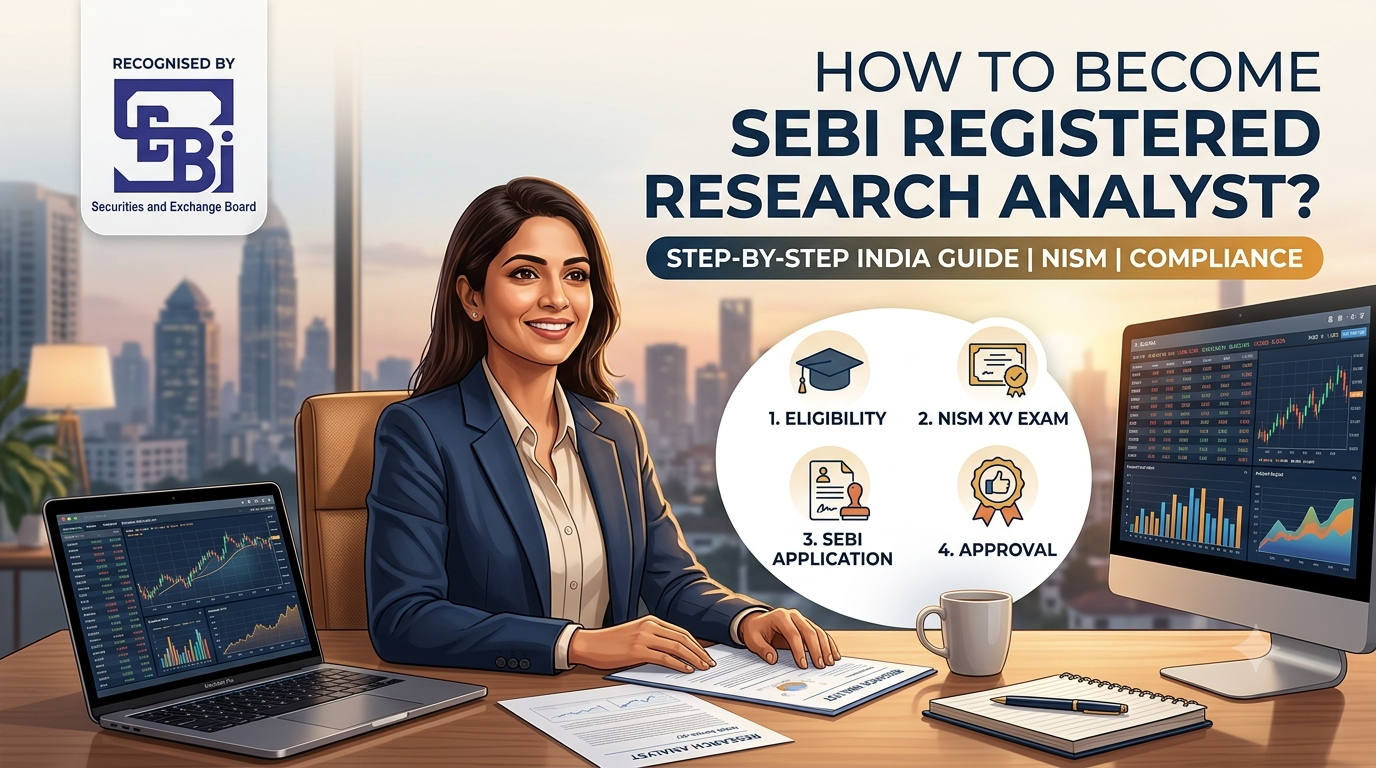
If you give stock recommendations, sell research reports, run a paid Telegram or WhatsApp community, or plan to build a serious equity research business in India, this guide is for you.

Over the last two years, SEBI has significantly tightened its oversight of anyone providing stock market recommendations for consideration. Unregistered “tips providers” are facing enforcement action, payment gateways and platforms are asking for registration numbers, and clients themselves have started checking whether the person charging them a fee is actually a SEBI Registered Research Analyst (RA).

At the same time, SEBI has made genuine efforts to make registration more accessible — a new administrative body (RAASB), a deposit-based capital requirement instead of the old net worth certificate, relaxed qualification norms, and even a part-time RA category. In short: 2026 is arguably the best time to get registered, and the worst time to operate without registration.

This guide walks you through the entire journey — from checking your eligibility and clearing the NISM exam, to filing with BSE RAASB, receiving your SEBI registration number, completing the five post-licence registrations, and staying compliant after you start onboarding clients. It is based on practical experience with actual RA applications, not just a reading of the regulations.

Need help with SEBI RA registration — eligibility review, documentation, BSE RAASB filing, and compliance setup?

What is a SEBI Registered Research Analyst?

A SEBI Registered Research Analyst is a person or entity that has been granted a certificate of registration by the Securities and Exchange Board of India under the SEBI (Research Analysts) Regulations, 2014, to provide research services for consideration.

In plain terms: if you analyse stocks or securities and give buy, sell, or hold views — whether through research reports, model portfolios, subscription services, or paid communities — and you charge for it (directly or indirectly), SEBI treats you as a research analyst. And a research analyst must be registered.

Once registered, you receive:

• A SEBI registration number in the format INH0000XXXXX, which must be displayed on your website, research reports, and marketing material.

Enlistment with RAASB (the Research Analyst Administration and Supervisory Body — currently BSE Limited), which administers and supervises RAs on SEBI’s behalf.

What an RA can broadly do: prepare and distribute research reports, give securities-specific recommendations with rationale, offer model portfolios (with prescribed disclosures), and charge subscription fees within SEBI’s fee framework.

What should be avoided without registration: giving stock-specific recommendations for any form of consideration. This applies whether you call it “education,” “premium community access,” or “market view sharing” — if the substance is a recommendation and there is consideration involved, the registration requirement can apply. When in doubt, take professional advice before monetising.

One important clarification that trips up many aspirants: clearing the NISM exam alone does not make you a Research Analyst. The NISM Series XV certificate is only a pre-requisite. Until your SEBI registration number is granted, you cannot give recommendations for consideration.

Who Needs SEBI RA Registration in 2026?

Step 1: Prepare the Required Documents

Registration is not just for “full-time professional analysts.” Under the current framework, the definition of a research analyst covers anyone receiving consideration — cash or non-cash — for research services. In practice, this typically includes:

•         Stock market research providers selling reports or recommendations.

•         Paid recommendation providers running subscription-based calls (intraday, swing, positional, long-term).

•         Finance influencers and creators who give specific stock calls in paid groups, courses, or communities.

•         Research report sellers distributing equity research for a fee.

•         Model portfolio providers offering curated baskets with entry/exit guidance.

•         Individuals or companies giving buy/sell/hold views on securities for consideration.

•         Businesses planning to monetise equity research in any structured way — websites, apps, broadcast channels, newsletters.

If you are earning (or plan to earn) from stock recommendations in any of these forms, assume registration is required and verify your specific model against the regulations. There is no “small-scale” exemption for side-income tips.

SEBI Research Analyst vs Investment Adviser: What’s the Difference?

This is the single most common point of confusion for new applicants. Both are SEBI registrations, but they serve different business models.

AspectResearch Analyst (RA)Investment Adviser (IA)
Governing regulationSEBI (Research Analysts) Regulations, 2014SEBI (Investment Advisers) Regulations, 2013
Nature of serviceResearch reports and securities recommendations to a general subscriber basePersonalised investment advice based on the client’s risk profile and financial situation
PersonalisationOne-to-many; same recommendation can go to all subscribersOne-to-one; advice tailored to each client after risk profiling
Typical outputResearch reports, stock calls, model portfoliosFinancial planning, personalised portfolio advice
Risk profiling of clientNot the core requirementMandatory before advising
Registration number formatINH…INA…
Administered byRAASB (BSE Limited)IAASB

The simple test: if you give the same recommendation to all your subscribers, you are operating like an RA. If you assess an individual’s finances and goals and then advise them specifically, that is IA territory.

Choose based on your actual business model, not on which registration looks easier. Operating an advisory-style business on an RA licence (or vice versa) is a compliance risk that surfaces during audits and inspections.

Note: Individuals and partnership firms can, subject to conditions, hold both RA and IA registrations with an arm’s-length separation between the two activities. Verify the current conditions before planning a dual-registration structure.

Eligibility Criteria for SEBI Research Analyst Registration

Eligibility is where most applications fail, so check this carefully before spending money on anything else.

1. Entity type

You can apply as an individual (including sole proprietor), partnership firm, LLP, or body corporate. This choice affects fees, deposit expectations, compliance structure, and future flexibility — more on this in the step-by-step section.

2. Educational qualification

Historically, SEBI required a professional qualification or postgraduate degree/diploma in fields such as finance, accountancy, business management, commerce, economics, capital markets, banking, insurance, or actuarial science — or a graduate degree with relevant experience in financial services.

Important 2025–26 update: SEBI has moved to relax these norms — recent amendments and circulars indicate acceptance of a graduate degree in any discipline for new applicants, opening the door for candidates from engineering, law, science, and arts backgrounds. However, because the implementation status and exact conditions of this relaxation directly affect whether your application is accepted, verify the currently effective qualification requirement on the SEBI website or with a professional before filing. Do not rely on YouTube videos or blog posts (including this one) for this specific point — check the regulation text and latest circulars.

3. NISM certification

The NISM Series XV: Research Analyst Certification Examination is mandatory. Key points:

•  The certificate is valid for 3 years. You must apply for registration within its validity.

•   Renewal is through the NISM Series XV-B examination.

•  For non-individual applicants, the Principal Officer must meet the qualification and certification requirements, and the compliance officer role has its own NISM certification expectations.

4. Deposit requirement (replaced net worth)

This is one of the biggest structural changes from the December 2024 amendments. The old net worth certificate requirement has been replaced by a client-based deposit, maintained with a scheduled bank (or, per later circulars, in specified liquid/overnight fund units) and marked under lien in favour of RAASB:

Maximum number of clientsDeposit amount
Up to 150₹1,00,000
151 – 300₹2,00,000
301 – 1,000₹5,00,000
Above 1,000₹10,00,000

The deposit must be topped up as your client count crosses slab boundaries, reviewed annually. New applicants must meet the deposit requirement at registration. (Verify the current slabs against the latest SEBI Master Circular before filing — SEBI reviews these periodically.)

5. Fit and proper criteria

The applicant (and connected persons) must satisfy the fit and proper criteria under the SEBI (Intermediaries) Regulations — no disqualifying regulatory or criminal history.

Documents Required for SEBI RA Registration

Documentation is where applications get stuck in query loops. Prepare everything before you file — not while you file.

Individual applicant documents

•         PAN and Aadhaar (with name matching exactly across all documents)

•         Educational qualification certificates (degree, mark sheets)

•         NISM Series XV certificate (valid)

•         Dedicated contact number and email ID (see practical tip below)

•         Bank account details

•         Deposit-related documents (FD receipt / lien marking as prescribed)

Partnership / LLP / Company documents

•         Certificate of incorporation / partnership deed / LLP agreement

•         MoA & AoA (for companies)

•         PAN of the entity

•         Details of directors/partners, shareholding pattern

•         Principal Officer’s qualification and NISM certification documents

•         Compliance Officer details

•         Board resolution authorising the application

Qualification and certification documents

•         Degree certificates and mark sheets

•         NISM Series XV certificate (and Series III-A / XV-B where applicable for compliance/renewal roles)

Business plan and declarations

•         A clear business plan: services offered, target clients, fee model, research methodology

•         The full set of declarations and undertakings in BSE RAASB’s prescribed formats — these run into multiple documents, and errors here are the most common source of queries

Compliance-related documents

•         Draft investor grievance mechanism

•         Proposed website details / disclosures plan

•         KYC and record-keeping process outline

Practical tip: set up a dedicated business email ID and phone number before you apply. Many applicants register with their personal email/number, and once the registration is live, that inbox gets flooded with regulatory, exchange, and client communication. Changing contact details on the portal later is avoidable friction — get it right on day one.

Step-by-Step SEBI RA Registration Process in 2026

Here is the full journey, in the sequence it actually happens.

Step 1: Decide your applicant type — individual or corporate

This decision matters far more than most applicants realise.

Choose individual RA if: you only want to do research work, as yourself, without other regulated business activities.

Choose corporate/non-individual if: you plan a larger organisation — for example, combining research with other business lines, building a team, or eventually adding other licences (broking, distribution, and so on) under one entity.

Two practical constraints seen in real cases:

•         An individual RA faces restrictions on simultaneously holding certain other positions/registrations (for instance, directorships in certain companies or broking roles). Evaluate your five-year plan, not just today’s plan.

•         There is no “upgrade” path. If you take an individual licence and later realise you needed a corporate one, it is a fresh application from scratch — another 3–4 months, fresh fees, and business disruption. Deciding correctly the first time is the single cheapest compliance decision you will make.

Step 2: Check your eligibility

Confirm your qualification against the currently effective norms (see the eligibility section), confirm you meet fit-and-proper criteria, and plan for the deposit requirement.

Step 3: Clear the NISM Series XV examination

Register on the NISM website, choose an exam date, and clear the NISM Series XV: Research Analyst Certification Examination. The certificate is valid for 3 years. Remember: this exam is a pre-requisite, not a licence — you cannot give recommendations on the strength of the NISM certificate alone.

Step 4: Prepare your documents

Assemble everything in the documents section. Pay special attention to:

•         Name consistency across PAN, Aadhaar, degree certificates, and application forms

•         Finalising your place of business before filing — changing it mid-application invites queries

Step 5: Prepare declarations and your business plan

Complete BSE RAASB’s full declaration set and checklist. Your business plan should be coherent: the services you describe, the fees you propose, and your public claims (website, social media) should all tell the same story. Inconsistencies here are a classic query trigger.

Step 6: File the application on the BSE RAASB portal

The application goes first to BSE (as RAASB), not directly to SEBI. BSE scrutinises the application against its checklist.

Step 7: Respond to BSE/RAASB queries

Expect multiple query rounds — three to four is normal, not a sign that something is wrong. Respond precisely and promptly; slow or incomplete responses are the biggest self-inflicted delay. Once satisfied, BSE grants an in-principle approval and generates Form A, which you sign and return. BSE then forwards the application to SEBI through the SEBI Intermediary (SI) portal.

Step 8: Pay the applicable fees

•         A challan is generated for the SEBI application fee at the BSE-to-SEBI stage.

•         If SEBI has queries, these typically flow through BSE, which coordinates the response.

•         Once SEBI approves, further challans are generated for the SEBI registration fee and the RAASB administrative/membership fee (the membership component is typically valid for a 5-year period, after which renewal fees apply).

Step 9: Complete the deposit and receive your registration

After fee payments, you place the prescribed deposit under lien to RAASB and submit the deposit proof (with physical copies to BSE where required). SEBI’s registration number may be communicated first, with the registration certificate and enlistment letter issued after the deposit formalities are completed. Only then is your registration fully complete.

Step 10: Complete post-licence registrations before starting business

The SEBI number alone is not “business-ready.” Before onboarding a single client, complete the post-licence registrations (detailed later): SCORES, Smart ODR, KRA, FIU-IND, and DLT (TRAI) if you plan bulk SMS marketing. Set up your compliant website. Then — and only then — start onboarding clients.

This is exactly the stage where most self-filed applications get stuck — query loops, document mismatches, and missed declarations. If you want to avoid delays, documentation errors, and repeated regulatory queries, professional assistance can save months. Contact [Brand Name] at [WhatsApp/Contact Link] for an eligibility review and end-to-end filing support.

Timeline for SEBI RA Registration

Based on current practical experience:

•         NISM preparation and exam: depends on you — typically 2–6 weeks of preparation.

•         Document preparation: 1–3 weeks if organised; longer if the trade licence or office finalisation is pending.

•         BSE RAASB + SEBI processing: approximately 3–4 months is the realistic current range, driven largely by application volumes at the regulator’s end and how quickly you respond to queries.

•         Post-licence registrations (SCORES, ODR, KRA, FIU, DLT): usually completed within 1–2 weeks, barring technical glitches (FIU registration is a known source of occasional technical delays).

Realistic end-to-end planning number: 4–5 months from the day you decide to pursue the licence to the day you are fully operational. Some applications close faster; some take longer. Anyone promising a fixed fast-track timeline is overpromising — the regulator’s queue is not in anyone’s control.

SEBI RA Registration Fees and Cost

Think of the total cost in four buckets:

1. Regulatory fees. These include the SEBI application fee, the SEBI registration fee, and the RAASB administrative/membership fee. For individual applicants these have been modest (indicatively, application and registration fees in the low thousands of rupees plus GST, and a RAASB membership fee around ₹15,000 plus GST valid for a 5-year period). Non-individual/corporate applicants pay substantially higher regulatory fees.i.e-5,50,000 Plus GST

2. Certification cost. The NISM Series XV exam fee, plus study material if you buy any. Renewal (Series XV-B) recurs every 3 years.

3. Deposit (capital) requirement. Not a fee, but capital you must set aside: ₹1 lakh and upward depending on client count, held under lien to RAASB. Later circulars permit holding this in specified liquid/overnight fund units, so the amount is not entirely idle.

4. Documentation, professional assistance, and compliance setup. Consultant/professional fees if you engage one, website development with SEBI-mandated disclosures, audit fees (annual compliance audit is mandatory), and ongoing compliance support.

Budget for the whole picture — the regulatory fees are the smallest part; the deposit and the ongoing compliance infrastructure are the real financial commitment.

Common Mistakes That Delay SEBI RA Registration

From real application experience, these are the delays that keep repeating:

1.       Wrong entity structure. Taking an individual licence in a hurry, then realising the business plan needed a corporate licence — and having to file fresh.

2.       Incomplete or incorrect declarations. BSE’s declaration set is extensive; missing even one triggers a query cycle.

3.       Name mismatch between PAN, Aadhaar, degree certificates, and the application.

4.       Qualification mismatch — applying with a background that doesn’t meet the currently effective norms.

5.       Personal email/phone used for registration — creating a lifetime of inbox chaos and later change requests.

6.       Place of business not finalised before filing — address changes mid-application invite queries.

7.       Inconsistent website/social media claims. If your public content promises “guaranteed returns” or advisory-style services while your application says “research reports,” expect trouble.

8.       Unclear research methodology in the business plan.

9.       Missing the state-specific Shops & Establishment certificate.

10.   Slow or sloppy query responses. Three to four query rounds are normal; each slow response adds weeks.

11.   Starting client onboarding before completing post-licence registrations — a compliance breach from day one.

What Happens After SEBI RA Registration?

Getting the number is the halfway mark. Here is what running a compliant RA business actually involves.

A. The five post-licence registrations

1.       SCORES (SEBI Complaints Redress System). Mandatory. If a client is dissatisfied, they have the right to file a complaint against you on SCORES. Registration involves submitting the prescribed form with your SEBI certificate; login credentials are issued within a few days.

2.       Smart ODR (Online Dispute Resolution). Mandatory. If a SCORES complaint isn’t resolved to the client’s satisfaction, the dispute can escalate to the ODR mechanism — conciliation and arbitration through the online portal, culminating in a hearing and a binding outcome.

3.       KRA registration (KYC Registration Agency). Mandatory before onboarding any client, because all client KYC must be done through a registered KRA. Multiple KRAs exist; register with one and use its credentials for KYC fetch/upload.

4.       FIU-IND registration (Financial Intelligence Unit). Mandatory. Linked to anti-money-laundering obligations under the PMLA framework. Day-to-day interaction is minimal unless a reportable event arises, but the registration and credentials must be in place and on record.

5.       DLT/TRAI registration (conditional). Required only if you plan bulk SMS marketing or transactional messages. WhatsApp-based communication follows its own platform rules.

Most of these close within a week or two if done systematically.

B. Mandatory website

A functional website is not optional, even if you haven’t started charging clients. It must carry, among other things:

•         Your name, SEBI registration number, registered office address, and the details exactly matching your SEBI application (any mismatch between the application and the website is itself a compliance issue)

•         SEBI’s regional/head office address relevant to you

•         The Investor Charter

•         Investor grievance data — a running record of complaints received and their status

•         Grievance redressal escalation matrix (complain to the RA first, then SCORES, then ODR)

•         Mandatory standard disclaimers (market risk, no assured returns)

•         Your annual compliance audit status — whether completed, for which financial year, and any adverse observations

C. Client onboarding — in the right order

The sequence matters and is enforced:

1.       KYC first — fetch/verify the client’s KYC via your KRA credentials (PAN + date of birth), and retain records.

2.       Terms & Conditions signed — the client must sign/accept the prescribed terms (the “Most Important Terms and Conditions” framework). You cannot charge a single rupee of fees until the T&C are executed.

3.       Collect fees — through traceable modes only (cheque, bank transfer, UPI). Cash is prohibited.

4.       Deliver research — with every recommendation backed by a documented rationale and sources: charts referenced for technical calls, financial data sources for fundamental calls, plus the prescribed disclosures and your registration details on every report.

D. Fee restrictions

For individual and HUF clients (who are not accredited investors), the fee is capped — currently ₹1,51,000 per annum per family, across all your research services, excluding statutory charges like GST. This cap does not apply to non-individual clients or accredited investors, where fees are contractual. Advance fee collection is restricted to prescribed limits, and proportionate refunds apply on early termination with no breakage fee. (The cap is reviewed periodically — verify the current figure and advance-fee limit before setting your pricing.)

E. Records to maintain

•         Register of clients — who they are, PAN, what was recommended, fees charged

•         Research reports with rationale and source documents for every recommendation

•         Client communications (emails, messages, call recordings where applicable) — retained for the prescribed period (currently five years or until dispute resolution, whichever is later)

F. Reporting and audit calendar

•         Half-yearly periodic reporting to RAASB (BSE portal): for April–September, report by end-October; for October–March, report by end-April. It covers client counts, fees charged, NISM certification status, complaints, bank accounts used for fee collection, and similar data. This applies even if your licence arrived one day before the period ended and you did zero business — nil reporting is still reporting.

•         Annual compliance audit: mandatory every year, conducted by a qualified auditor (CA/CS/CMA), with the report uploaded on the BSE portal and the status published on your website. If the auditor flags non-compliances, you must submit an Action Taken Report describing corrective steps within the prescribed window. SEBI’s approach here is constructive — flagged issues fixed within the corrective window are treated far more leniently than issues discovered untouched during an inspection.

The golden rule of post-registration life: do compliance as you go, item by item, from day one. Analysts who ignore it for six months and then try to fix everything at once find it overwhelming — and inspections do not wait for you to catch up. If non-compliance is discovered, demonstrating that you corrected it promptly on discovery materially changes how the regulator views it; letting the damage compound does the opposite.

Can You Become a Part-Time SEBI Registered Research Analyst?

Yes — the current framework recognises part-time research analysts, which is a meaningful opening for professionals who want to run research alongside another (unrelated) profession.

Broad contours, subject to verification of current conditions:

•         Professionals such as CAs, CSs, CMAs, teachers/professors (with employer NOC), lawyers, doctors, and architects may be eligible for part-time RA registration.

•         The other activity must be unrelated to securities markets, disclosed, and kept clearly segregated, with a prescribed disclaimer clarifying that the non-RA activity is outside SEBI’s purview.

•         Persons advising on assets like gold, real estate, or cryptocurrency are specifically not eligible for the part-time category.

Do not structure your business around the part-time route without first verifying the current eligibility conditions, disclosure requirements, and any client-count limits from the latest SEBI Master Circular — this is a newer category and the fine print matters.

Is SEBI RA Registration Worth It in 2026?

The case for yes:

•         Legal standing. You can monetise research openly — subscriptions, reports, model portfolios — without the constant risk of enforcement action that unregistered tip-sellers now face.

•         Credibility and trust. An INH number on your reports and website is a genuine trust signal. Clients, platforms, and payment partners increasingly ask for it.

•         A real business, not a workaround. Registration lets you build a durable brand — with proper onboarding, invoicing, and scale — rather than a Telegram channel that could vanish overnight.

•         Long-term brand value. As SEBI keeps cleaning up the recommendation space, registered analysts inherit the market that unregistered players are being pushed out of.

The honest other side:

•         Compliance is a permanent operating cost — website disclosures, record-keeping, half-yearly reporting, annual audits, fee caps for individual clients, and the discipline of documenting rationale for every single call.

•         The fee cap of ₹1,51,000 per family per year for individual/HUF clients shapes your revenue model — scale comes from client count and non-individual/accredited clients, not from charging a few clients heavily.

•         You are accountable to a regulator, with inspections and enforcement as real possibilities.

If you are serious about research as a business, the answer in 2026 is clearly yes. If you were hoping registration would be a rubber stamp on an advisory-style tips operation, the compliance framework will be an uncomfortable fit — and that’s by design.

How We Help With SEBI RA Registration

The registration process is manageable — but it is long, document-heavy, and unforgiving of small errors. Most delays come from avoidable issues: a missed declaration, a name mismatch, an entity-type decision made in haste, or a query answered incompletely.

If you want to avoid delays, documentation errors, compliance mistakes, and repeated regulatory queries, professional assistance can save time and reduce mistakes.

At Taxation Consultancy, we support RA and IA applicants end-to-end:

•         Eligibility review — before you spend a rupee, we confirm whether and how you qualify under the currently effective norms

•         Entity structure advice — individual vs corporate, evaluated against your actual business plan

•         Complete documentation — declaration sets, business plan, and BSE RAASB checklist preparation

•         Application filing and query handling — through in-principle approval, Form A, and SEBI processing

•         Post-licence setup — SCORES, Smart ODR, KRA, FIU-IND, DLT registrations, and website compliance

•         Ongoing compliance — half-yearly reporting, annual audit coordination, and record-keeping frameworks

CTA 3: [WhatsApp/Contact Link]  |  [Email]  |  [Website URL][SEBI Registration/Consultant Details, if applicable]

Final Checklist Before Applying

☐  Eligibility verified against the currently effective SEBI qualification norms

☐  NISM Series XV certification completed and valid

☐  Entity type decided (individual vs corporate) against a 5-year business plan

☐  All documents ready — PAN/Aadhaar matched, ITRs, degree certificates, trade licence

☐  Place of business finalised

☐  Dedicated business email and phone number created

☐  Deposit capital arranged (₹1 lakh+, per client slab)

☐  Business model and fee structure clear (within the individual-client fee cap)

☐  Research methodology documented

☐  Website and social media reviewed for consistency with the application

☐  Declarations and business plan prepared per BSE RAASB formats

☐  Compliance framework planned (reporting calendar, audit, record-keeping)

☐  Application filed correctly on the BSE RAASB portal

Frequently Asked Questions (FAQs)

1. How can I become a SEBI Registered Research Analyst in 2026?

Check your eligibility, clear the NISM Series XV exam, prepare your documents, file through the BSE RAASB portal, respond to queries, pay SEBI/RAASB fees, place the client-based deposit under lien to RAASB, and complete post-licence registrations (SCORES, ODR, KRA, FIU) before onboarding clients. Realistic end-to-end timeline: 4–5 months.

2. Is NISM certification mandatory for SEBI RA registration?

Yes. The NISM Series XV: Research Analyst Certification Examination is mandatory and valid for 3 years. But clearing it alone does not permit you to give recommendations — it is only a pre-requisite for registration.

3. Can a stock market YouTuber apply for SEBI RA registration?

Yes, provided they meet the eligibility criteria. In fact, creators who give stock-specific calls for any consideration generally need registration. Note that your public content will need to be consistent with RA regulations — no assured-return claims, proper disclosures, and clear separation of general education from recommendations.

4. What is the difference between a Research Analyst and an Investment Adviser?

An RA gives one-to-many securities research and recommendations; an IA gives one-to-one personalised advice after risk-profiling the client. RA numbers start with INH; IA numbers with INA. Choose based on your business model.

5. How long does SEBI RA registration take?

The BSE RAASB + SEBI processing stage currently takes around 3–4 months in practice. Including NISM preparation, documentation, and post-licence registrations, plan for 4–5 months end to end.

6. What documents are required for SEBI RA registration?

For individuals: PAN, Aadhaar, 3 years’ ITRs, degree certificates, valid NISM Series XV certificate, Shops & Establishment certificate, office address proof, dedicated contact details, deposit documents, and the full BSE RAASB declaration set. Non-individuals additionally need incorporation documents, Principal Officer credentials, and board resolutions.

7. Can I give stock recommendations without SEBI RA registration?

If you receive any consideration for stock-specific recommendations, registration is required. Operating without it exposes you to SEBI enforcement action. Genuine general education without securities-specific recommendations stands on different footing, but the line is thinner than most creators assume — take professional advice on your specific model.

8. Can a company apply for SEBI Research Analyst registration?

Yes. Body corporates, LLPs, and partnership firms can apply as non-individual RAs. They must appoint a qualified Principal Officer and a Compliance Officer, and pay the higher non-individual fee structure.

9. What are common reasons for SEBI RA application rejection or delay?

Qualification mismatch, incomplete declarations, name mismatches across documents, unclear business plans, inconsistent website/social media claims, missing trade licence, and slow query responses.

10. Do I need a website before applying for SEBI RA registration?

A compliant website is a mandatory requirement for registered RAs — with registration details, Investor Charter, grievance data, audit status, and disclaimers. Practically, plan and build it during the application process so you are ready the moment registration is granted, and ensure its details exactly match your application.

11. What compliance is required after becoming a SEBI Registered Research Analyst?

Five post-licence registrations (SCORES, Smart ODR, KRA, FIU-IND, plus DLT if doing bulk SMS), website disclosures, KYC-first client onboarding with signed T&C before charging fees, rationale-backed research reports, client registers, half-yearly reporting to RAASB, and an annual compliance audit with corrective-action reporting.

12. Is SEBI RA registration useful for finance creators?

Very. It converts a legally grey monetisation model into a legitimate research business, adds a strong trust signal (your INH number), and future-proofs you as SEBI tightens enforcement against unregistered recommendation providers. 

How to Become SEBI Registered Research Analyst: A Step-by-Step Guide to a Legal, High-Income Career

Sebi Registrations and Legal Support - Taxation Counsultancy

There is a lot of happening in the Indian stock market, which currently has more than 5 crores of investors taking part in it. This unprecedented growth in the stock market has created a huge need for quality and reliable stock advice.

 As a working professional who wants to work in the field of finance or is pursuing his/her CAs and MBA from any other university, if you wonder how to become a SEBI Registered Research Analyst, then this article can prove to be very useful.

With only2000  SEBI Registered Research Analysts in India, there is a great opportunity for becoming successful in this profession.

1. Understand the Legal Mandate

According to the SEBI (Research Analyst) Regulations, 2014, every person or firm that gives any kind of recommendation, targets prices, or writes research reports on listed stocks shall be required to have SEBI registration.

There are many financial influencers and teachers who try to cover themselves under the general disclaimer “for educational purposes only.” But SEBI has always made it clear that these disclaimers don’t provide legal protection. And if your material ends up influencing investors, you are technically performing as a research analyst and need to get yourself registered. Not having SEBI registration can result in serious penalties like:

●       Strict financial penalties

●       Legal proceedings and asset freezing

●       Permanent blacklisting from the financial markets

2. The Step-by-Step SEBI Registration Process

Step 1: Prepare the Required Documents

Documentation is the most important—and most difficult—aspect of the entire process. Incomplete or incorrect documentation is usually the main cause of applications being rejected. The following documents will be needed:

● Identity and Address Proof: Valid government-issued identification (such as a PAN Card or Adhar Card along with that as the infrastructure criteria is removed a declaration for the infra would be enough.

● Educational Certificates: Graduation or Post-Graduation degree(Any graduate can apply now). Crucially, you must have cleared the NISM Series-XV: Research Analyst Certification Examination.

● Deposit Requirement / RAASB Lien Confirmation: As per the amended SEBI (Research Analysts) Regulations, 2014, applicants are required to maintain the applicable deposit instead of the earlier capital adequacy / net-worth certificate requirement. The deposit may be maintained as a scheduled bank deposit or in permitted liquid / overnight mutual fund units, marked as lien in favour of RAASB, based on the maximum number of clients — ₹1 lakh up to 150 clients, ₹2 lakhs for 151–300 clients, ₹5 lakhs for 301–1,000 clients, and ₹10 lakhs for 1,001 or more clients.

● Internal Policies & Business Plan: A comprehensive, professionally drafted business roadmap alongside internal compliance and conflict-of-interest policies and other all important declarations as per SEBI regulations.

Step 2: Apply on the SEBI Intermediary Portal

Once all the required documents are ready, you will have to apply (Form A) through the online SEBI Intermediary Portal (run by BSE). Select “Research Analyst” from the drop-down menu and attach clear scans of all the documents.(iara.sebi.gov.in)

Step 3: Pay the Required Fees

The application process will only get into motion after the payment of relevant amounts. The latest rates of payment are:

Applicant TypeApplication FeeRegistration Fee (Upon Approval)
Individuals / Partnerships₹5,000₹10,000
Body Corporates / LLPs₹50,000₹5,00,000

SEBI officers will meticulously review your submissions to ensure you meet the strict “fit and proper” person criteria. In certain circumstances, regulatory authorities may conduct an official physical inspection of your declared office infrastructure to verify the authenticity of your details.

Step 5: Approval and Certification

Once SEBI approves your profile and your final registration fee is processed, you will be issued your official Certificate of Registration. This certificate remains valid for five years and can be systematically renewed.

3. Why You Need a Consultant for This Process

Though the procedure may seem simple at face value, there is nothing short of technicalities involved in going through regulatory websites. Even one little mistake in structuring your internal policies or your business model could mean instant disqualification or long-winding processes.

At Taxation Consultancy, we know exactly how to go about the SEBI compliance process. Our team of professionals, headed by CA’s, can make sure that all your registration requirements are met smoothly. Let us do the hard work for you:

● Application Drafting & Filing: We cross-verify and assemble your Form A alongside all supporting exhibits to ensure they perfectly meet SEBI specifications.

● Professional Business Plan Preparation: We help you formulate a compliant, professional business roadmap that satisfies regulatory expectations.

● Expert Legal Consultation: Our specialists provide continuous guidance to ensure your operations align with corporate governance guidelines.

● Post-Registration Compliance Support: We don’t just stop at approval; we help you maintain your compliance calendar so you can focus entirely on market research and client growth.

4. Conclusion

Becoming a SEBI Registered Research Analyst is a high-yield, strategic career move that establishes you as a trusted authority in a booming market. While the registration pathway requires meticulous attention to detail, the long-term rewards—unmatched credibility, legal immunity, and access to millions of investors—are invaluable.

Ready to launch your professional advisory career? Do not let documentation errors or compliance confusion delay your professional growth. Let industry experts handle the regulatory complexities while you focus on analyzing the markets.

Click Here to Speak to a SEBI Registration Expert at Taxation Consultancy Now!

SEBI Show Cause Notice: Meaning, & Latest on PACL| 2026

SEBI Show Cause Notice

SEBI Show Cause Notice – What It Means, Latest Trends & How to Protect Yourself

 If you’re reading headlines about a Securities and Exchange Board of India (SEBI) show cause notice and feeling a bit lost — you’re not alone. It sounds serious, but what does it actually mean? For many, it’s like a “notice” saying: “You might have crossed the line. Explain yourself.”

A show cause notice isn’t a final punishment — it’s a chance for the accused to respond. And when it comes from SEBI, it often signals investigations into financial wrongdoing, fraud, or regulatory breaches. Given how common SEC-style scams and schemes have become, knowing what a show cause notice entails can protect you as an investor, a company director, or just a curious citizen.

In this article, we’ll go deep — explaining show cause notices under the SEBI Act, the process, recent trends (including major cases like the PACL Ltd. saga), why you should pay attention, and how you can stay safe. We also throw in practical advice — and a word about how a professional service like TaxationConsultancy can help you stay compliant and avoid trouble.


Consult SEBI Expert Now

What is a SEBI Show Cause Notice?

A show cause notice (SCN) from SEBI is essentially a formal letter. It says: “We believe you may have violated rules under the SEBI Act or related regulations. Please explain why we should not penalise you.”

It’s not a final verdict or punishment — rather, it’s a chance to respond, to present your side, and to defend yourself before SEBI takes further action. In legal parlance, it ensures natural justice and due process. Without assessing your explanation, SEBI doesn’t immediately impose fines or bans.

In other words: think of it as being asked to step into the ring — not yet judged guilty, but challenged to explain yourself before the referee makes a decision.

Why Does SEBI Issue Show Cause Notices?

Common Triggers

SEBI doesn’t issue notices randomly. Here are common reasons:

  • Illegal investment schemes or Ponzi-style operations: Companies promising unrealistic returns through dubious collective investment.
  • Misleading or false communication: False promises to attract investors or financial advice without proper registration.
  • Insider trading, price manipulation, or unfair trading practices.
  • Violation of listing or takeover regulations when companies are publicly traded.
  • Non-compliance by market intermediaries — brokers, advisors — such as misuse of client funds or lack of proper disclosures.
  • Failure to comply with SEBI’s orders or previous warnings.

For example, a legal blog explaining how SEBI may issue a show cause notice states that common triggers include giving stock tips without registration, operating illegal WhatsApp/Telegram groups for investment advice, or misusing client funds.

In short, if you or your firm deals with investors, securities, advice, or schemes — you must tread carefully.

Legal Foundation — The SEBI Act & Amendments

The power of SEBI to issue show cause notices comes from the SEBI Act, 1992. Under various sections (like Section 11, Section 11B, Section 15HA/15HB, among others), SEBI is empowered to investigate securities-market irregularities, appoint adjudicating officers, and impose penalties or other orders where necessary. 

Legislative updates — such as the Securities Laws (Amendment) Act, 2014 — have given SEBI more teeth. 

Particularly in cases of fraud, Ponzi-style schemes, or mis-selling, SEBI now has clearer powers to crack down. 

That legal backing ensures that show cause notices — and subsequent actions — stand on firm statutory ground. That said, it also places a high responsibility on people and firms dealing in securities or client funds to stay compliant.

The Process: From Investigation to Final Order

Here’s generally how it unfolds — like a staircase you’d rather not climb:

  • Investigation Starts

SEBI gathers data, monitors markets, looks into suspicious activity — could be anything from unusual trading patterns, large fund flows, or investor complaints. Their investigations may involve x-rays of trading data, documents, KYC records, communications, etc. 

  • Show Cause Notice Issued

If SEBI finds sufficient preliminary grounds, it issues an SCN. This document outlines: the allegations, which SEBI Act/regulation is alleged to be violated, evidence gathered, and the time period within which the accused must respond (commonly 15–30 days, but may vary). 

  • Response from the Accused

The accused needs to respond diligently: addressing each allegation, providing explanations, submitting documents, clarifications, etc. Legal representation is allowed. It’s key to respond — ignorance or silence doesn’t help. 

  • Hearing / Adjudicating Process

SEBI may schedule a personal hearing or further adjudication if needed. The noticee gets an opportunity to defend themselves or explain mitigating circumstances. 

  • Final Order

Based on reply, evidence, and proceedings, SEBI passes a final order. This could result in a warning, monetary penalty, disgorgement of profits, ban from markets, cancellation of licenses, or directions to refund investors. 

In some cases, SEBI might even issue supplementary notices if more facts emerge later — a point of controversy among legal experts. 

Because of this rigorous process, a show cause notice should always be taken seriously and acted upon promptly.

Recent Trends: Warning Letters vs Show Cause Notices

SEBI’s approach to enforcement is evolving. In recent years, it has increasingly used warning letters — soft-enforcement tools — before or in place of issuing full-fledged SCNs. These are like “yellow cards”: warnings meant to steer behaviour without immediate heavy penalty. 

According to a recent legal commentary (2025), SEBI issued many more warning letters during 2023–2024 compared to previous years — indicating a push toward compliance via caution first, and heavy enforcement only if warnings are ignored. 

That shift shows two things:

  • SEBI is serious about regulating the market, but also keen to avoid heavy penalties for minor or first-time infractions.
  • As a market participant — whether you’re an investor, broker, or advisor — you may get a warning first. But ignoring that could escalate to a show cause notice.

This evolving enforcement approach means staying compliant — and taking warnings seriously.

Real-World Example: PACL Ltd. Case and Investor Refunds

One of the most massive and long-running enforcement cases by SEBI has been the saga of PACL Ltd. — widely considered one of the largest scams involving public money in India’s securities/collective-investment space. 

What Went Wrong

PACL marketed itself as a bona fide land-investment company. It collected money from millions of investors on the promise of high returns or land allotments. In reality, the scheme lacked substance — no real land allocation, delayed or no returns, and practices typical to Ponzi or collective-investment scams.

SEBI’s Intervention

SEBI triggered investigations, issued show cause notices, and eventually, after protracted legal and regulatory processes — including intervention by the Supreme Court of India — it declared PACL’s schemes illegal. The Court directed sale of PACL properties and refund of investors via a committee headed by Justice R. M. Lodha. 

As of late 2025, the committee reportedly refunded a portion of the investors: over 23 lakh (2.3 million) applications processed, with refunds totalling more than ₹1,300 crore. 

Why It Matters for Everyone

The PACL case stands as a textbook warning: if you trust unsolicited “investment opportunities” or schemes promising high returns with little clarity — you risk being part of a bubble waiting to burst.

It also shows that show cause notices — followed by protracted legal action — can lead to years of delay before justice or refunds. Meanwhile, investors may remain exposed.

For you as an investor or market participant, it’s a reminder: always verify, always be sceptical, and always demand transparency.

Other High-Profile Cases: What They Teach Us

Beyond PACL, SEBI has used show cause notices in several high-profile market-manipulation or scam cases. 

For example:

  • In cases involving brokers of commodity or securities exchanges (mis-selling, client-code misuse) after alleged collapses of trading platforms.
  • In takeover and insider-trading related matters — SEBI’s adjudicating officers have issued SCNs under Takeover Regulations when acquiring shares without proper disclosure.

These show that SEBI monitors a wide variety of risky behaviors: corporate takeovers, mis-selling, trading-code manipulation, insider trading, and fraudulent schemes.

Take-away: if you operate in stock markets, mutual funds, commodity trading, or even give investment advice — SEBI’s gaze may reach you. Thus, staying compliant and transparent is not optional.

Rights & Obligations of the Noticee

Receiving a show cause notice doesn’t mean you’re guilty — you have rights. At the same time, there are obligations and serious responsibilities.

Your Rights:

  • To know the exact allegations, evidence, and laws under which you’re charged.
  • To access the material and documents SEBI relies on.
  • To give a written response, within the stipulated timeframe.
  • To request a hearing or personal hearing (in many cases).
  • To be represented legally — by a lawyer or authorized representative.
  • To appeal against the final SEBI order via appropriate appellate mechanisms (for instance, the Securities Appellate Tribunal (SAT), or even courts, where applicable).

Your Obligations:

  • Respond truthfully and comprehensively — avoid misstatements or omissions.
  • Submit all relevant documents/evidence supporting your response.
  • Attend hearings if called.
  • Respect deadlines.

Failure to respond or negligence can lead to ex-parte orders (decisions made without your input), heavy penalties, bans, or blacklisting from markets. 

Risks of Ignoring the Notice — What Could Happen

Ignoring a show cause notice is risky — like leaving a cracked foundation unchecked. Consequences may include:

  • Ex-parte orders — meaning SEBI can pass orders against you without hearing your side.
  • Heavy fines or disgorgement (i.e. returning illegal gains).
  • Ban or suspension from trading or acting as a market intermediary.
  • Freezing of assets or accounts linked to the alleged offence.
  • Blacklist or permanent prohibition from securities market participation.
  • Legal consequences — sometimes overlapping with criminal or civil liability depending on the nature of violation.

So even if you think “I did nothing wrong” — not responding or ignoring the notice could be far worse than defending yourself.

How To Respond: Practical Steps & Checklist

If you or your firm receives a SEBI show cause notice, here’s a practical, step-by-step checklist:

  1. Read the notice carefully — note allegations, regulations cited, deadlines.
  2. Gather all relevant documents — bank statements, transaction receipts, agreements, correspondence, compliance records, KYC, audit trails.
  3. Prepare a detailed written reply — address every allegation point-by-point. Be honest. Mistakes or omissions can be corrected but transparency helps.
  4. Attach documentary evidence — Don’t just write: “It didn’t happen.” Show proof.
  5. Request a hearing (if not already offered) — personal hearings give a chance to explain nuance, context or misunderstanding.
  6. Get legal or professional help — securities laws are technical. A lawyer or consultant specializing in SEBI law helps you draft stronger responses, avoid mistakes, and protect your interests (see next section).
  7. Review your compliance history — check if prior warnings or notices were ignored by mistake.
  8. Track deadlines carefully — missed deadlines can worsen your case.
  9. If needed, prepare for appeal — In case SEBI passes an adverse order, you may need to appeal to SAT or other courts.

Role of Professional Help — Why TaxationConsultancy Matters

Working through a SEBI show cause notice isn’t trivial. Laws, regulations, evidence, procedures — it’s like playing a complex chess game. This is where a professional firm like TaxationConsultancy becomes very helpful.

What TaxationConsultancy Offers:

  • Expert review of your notice and allegations.
  • Help in gathering and organising all relevant documents, financial records, communications.
  • Drafting a well-structured, compelling reply to SEBI.
  • Representing you in hearings or follow-up proceedings.
  • Providing advice to bring compliance up to mark and avoid future violations.
  • Helping interpret complex sections of the SEBI Act, amendments, and ongoing regulatory updates.

Think of TaxationConsultancy as your guide — helping you navigate a stormy sea (SEBI scrutiny) and steer safely to shore.

Especially if you run an investment advisory firm, a broker-dealer company, or manage client funds — having expert help can make a difference between a heavy penalty and a clean resolution.

Preventive Measures: Staying Compliant and Smart

Prevention is always better than cure. Here are some habits and steps that help safeguard you before any notice arrives:

  • Maintain accurate records — transactions, client funds, communications, KYC, audits.
  • Follow SEBI regulations strictly — especially if you give investment advice, run schemes, or manage funds.
  • Stay updated on regulatory changes — Acts and rules (like SEBI Act amendments) evolve over time.
  • Avoid “get-rich-quick” schemes — if a scheme promises unrealistic returns, investigate.
  • Follow transparency — disclosures, disclaimers, consent, documented agreements.
  • Conduct internal audits & compliance checks periodically.
  • Consult professionals or legal experts before launching schemes or giving advice.

By treating compliance as a culture — not just a paperwork chore — you reduce chances of triggering SEBI’s scrutiny.

What Investors Should Do When They Hear About a Notice

As an investor, you don’t always need to panic when you see headlines about SEBI issuing show cause notices to a company or firm. Here’s a balanced approach:

  • Wait for official orders — a notice is just the start. Until SEBI’s final decision or court verdict, outcomes are uncertain.
  • Avoid panic selling or rash decisions — market over-reaction can cause more harm.
  • Check SEBI’s official website or trusted sources for updates — including public notices or hearing details.
  • Be cautious of schemes promising unrealistic returns — especially if associated with firms under investigation.
  • Seek legal or financial advice — especially before acting on rumours or news.

Smart, informed investors treat such cases as signals — not panic buttons.

How SEBI’s Evolving Enforcement Affects the Market & You

SEBI’s regulatory environment has been changing. Recent years show greater reliance on soft enforcement mechanisms (warning letters), faster investigations, and tougher punishment for large-scale scams. 

Also, courts have started scrutinizing SEBI’s supplementary notices or repeated proceedings in some cases — questioning whether SEBI’s powers are too broad or arbitrary. 

For you as a market participant, this means:

  • Greater risk if compliance is lax.
  • Higher reward for transparency and good governance — reputations matter more than ever.
  • As an investor — more importance on due diligence before trusting schemes or unregulated entities.
  • If you’re giving advice or running a firm — professional compliance support (like TaxationConsultancy) becomes more valuable.

Conclusion

A SEBI show cause notice isn’t automatically a sentence — it’s a call for explanation. But ignoring it? That’s risky. Responding properly, with evidence and clarity — ideally with expert help — can save you from serious consequences.

As the financial markets and regulatory environment become more complex, understanding your rights, obligations, and how to stay compliant is not just for big companies — it’s for anyone interacting with securities, investments, or client funds.

If you’re running investments, schemes, advisory services — or are an investor in such — consider getting help from professionals like TaxationConsultancy to ensure you navigate regulations smoothly, avoid pitfalls, and stay ahead of trouble.

Think of SEBI as a watchful referee — issuing warning letters, pulling out yellow cards, and sometimes red cards. But if you play fair, follow rules, and keep good records — you’re always in the game.

Also Read : Investment Advisor Registration SEBI – Process, Fees & Eligibility 2026

Also Read : How to Become SEBI Registered Research Analyst

FAQ’S

A SEBI Show Cause Notice is triggered when SEBI’s investigation finds reasonable grounds to believe there has been a violation — such as illegal investment schemes, mis-selling, insider trading, price manipulation, misuse of client funds, or non-compliance with regulations.

Not at all. It simply means SEBI believes there may be a violation and wants an explanation. The final outcome depends on your response, evidence, and SEBI’s adjudication process.

Typically, SEBI gives 15–30 days (or as mentioned in the notice) to submit a detailed reply. It’s important to respond within that timeframe or request an extension if needed.

If you don’t respond, SEBI may proceed ex-parte — which means it could issue orders without hearing from you. This can lead to penalties, bans, or worse.

Because compliance involves legal, financial, and procedural complexities. A professional service like TaxationConsultancy helps you draft thorough responses, gather documents, represent you in hearings, ensure you don’t miss deadlines — and significantly improves your chances of a favourable outcome.

Physical Stock Verification in Modern ERP | Audits 2026

Physical Stock Verification

Physical Stock Verification: The Missing Layer in Modern ERP Systems (2026 Complete Guide)

Enterprise Resource Planning systems have transformed how businesses manage inventory. From real-time stock updates to automated financial postings, modern ERP platforms promise accuracy, control, and efficiency. Yet despite decades of ERP adoption, one persistent problem remains unsolved:

System inventory rarely matches physical stock on the ground.

This gap is not caused by weak software. It exists because ERPs were never designed to verify physical reality. They manage data, transactions, and processes. Physical stock verification lives outside that digital layer.

In 2026, this disconnect is no longer a minor operational issue. It has become a strategic, financial, and compliance risk.


Get Expert CA Advice

What Modern ERP Systems Do Well

Before discussing what is missing, it is important to understand what ERPs actually excel at.

Modern ERP systems are built to:

  • Record inventory movements such as goods receipt, issues, and transfers
  • Maintain real-time system stock balances
  • Integrate inventory with finance, procurement, and production
  • Enable planning, forecasting, and reporting
  • Enforce standardized processes across locations
  • Generate valuation reports and closing stock statements
  • Automate accounting entries for inventory movements

For managing what should exist, ERPs are extremely powerful.

However, ERPs assume that the data entered into the system is correct. They do not independently verify physical stock.

That assumption creates a structural blind spot.

The Reality on the Warehouse Floor

Warehouses and factories operate in imperfect environments. Real-world inventory is influenced by human behavior, operational pressure, and environmental factors.

Common causes of mismatch between ERP and actual stock:

  • Human errors during picking, issuing, or receiving
  • Unrecorded damages, spillages, or wastage
  • Delayed system entries due to operational urgency
  • Theft or pilferage
  • Incorrect storage locations
  • Batch mislabeling
  • Unit of measurement errors
  • Process deviations during peak operations
  • System back-dated entries

Over time, these small discrepancies accumulate.

The ERP continues to reflect system truth, while physical stock slowly drifts away from it.

Without structured stock verification, organizations discover problems only during:

  • Year-end audit of inventory
  • Unexpected stockouts
  • Financial closing mismatches
  • Production stoppages

By then, corrective action becomes expensive and reactive.

Why ERP Inventory Alone Is Not Enough in 2026

Inventory complexity has increased significantly in 2026.

Businesses now manage:

  • Multi-location warehouses
  • Faster fulfillment cycles
  • Higher SKU complexity
  • Tighter compliance standards
  • Increased audit scrutiny
  • Higher inventory carrying costs
  • Volatile global supply chains

In this environment, relying solely on ERP inventory creates serious risks.

Key Risks of Missing Physical Verification

  • Financial misstatements due to inaccurate closing stock
  • Production delays caused by hidden shortages
  • Excess working capital locked in phantom inventory
  • Audit observations and compliance failures
  • Loss of operational trust between systems and teams
  • Poor demand planning decisions
  • Margin leakage

Modern ERP answers:
“What does the system believe exists?”

Physical verification of stock answers:
“What actually exists?”

Both are required. One without the other is incomplete.

What Is Physical Inventory Verification?

Physical inventory verification is the structured process of validating actual stock on the ground and reconciling it with system records.

It involves:

  • Counting physical stock at defined storage locations
  • Capturing who verified it, when, and how
  • Identifying variances between physical and ERP stock
  • Creating traceable evidence for audit of inventory
  • Feeding verified data back into ERP systems

Unlike inventory management, verification is not continuous tracking. It is controlled validation at critical checkpoints.

Typical Use Cases of Physical Stock Verification

  • Cycle counts
  • Periodic stock audits
  • Year-end inventory audits
  • Warehouse handovers
  • Compliance-driven reconciliations
  • Pre-merger inventory validation
  • Insurance verification

Manual Stock Verification: Why It Fails in 2026

Traditionally, physical verification of stock has been handled using:

  • Paper sheets
  • Excel templates
  • Ad-hoc scanner uploads
  • External audit teams with disconnected tools

Limitations of Manual Verification

  • High dependency on individual discipline
  • No real-time visibility
  • Delayed variance detection
  • Limited audit trail
  • Error-prone data consolidation
  • Weak accountability
  • Difficult evidence tracking
  • Risk of data manipulation

Manual methods treat stock verification as an event.

Modern operations require it to be a structured, repeatable, digital process.

The Missing Layer: Digital Physical Inventory Verification

A digital physical inventory verification layer sits between the warehouse floor and the ERP system.

It acts as a bridge between reality and recorded data.

It does not replace the ERP.
It strengthens it.

What This Layer Enables

  • Mobile-based on-ground verification
  • Time-stamped and user-mapped counts
  • Location-wise validation
  • Structured verification workflows
  • Automated variance identification
  • Audit-ready reports
  • Controlled ERP reconciliation
  • Role-based access control
  • Real-time management dashboards

Instead of discovering discrepancies weeks later, businesses gain immediate visibility.

ERP vs Verification Layer: Role Comparison

FeatureModern ERPPhysical Verification Layer
Transaction ManagementYesNo
Financial IntegrationYesLimited
Planning & ForecastingYesNo
Physical Count ExecutionNoYes
Variance DetectionLimitedYes
Audit Trail for Physical CountsLimitedStrong
On-Ground AccountabilityNoYes
Real-Time Physical VisibilityNoYes

Together, they form a complete inventory integrity framework.

Why Audit of Inventory Failures Are Increasing

Auditors in 2026 demand more than summary sheets. They require:

  • Evidence of who counted stock
  • Time-stamped verification records
  • Location-based reconciliation
  • Variance justification trail
  • Digital documentation

Common audit observations include:

  • Inadequate physical verification
  • Unsupported stock adjustments
  • Weak internal control over inventory
  • Delayed variance reporting
  • Incomplete audit trail

Without structured physical stock verification, businesses face:

  • Qualified audit opinions
  • Increased compliance risk
  • Regulatory scrutiny
  • Financial reporting corrections

Strategic Benefits of Physical Stock Verification

Operational Benefits

  • Early detection of shrinkage

  • Reduced production disruption

  • Improved warehouse discipline

  • Better demand planning accuracy

Compliance Benefits

  • Stronger audit of inventory outcomes

  • Evidence-backed reconciliation

  • Reduced regulatory risk

Governance Benefits

  • Increased management confidence

  • Improved internal control framework

  • Clear accountability mapping

Physical Verification Framework for 2026

To build a future-ready verification process, organizations should implement:

1. Structured Cycle Counting

  • ABC classification-based frequency

  • Risk-weighted counting schedule

  • Surprise verification programs

2. Digital Workflow Integration

  • Mobile-enabled verification

  • Role-based approvals

  • Automated variance escalation

3. Accountability Mapping

  • User-linked count records

  • Supervisor verification

  • Audit log storage

4. ERP Reconciliation Control

  • Approved adjustment workflow

  • Segregation of duties

  • Variance trend analysis

Where Taxation Consultancy Fits In

Taxation Consultancy is designed specifically to act as this missing verification layer.

Instead of managing inventory movements like a modern ERP, it focuses on verifying physical reality.

How Taxation Consultancy Strengthens Inventory Governance

  • Enables structured physical inventory verification
  • Captures verification data directly from warehouse floors
  • Maintains strong audit trails
  • Identifies variances in real-time
  • Supports clean ERP reconciliation
  • Works ERP-neutral across platforms
  • Strengthens audit of inventory compliance

By working alongside existing ERP systems, Taxation Consultancy transforms stock verification from an afterthought into a controlled governance layer.

2026 Trends Making Stock Verification Non-Negotiable

1. Increased Audit Scrutiny

Regulators expect traceability, not assumptions.

2. Distributed Warehousing

Remote operations require digital visibility.

3. Faster Supply Chains

Speed increases error probability.

4. Margin Sensitivity

Inventory inaccuracies directly affect profitability.

5. AI-Based Planning

AI forecasts fail when base data is inaccurate.

Garbage data in → wrong planning out.

The Strategic Conclusion

Modern ERP systems are powerful.
But they were never built to see the warehouse floor.

Physical inventory verification fills that gap. It transforms inventory accuracy from an assumption into a controlled, auditable process.

In 2026, businesses that treat stock verification as a core governance layer — not a periodic activity — gain:

  • Higher trust in data
  • Stronger audit outcomes
  • Better financial control
  • Improved operational decisions
  • Reduced financial risk

The future of inventory control is not just digital.

It is digitally verified.

And with structured verification solutions like Taxation Consultancy, organizations can finally bridge the gap between system truth and physical reality — creating inventory integrity that stands up to audit scrutiny, regulatory compliance, and strategic growth.

Name : CA DEEPANSHU GUPTA
Contact Number : 9050869384

FAQ’S

Physical stock verification is the process of counting actual inventory and reconciling it with ERP records to identify discrepancies and ensure accurate financial reporting.

It prevents financial misstatements, improves operational accuracy, strengthens audit of inventory outcomes, and reduces working capital risk.

Best practice includes:

  • Daily cycle counts for high-value items
  • Monthly verification for critical SKUs
  • Quarterly review for moderate-risk inventory
  • Annual full inventory audit

Ignoring mismatches can result in:

  • Audit qualifications
  • Financial misstatements
  • Production stoppages
  • Revenue loss
  • Compliance penalties

Taxation Consultancy creates structured verification workflows, time-stamped evidence, variance tracking, and audit-ready documentation that strengthens inventory governance.

Inventory management tracks movements and balances in ERP.
Stock verification confirms whether physical inventory matches system records.

Stock verification is the structured process of physically counting inventory and reconciling it with ERP records to detect variances and ensure financial accuracy.

Modern ERP systems manage transactions but cannot confirm actual stock on the warehouse floor. Physical verification ensures inventory integrity and audit compliance.

Risks include financial misstatements, audit qualifications, stock shortages, margin loss, and regulatory scrutiny.

Physical Fixed Asset Management & Tagging Solutions

Physical Fixed Asset Management & Tagging Solutions

Physical Fixed Asset Management & Tagging: The Complete 2026 Guide

Have you ever tried finding an important document in a messy room?

Now imagine that “room” is a company with thousands of laptops, machines, tools, vehicles, and equipment spread across different departments and locations.

Without proper tracking, things get lost. Duplicate purchases happen. Audits become stressful. Money quietly slips away.

That’s exactly why physical fixed asset management tagging exists.


Get Expert CA Advice

What is Fixed Asset Management?

Fixed asset management is the process of tracking, monitoring, maintaining, and managing physical assets throughout their lifecycle — from purchase to disposal.

These assets are long-term resources used for operations, not for resale.

In simple words:

If inventory makes you money, fixed assets help you operate.

A well-structured fixed assets management system ensures:

  • Assets are accounted for


  • Assets are physically verified


  • Depreciation is tracked


  • Losses are minimized


  • Maintenance is scheduled

Without it, organizations operate blindly.

Fixed Assets Examples Explained Simply

Let’s remove complexity.

Here are common fixed assets examples you see every day:

Office Assets

  • Laptops
  • Desktops
  • Printers
  • Furniture
  • Air conditioners

Industrial Assets

  • Manufacturing machines
  • Conveyor belts
  • Heavy tools
  • Production lines

Institutional Assets

  • Medical equipment
  • Laboratory instruments
  • School projectors
  • Library systems

Transport Assets

  • Company cars
  • Delivery trucks
  • Forklifts

If it:

  • Has long-term value
  • Supports business operations
  • Is not for resale

It’s a fixed asset.

Why Physical Asset Control Is Crucial

You might think, “We already record assets in accounting software.”

But here’s the problem:

Accounting records value.
It doesn’t confirm physical existence.

Imagine a hospital thinking it owns 50 infusion pumps — but physically only 42 exist. That gap creates financial and operational risk.

Physical fixed asset management ensures:

  • Assets actually exist


  • They’re located correctly


  • They’re being used properly


  • They aren’t stolen or misplaced

Without tagging, asset tracking becomes guesswork.

What is Fixed Asset Tagging?

Fixed asset tagging is the process of labeling physical assets with unique identification tags.

These tags typically contain:

  • Asset ID number
  • Barcode or QR code
  • Serial number
  • Company details

Think of it like giving each asset its own passport.

When scanned, it reveals:

  • Purchase date
  • Location
  • Assigned department
  • Depreciation status
  • Maintenance history

Tagging connects the physical asset to digital records.

Without tagging, control weakens.

Types of Asset Tags Used Today

Different environments require different tagging solutions.

1. Barcode Labels
Affordable and widely used in offices and schools.

2. QR Code Tags
Store more data and can be scanned via smartphones.

3. RFID Tags
Use radio frequency for automated tracking without direct scanning.

4. Metal Asset Tags
Durable for industrial use and harsh conditions.

5. Tamper-Evident Tags
Show visible damage if removed — ideal for high-value assets.

Choosing the right tag depends on:

  • Asset type

  • Environmental conditions

  • Budget

Security needs

The Complete Fixed Asset Tagging Process

A successful tagging system follows a structured process.

Step 1: Asset Discovery

Conduct a physical audit of all assets.

Step 2: Data Collection

Capture details like:

  • Serial number

  • Location

  • Department

  • Condition

Step 3: Asset Classification

Group assets into categories (IT, furniture, machinery, etc.)

Step 4: Unique ID Assignment

Generate a structured numbering system.

Step 5: Tag Printing & Attachment

Attach durable tags securely.

Step 6: Digital Entry

Upload all data into a fixed asset management software.

Step 7: Physical Verification

Reconcile physical count with system data.

This ensures accuracy from day one.

Our Structured Asset Management Process

Here’s a detailed, systematic approach used for effective fixed asset management program implementation:

Phase 1: Planning & Strategy

  • Define asset management objectives

  • Set tagging standards

  • Choose technology (barcode, RFID, etc.)

  • Assign roles and responsibilities

Without planning, execution fails.

Phase 2: Physical Verification & Survey

  • Conduct site visits

  • Identify all movable and immovable assets

  • Cross-check with financial records

  • Mark unrecorded assets

This phase uncovers discrepancies.

Phase 3: Data Standardization

  • Clean existing asset records

  • Remove duplicates

  • Standardize asset naming conventions

  • Create uniform coding structures

Consistency prevents confusion later.

Phase 4: Tagging & Labeling

  • Print high-quality asset tags

  • Attach tags properly

  • Ensure visibility and durability

  • Document tagging completion

Precision is key.

Phase 5: System Integration

  • Upload data into asset management software

  • Map financial records with physical assets

  • Configure depreciation tracking

  • Set maintenance alerts

Digital alignment is critical.

Phase 6: Audit & Validation

  • Conduct post-tagging verification

  • Ensure 100% asset reconciliation

  • Generate discrepancy reports

Accuracy builds trust.

Phase 7: Ongoing Monitoring & Reporting

  • Schedule periodic audits

  • Track asset movement

  • Monitor maintenance schedules

  • Update system regularly

Asset management is not one-time — it’s continuous.

Key Benefits of a Fixed Asset Management Program

A structured fixed asset management program offers powerful advantages:

1. Improved Accountability

Every asset is traceable.

2. Reduced Theft & Loss

Tagged assets are harder to misplace.

3. Accurate Financial Reporting

Depreciation is calculated properly.

4. Better Budget Planning

Avoid duplicate purchases.

5. Simplified Audits

Physical verification becomes faster.

6. Maintenance Optimization

Schedule servicing before breakdowns occur.

It’s like installing GPS on your valuable equipment.

Common Mistakes in Fixed Assets Management

Many organizations struggle due to:

  • Poor quality tags
  • Lack of regular audits
  • No centralized system
  • Incomplete asset records
  • Staff not trained properly

Remember, even the best system fails without discipline.

Role of Technology in Asset Tracking

Technology has transformed fixed asset management.

Cloud-Based Systems

Access records from anywhere.

Mobile Apps

Scan assets instantly.

RFID Automation

Track assets in bulk.

IoT Integration

Monitor usage patterns.

AI Predictive Maintenance

Prevent breakdowns before they happen.

Modern tools reduce manual errors dramatically.

Asset Audits & Compliance Simplified

Audits don’t have to be stressful.

With proper fixed asset tagging, organizations can:

  • Verify asset existence quickly
  • Match financial and physical records
  • Detect ghost assets
  • Ensure regulatory compliance

When everything is documented, audits become smooth.

Cost vs ROI of Asset Tagging

s asset tagging expensive?

Yes, there is initial investment in:

  • Tags
  • Software
  • Training
  • Physical surveys

But compare that with:

  • Lost equipment
  • Insurance disputes
  • Duplicate purchases
  • Audit penalties

The return on investment is long-term and measurable.

Prevention is cheaper than correction.

Best Practices for Long-Term Success

To maintain strong fixed assets management, follow these best practices:

  • Conduct annual physical audits
  • Update records immediately after asset movement
  • Train staff regularly
  • Use durable, tamper-proof tags
  • Implement approval processes for asset disposal
  • Maintain centralized software access

Consistency keeps the system strong.

How to Implement a Fixed Asset Management System

If you’re starting from scratch, follow this roadmap:

  1. Assess current asset records
  2. Perform physical verification
  3. Choose tagging technology
  4. Develop asset coding structure
  5. Implement tagging
  6. Integrate with accounting
  7. Train staff
  8. Schedule recurring audits

Start simple. Improve gradually.

Even small businesses benefit greatly from organized asset tracking.

The Future of Fixed Asset Management

The future is intelligent.

We will see:

  • Real-time IoT asset monitoring
  • Blockchain-based asset verification
  • AI-powered predictive maintenance
  • Fully automated RFID warehouses

Asset management is moving from reactive to proactive.

Organizations that embrace digital transformation will lead.

Conclusion

Physical fixed asset management tagging is not just about sticking labels on equipment. It’s about protecting investments, improving transparency, and strengthening operational efficiency.

From laptops in offices to heavy machinery in factories, assets drive productivity. Without proper control, businesses face hidden losses.

By implementing a structured fixed asset management program, applying durable fixed asset tagging, and maintaining strong fixed assets management practices, organizations can reduce risk, increase accountability, and improve financial clarity.

Think of asset tagging as giving your equipment a voice. Once it can be identified, tracked, and monitored — you stay in control.

And in business, control means stability and growth.

Name : CA DEEPANSHU GUPTA
Contact Number : 9050869384

FAQ’S

Fixed asset management is the process of tracking and managing long-term physical assets from acquisition to disposal.

Examples include computers, machinery, furniture, vehicles, medical equipment, and buildings.

It ensures accurate identification, reduces loss, improves accountability, and simplifies audits.

It is a structured system that combines asset tagging, tracking software, audits, and lifecycle management.

Most organizations conduct annual audits, while high-value or mobile assets may require quarterly checks.

How to become a sebi registered investment advisor

sebi registered investment advisor

How to Become a SEBI Registered Investment Advisor?

The fundamental point which SEBI wanted to achieve was that there are a lot of investors who are looking for independent advice. And when we say independent, it really means independent — which is in a fiduciary capacity. It’s just like a doctor giving advice to a patient, where the patient is paying the doctor.

Similarly, no manufacturer pays the advisor — the client pays a fee. That arrangement was very important in the eyes of SEBI because there were a lot of investors who were certainly looking for very independent, unbiased advice. That’s where the RIA regulations were introduced back in 2013.


Start Your Investment Advisor Process Now

What Does a SEBI Registered Investment Advisor Really Mean?

It essentially means advice that is given to an investor, which has to be one-on-one advice. There are also many kinds of advice that can be given as one-to-many, and those are typically termed Research Analysts (RA).

  • This is the key difference — when you give one-on-one advice it is Investment Advisory (IA); when you give one-to-many, it is Research Analysis (RA).
  • Many people often get confused between these two terms. Both IA and RA may have the same ingredients — they may discuss mutual funds, stocks, or debt securities — but the approach is completely different.
  • As mentioned earlier, unlike distributors where a commission is paid, under an RIA the client pays a fee directly. A conflict of interest has to be eliminated to a large extent.
  • However, there are situations where conflicts cannot be completely eliminated, especially when transitioning from one avatar to another — for instance, from a distributor to an RIA. In such cases, you need to disclose this clearly, because you might still be earning commissions from legacy clients. After signing a client as an IA, you cannot distribute to that client anymore.

If you have some historical commissions, you may continue earning those, as SEBI has provided for that.

Types of RIA Structures:

There are two types of structures under which an IA can seek a license:

1. Individual structure, and

2. Non-individual structure, also known as a body corporate.

SEBI registered investment advisor eligibility?

Earlier, the registered investment advisor sebi eligibility were quite stiff (prior to 17th December 2024), but after that SEBI relaxed the norms significantly.

When you become an IA, you are known as a Principal Officer (PO) — the head of that entity.

Education background required:

  • You just need a graduation or a post-graduation degree in finance, economics, commerce, business management, or related field in finance from a recognized by government.
  • In addition to educational qualifications, every applicant must also complete the mandatory NISM certification requirements. Additional Mandatory certifications include NISM Series X-A, which is also known as Investment Adviser – Level 1, and NISM Series X-B, which is also known as Investment Adviser – Level 2.
  • The education criteria along with these certifications are compulsory for both applicants applying as RIA and directors who are getting their company registered with SEBI as an RIA company.

Persons Associated with Investment Advice (PAI)

  • There are also people who work under the RIA who are known as PAIs (Persons Associated with Investment Advice). For them, the educational requirement has been relaxed to minimum graduation (earlier it was postgraduate).
  • The experience requirement has been completely removed by SEBI — both for Principal Officers and PAIs. While having experience is good, it is no longer mandatory.

Registration Process for SEBI Registered Investment Advisor

The regulator is now the Bombay Stock Exchange (BSE), whose mother regulator is SEBI.

You must go to the BSE portal, select the IA registration option (under “IA and RA”), and register yourself. The process is self-explanatory, and BSE also provides a helpline to clarify your queries.

Registration fees (updated):

* Individuals: ₹15,000 + 18% GST

* Non-individuals (Pvt Ltd / LLP):

* ₹5,50,000 + 18% GST if license is granted for 5 years

* ₹3,50,000 + 18% GST if license is granted for 3 years

Once submitted, BSE will review and, upon approval, grant an RIA license or certificate to you.

Skillsets Required to Become a Successful RIA

To thrive as an Investment Advisor, you must possess a combination of five key skills:

  1. Financial Planning and Investment Knowledge – this is the backbone of advisory.
  2. Regulatory and Compliance Understanding – since it’s a regulated business, understanding SEBI rules is crucial.
  3. Client Relationship Management – building trust with clients and families is key.
  4. Strong Analytical and Research Skills – because you’re working primarily with numbers and analysis.
  5. Communication and Presentation Abilities – to clearly convey your advice and analysis.

Having all these in good proportion helps you establish yourself faster in the market.

Earning Potential and Revenue Models

At the entry level, an RIA can expect to earn around ₹5–10 lakh per annum.

Once established, this can rise to ₹25–50 lakh per annum at a minimum, depending on your skill and credibility. With high-net-worth clients, RIAs can even earn ₹1 crore+ per annum, as this segment prefers independent and unbiased advice and is happy to pay for it.

Commission-Based vs Fee-Based Models

RIAs work on a fee-based model, not a commission-based model.

According to SEBI’s client segregation rules, you cannot earn both commission and fee from the same client.

Two fee models are permitted:

  1. Fixed Fee Model
  2. AUA (Assets Under Advice) Fee Model

Currently, the maximum fixed fee is reviewed periodically; please refer to the latest BSE/SEBI guidance for the current fixed-fee cap.

Accredited Investors

An Accredited Investor (as defined under SEBI) is someone with higher financial sophistication, measured by income or assets.

With accredited investors, the RIA can negotiate any fee structure, since the fixed or AUA limits do not apply. However, you must first obtain an Accredited Investor Certificate (for example, from a CVL).

Time Required to Build a Stable RIA Practice

It typically takes 3–5 years to stabilize your practice.

Starting an RIA practice requires mental preparation, understanding regulatory costs, and managing ongoing compliance.

You’ll need to handle:

* Semi-annual audits

* Reporting requirements

* Conflict of interest policies

* Client segregation (especially if you also distribute products)

* Technology, legal, and compliance costs

Building Trust and Acquiring Clients

The foundation of the RIA business is trust. Since there’s no conflict of interest, clients see RIAs as independent professionals.

However, convincing clients to pay for advice can be challenging — especially since they may be used to “free” advice from banks or brokers. Educating them about unbiased advice and regulatory protection helps bridge that gap.

To stand out, specialization helps — whether it’s HNIs, NRIs, ESG investing, or financial planning.

You can also grow through:

* Thought leadership – writing blogs, appearing in media, etc.

* Referral programs – leveraging satisfied clients for new ones.

* Partnerships – with professionals who refer clients mutually.

Competition and Industry Trends

Investor awareness is increasing rapidly, fueled by media coverage and financial literacy drives.

Regulators are supporting this growth, and fintech innovations like robo-advisory and hybrid advisory models are emerging.

With growing wealth and financial consciousness, there’s high demand for personalized financial planning — something only RIAs are legally permitted to offer under SEBI’s definition.

Growth Opportunities and Future Outlook :

India’s affluent and HNI population is growing rapidly, especially post-COVID. Retail investor participation is booming, and financial literacy is improving.

As awareness increases, demand for professional, unbiased RIAs will surge.

RIAs differentiate themselves through customized, high-touch financial planning, niche specialization, and unbiased advisory.

With technology, AI, and CRM tools improving efficiency, the next decade will see a major shift in how advisory is delivered — blending human expertise with digital tools.

However, remember to follow BSE advertising guidelines before marketing on platforms like LinkedIn, YouTube, or newsletters.

Solo Practice vs Joining an Existing RIA Firm

You can start:

* Solo: Lower cost, full independence, higher initial risk.

* Join an existing RIA firm: Learn practical operations, compliance, and gain experience before starting your own.

* Build a team: As your client base grows, expand your team with competent members.

Though capital requirements are now reduced, having some initial capital helps scale faster and fund marketing or technology investments.

Who Should Consider This Career :

Ideal candidates are those who are:

  1. Passionate about financial markets and advisory
  2. Enjoy teaching and imparting knowledge
  3. Have a strong ethical and client-centric focus
  4. Possess an entrepreneurial mindset

Common Mistakes to Avoid

  1. Underpricing or giving free advice – it’s not allowed and undervalues your expertise.
  2. Neglecting client relationships – existing clients are your strongest brand ambassadors.
  3. Ignoring compliance – incomplete documentation or audits can attract penalties.

Compliance is non-negotiable; regulators are vigilant and can audit at any time.

What Differentiates Top Performing RIAs

  1. Continuous client education – empowering clients adds immense long-term value.
  2. Continuous learning and staying updated – regulations evolve constantly.
  3. Networking and community participation – through associations like ARIA (Association of Registered Investment Advisors).

ARIA, a Section 8 company, works closely with SEBI to build the RIA ecosystem, provide training, and represent industry feedback. It connects RIAs with peers and creates a collaborative environment for professional growth.

Certification Requirement

Every applicant must clear the NISM Series X-A (Investment Adviser – Level 1) and NISM Series X-B (Investment Adviser – Level 2) certifications before filing the application with BSE for the RIA license.

These certifications are mandatory for both Principal Officers and Persons Associated with Investment Advice as per SEBI’s RIA Regulations.

Conclusion

If you’re wondering how to become a SEBI registered investment advisor, the process involves meeting SEBI’s eligibility requirements, obtaining the necessary certifications, and completing the registration process through the SEBI Intermediary Portal. Fulfilling the SEBI registered investment advisor eligibility criteria — including relevant education, experience, and financial qualifications — allows you to offer professional and compliant investment advice in India. Partnering with Taxation Consultancy – sebi registration process can help you with documentation, compliance, and registration guidance to simplify the process.

Also Read : SEBI Registered Research Analyst – Process, Fees & Eligibility

FAQ’S

To meet the SEBI registered investment advisor eligibility norms, you need a finance-related degree, NISM-Series-XA and XB certifications, relevant experience, and a minimum net worth as defined by SEBI.

To know how to become a SEBI registered investment advisor, visit the SEBI Intermediary Portal, fill out the online form, upload documents, pay the registration fee, and wait for SEBI’s approval after verification. You can also get professional help from Taxation Consultancy to ensure a smooth application process.

Yes, anyone offering paid investment advice in India must register with SEBI under the Investment Advisers Regulations, 2013.

The SEBI registration is valid for five years and must be renewed before expiry to continue offering advisory services legally.

Registration boosts your credibility, ensures transparency, builds client trust, and allows you to operate ethically under SEBI’s regulatory framework. For expert guidance during the registration process, visit sebi registered advisory

SEBI Research Analyst Eligibility Criteria

SEBI Research Analyst Eligibility Criteria

SEBI Research Analyst Eligibility – A Complete 2026 Guide by Taxation Consultancy

Have you ever followed a financial YouTuber or analyst giving “top stock picks” and wondered — are they even allowed to do that?

Well, in India, anyone who gives public investment advice or publishes stock research must be registered with SEBI — the Securities and Exchange Board of India. This registration isn’t just a formality — it’s a legal requirement to ensure transparency, integrity, and investor safety.

In this guide, Taxation Consultancy explains everything about SEBI Research Analyst eligibility, registration process, and key regulations — in a simple, step-by-step manner.


Start Your Research Analyst Process Now

What is a SEBI Registered Research Analyst?

A SEBI Registered Research Analyst is an individual or firm approved by SEBI to publish research reports, give stock recommendations, or provide investment opinions publicly.

In simpler terms — it’s a licensed financial researcher who helps investors make informed decisions while following SEBI’s strict ethical and disclosure guidelines.

This registration ensures that analysts operate transparently and avoid conflicts of interest.

Why SEBI Registration is Mandatory

Under SEBI (Research Analysts) Regulations, 2014, no one can issue stock recommendations or investment research publicly without registration.

Why it matters:

  • Prevents fraud and false claims
  • Ensures data-based, unbiased analysis
  • Protects investors from misleading advice
  • Enhances market credibility

Think of SEBI registration like a driver’s license for market analysts — without it, you can’t “drive” in the investment world.

SEBI Research Analyst Eligibility Criteria

CriteriaRequirement
Education Graduate in finance, commerce, economics, or related fields. As per SEBI’s recent press release, any graduate can apply (not yet in place as of 10th November 2025).
CertificationNISM Series XV – Research Analyst Certification
Clean RecordMust meet SEBI’s “fit and proper” criteria (no frauds, defaults, etc.)

Qualification Criteria (as on November 2025)

You must have a degree in finance, accounting, commerce, economics, capital markets, banking, insurance, or actuarial science and as per SEBI recent Press Release any graduate can apply which is  not yet in Place as on 10th November 2025.

Proposed Changes (August 2025 Consultation Paper)

The consultation paper titled “Ease of Doing Business for Investment Advisers and Research Analysts” suggests:

  • Allowing graduates from any discipline to apply
  • Replacing supporting documents like CIBIL or infrastructure proofs with self-declarations
  • Continuing to use the BSE portal for applications
    These are still proposals. Until SEBI releases an official notification, the December 2024 process and eligibility remain in force.
  • Also, your university or institute must be approved by UGC or AICTE. If not, your application may get rejected.

Educational Qualifications

The minimum qualification requirement is a bachelor’s degree or equivalent in:

  • Finance
  • Commerce
  • Economics
  • Business Management
  • Accounting

If your degree is unrelated (like Engineering or Arts), SEBI still allows registration if you’ve passed the NISM Research Analyst exam and can prove relevant work experience in financial research.

NISM Research Analyst Certification Exam

To meet SEBI’s certification requirement, every applicant must clear the NISM Series XV – Research Analyst Certification.

Exam Overview:

The exam covers:

  • Financial market basics
  • Quantitative analysis
  • Valuation and fundamental analysis
  • Report writing
  • Ethical standards and regulations

Once you clear this exam, you can proceed with your SEBI registration.

Step-by-Step SEBI Registration Process

Applying for SEBI registration .

Step 1: Obtain NISM Research Analyst Certificate

This is the first eligibility step.

Step 2: Prepare Necessary Documents

Collect education, experience, ID, net worth, and other proof documents.

Step 3: Fill Form A

Download Form A from SEBI’s official website.

Step 4: Pay Application Fee

  • ₹15,000 Plus GST for Individuals
  • ₹5,50,000 Plus GST  for Corporates

Step 5: Submit Application

Submit your documents on the BSE IA/RA membership.

Step 6: Await SEBI Verification

SEBI reviews your qualifications and background before approval.

Once approved, SEBI issues a unique registration number — e.g., INH0000XXXX — which must be displayed on all reports and materials.

Key SEBI Research Analyst Regulations

According to SEBI (Research Analysts) Regulations, 2014, analysts must:

  • Maintain independence and objectivity in research.
  • Disclose any financial interest in recommended stocks.
  • Avoid front-running (trading before publishing recommendations).
  • Preserve all research records for 5 years.
  • Include proper disclaimers in every report.

Violating these regulations can lead to penalties, suspension, or permanent ban from SEBI.

Required Documents for Registration

Here’s a complete list of documents you’ll need:

  • PAN and Aadhaar Card copies
  • Educational certificates
  • NISM Research Analyst certificate
  • Income tax returns (last 3 years)-Not Mandatory as said in SEBI recent Press Release But yet to become an amendment.
  • Office address proof
  • Declaration of “fit and proper” status

Taxation Consultancy ensures all documents are properly formatted, notarized, and submitted as per SEBI guidelines.

Renewal Process and Compliance

Before your 5-year license expires, you must apply for renewal at least three months prior.

You’ll need to:

  • Submit the latest NISM certificate (valid at the time of renewal)
  • Pay the renewal fee
  • File compliance reports

Taxation Consultancy provides annual SEBI compliance and renewal support, so you never miss a deadline.

Role of a Research Analyst

A research analyst’s role goes beyond writing stock reports. They:

  • Evaluate companies and industries

  • Track financial performance and news

  • Create research reports and investment ideas

  • Advise portfolio managers or clients

  • Ensure SEBI-compliant disclosures

Essentially, they’re the data interpreters of the stock market — turning numbers into insights.

Research Analyst vs Investment Adviser

CriteriaResearch AnalystInvestment Adviser
ObjectivePublish general research reportsOffer personalized investment advice
SEBI Regulation20142013
Client InteractionLimited / NoneDirect client-based
Revenue SourceResearch-basedClient-based

Both require SEBI registration, but serve different functions within the investment ecosystem.

How Taxation Consultancy Can Help You Register

Getting SEBI approval can be complicated — from eligibility checks to documentation and compliance.

That’s where Taxation Consultancy simplifies the process.

Our Services Include:

  • Eligibility assessment

  • Preparation of application and Form A

  • NISM certification guidance

  • Net worth and compliance verification

  • Document drafting and notarization

  • SEBI submission and follow-up

With our end-to-end support, you can obtain SEBI registration quickly, without any rejection or delays.

Future Opportunities and Career Scope

With India’s booming investment culture, SEBI-registered research analysts are in high demand across:

  • Brokerage firms

  • Asset management companies

  • Financial advisory firms

  • Fintech startups

  • Independent research consultancies

You can even start your own SEBI-compliant research brand — publishing reports, running a YouTube channel, or offering B2B financial analytics services.

Conclusion

Legality and becoming a SEBI registered research analyst are not the same thing; it is also about professional credibility.

By having appropriate training, qualifications and mentoring by professionals such as Taxation Consultancy, you will have the opportunity to become a trusted and compliant financial professional.

You are either a graduate in finance or an experienced market researcher, but the SEBI registration has become your initial step in professional success in the Indian financial ecosystem.

Also Read : Investment Advisor Registration SEBI – Process, Fees & Eligibility 2026

FAQ’S

A candidate must be a finance-related graduate, hold a valid NISM Research Analyst certificate, and as per SEBI recent Press Release any graduate can apply which is  not yet in Place as on 10th November 2025.

It’s an individual or firm authorized by SEBI to publish stock research and investment opinions legally.

The SEBI (Research Analysts) Regulations, 2014 define eligibility, ethics, and compliance standards analysts must follow.

The total cost is For Individual and Partnership Firm 15,000 Plus GST and For PVT LTD Company and LLP 5,50,000 plus GST

Yes! Taxation Consultancy offers full assistance — from eligibility checks to SEBI coordination and renewal compliance.

How to Apply for SEBI RA License Online (2026 Guide)

SEBI RA License Process 2026

How to Apply for SEBI RA License Online (2026 Guide)

If you are searching how to become sebi registered research analyst, the process is now simpler and fully online. Since December 2024, SEBI has shifted the registration system to the BSE (Bombay Stock Exchange) portal. Applicants can now create an account, upload documents, and track their applications easily without using the old SEBI intermediary platform.

At the same time, SEBI issued a consultation paper in August 2025 proposing further relaxation in educational qualifications and documentation. However, those changes are not yet implemented. The December 2024 process remains the valid procedure as of now.


Start Your RA LICENSE Process Now

What is a Research Analyst (sebi ra License)

The Research Analyst (RA) license allows professionals to provide investment research, publish analytical reports, and make recommendations to investors. The license ensures that public advice is given only by qualified and compliant professionals.

Starting the SEBI RA Registration Process

The current registration process begins on the BSE portal.

  1. Visit the official BSE portal and open the Research Analyst Registration section.
  2. Create an account using your PAN name, email address, and mobile number.
  3. Verify your identity through an OTP.
  4. Choose your applicant type – individual, partnership firm, or company/LLP.
  5. Fill the application form with your education details, NISM Series XV certification number, business plan, and contact information.
  6. Upload all required documents and pay the registration fee online.
  7. The application is then reviewed by BSE and SEBI. Once verified, you receive a registration number starting with INH.

Eligibility Criteria (As per December 2024 Framework)

To be eligible under the current process:

  • You must hold a graduation or post-graduation degree in Finance, Commerce, Economics, Business Management, or a related field.
  • No work experience is needed if you hold a finance-related qualification.
  • You must have a valid NISM Series XV Research Analyst certificate.
  • Instead of net worth, a fixed deposit in a bank account accessible to SEBI is required. The amount depends on your client base.

Documents Required For Sebi RA License

For individuals and partnership firms:

  • PAN and Aadhaar
  • Degree certificate
  • NISM Series XV certificate
  • Income tax returns for the past three years
  • Address proof (rent agreement or electricity bill)
  • Six-month bank statement
  • Business plan and internal policies
  • Required declarations

For companies and LLPs:

  • Company PAN and incorporation certificate
  • PAN and Aadhaar of directors or shareholders
  • GST certificate or declaration
  • Educational and NISM certificates of principal officers
  • Shareholding pattern
  • ITRs and bank statements for three years
  • Compliance and policy documents

Deposit Requirement

The deposit structure under the December 2024 rules is as follows:

  • 0–150 clients: Fixed Deposit of ₹1,00,000 (lien in favor of BSE)
  • 150–300 clients: ₹2,00,000
  • 300–500 clients: ₹5,00,000
  • Above 1,000 clients: ₹10,00,000 (maximum cap)

Fee Structure (2025)

  • Individuals and partnership firms: ₹10,000 for a five-year license
  • Companies and LLPs: ₹3,50,000 for three years or ₹5,50,000 for five years
  • 18% GST is applicable on all fees

Post-SEBI RA registration Responsibilities

Once registered, every Research Analyst must:

  • Renew the sebi ra license before expiry
  • Maintain updated disclosure documents
  • File regular compliance reports
  • Follow the SEBI Research Analyst Regulations, 2014

Proposed Changes (August 2025 Consultation Paper)

The consultation paper titled “Ease of Doing Business for Investment Advisers and Research Analysts” suggests:

  • Allowing graduates from any discipline to apply
  • Replacing supporting documents like CIBIL or infrastructure proofs with self-declarations
  • Continuing to use the BSE portal for applications

These are still proposals. Until SEBI releases an official notification, the December 2024 process and eligibility remain in force.

Comparison Between Current and Proposed Rules

  • Present system: Active on BSE portal, finance-related degree required, standard documentation.

Proposed system: Same portal, any graduate eligible, simplified documentation process.
Implementation dates are pending, so applicants must still follow existing guidelines.

Important Reminders

  • Graduation or post-graduation in finance, commerce, economics, or business management remains valid.
  • Non-finance graduates cannot yet apply.
  • NISM Series XV certification is compulsory.
  • Deposit requirement ranges from ₹1 lakh to ₹10 lakh based on client numbers.
  • Processing time varies depending on document verification and response speed.

Conclusion

If you wish to apply for a sebi ra license today, start through the BSE portal. Keep your finance-related degree, NISM Series XV certificate, and all documents ready. Submit the application as per the December 2024 process, pay the correct fee, and maintain the required deposit.

The current route through the BSE portal is valid until SEBI officially implements the new proposals. Once approved, the changes may allow graduates from any field to apply, but for now, the December 2024 process remains the correct and legal route for sebi ra registration.

Also Read : how to become sebi registered investment advisor

FAQ’S

A SEBI RA License is an official authorization granted by the Securities and Exchange Board of India (SEBI) that allows individuals or firms to operate as Research Analysts (RA) and provide research-based investment recommendations to clients legally.

To apply for SEBI RA registration, you must visit the SEBI Intermediary Portal, fill out Form A, and submit the required documents like educational qualification, experience proof, and fee payment receipt. Once verified, SEBI issues the RA License with a unique registration number.

To obtain a SEBI RA License, an applicant must have:

  • A professional qualification such as CFA, MBA (Finance), or Postgraduate in Economics/Commerce.
  • Minimum five years of experience in financial analysis or research.
  • A valid NISM-Series-XV Research Analyst Certification.

The SEBI RA license remains valid until it’s voluntarily surrendered, suspended, or cancelled by SEBI. However, analysts must comply with ongoing regulatory and compliance obligations to maintain their license in good standing.

No, SEBI regulations do not permit holding both Research Analyst (RA) and Investment Adviser (IA) licenses simultaneously within the same entity. You must choose one registration based on your business model and service type.