SEBI Research Analyst Eligibility Criteria

SEBI Research Analyst Eligibility Criteria

SEBI Research Analyst Eligibility – A Complete 2026 Guide by Taxation Consultancy

Have you ever followed a financial YouTuber or analyst giving “top stock picks” and wondered — are they even allowed to do that?

Well, in India, anyone who gives public investment advice or publishes stock research must be registered with SEBI — the Securities and Exchange Board of India. This registration isn’t just a formality — it’s a legal requirement to ensure transparency, integrity, and investor safety.

In this guide, Taxation Consultancy explains everything about SEBI Research Analyst eligibility, registration process, and key regulations — in a simple, step-by-step manner.

What is a SEBI Registered Research Analyst?

A SEBI Registered Research Analyst is an individual or firm approved by SEBI to publish research reports, give stock recommendations, or provide investment opinions publicly.

In simpler terms — it’s a licensed financial researcher who helps investors make informed decisions while following SEBI’s strict ethical and disclosure guidelines.

This registration ensures that analysts operate transparently and avoid conflicts of interest.

Why SEBI Registration is Mandatory

Under SEBI (Research Analysts) Regulations, 2014, no one can issue stock recommendations or investment research publicly without registration.

Why it matters:

  • Prevents fraud and false claims
  • Ensures data-based, unbiased analysis
  • Protects investors from misleading advice
  • Enhances market credibility

Think of SEBI registration like a driver’s license for market analysts — without it, you can’t “drive” in the investment world.

SEBI Research Analyst Eligibility Criteria

CriteriaRequirement
Education Graduate in finance, commerce, economics, or related fields. As per SEBI’s recent press release, any graduate can apply (not yet in place as of 10th November 2025).
CertificationNISM Series XV – Research Analyst Certification
Clean RecordMust meet SEBI’s “fit and proper” criteria (no frauds, defaults, etc.)

Qualification Criteria (as on November 2025)

You must have a degree in finance, accounting, commerce, economics, capital markets, banking, insurance, or actuarial science and as per SEBI recent Press Release any graduate can apply which is  not yet in Place as on 10th November 2025.

Proposed Changes (August 2025 Consultation Paper)

The consultation paper titled “Ease of Doing Business for Investment Advisers and Research Analysts” suggests:

  • Allowing graduates from any discipline to apply
  • Replacing supporting documents like CIBIL or infrastructure proofs with self-declarations
  • Continuing to use the BSE portal for applications
    These are still proposals. Until SEBI releases an official notification, the December 2024 process and eligibility remain in force.
  • Also, your university or institute must be approved by UGC or AICTE. If not, your application may get rejected.

Educational Qualifications

The minimum qualification requirement is a bachelor’s degree or equivalent in:

  • Finance

  • Commerce

  • Economics

  • Business Management

  • Accounting

If your degree is unrelated (like Engineering or Arts), SEBI still allows registration if you’ve passed the NISM Research Analyst exam and can prove relevant work experience in financial research.

NISM Research Analyst Certification Exam

To meet SEBI’s certification requirement, every applicant must clear the NISM Series XV – Research Analyst Certification.

Exam Overview:

The exam covers:

  • Financial market basics

  • Quantitative analysis

  • Valuation and fundamental analysis

  • Report writing

  • Ethical standards and regulations

Once you clear this exam, you can proceed with your SEBI registration.

Step-by-Step SEBI Registration Process

Applying for SEBI registration .

Step 1: Obtain NISM Research Analyst Certificate

This is the first eligibility step.

Step 2: Prepare Necessary Documents

Collect education, experience, ID, net worth, and other proof documents.

Step 3: Fill Form A

Download Form A from SEBI’s official website.

Step 4: Pay Application Fee

  • ₹15,000 Plus GST for Individuals

  • ₹5,50,000 Plus GST  for Corporates

Step 5: Submit Application

Submit your documents on the BSE IA/RA membership.

Step 6: Await SEBI Verification

SEBI reviews your qualifications and background before approval.

Once approved, SEBI issues a unique registration number — e.g., INH0000XXXX — which must be displayed on all reports and materials.

Key SEBI Research Analyst Regulations

According to SEBI (Research Analysts) Regulations, 2014, analysts must:

  • Maintain independence and objectivity in research.
  • Disclose any financial interest in recommended stocks.
  • Avoid front-running (trading before publishing recommendations).
  • Preserve all research records for 5 years.
  • Include proper disclaimers in every report.

Violating these regulations can lead to penalties, suspension, or permanent ban from SEBI.

Required Documents for Registration

Here’s a complete list of documents you’ll need:

  • PAN and Aadhaar Card copies

  • Educational certificates

  • NISM Research Analyst certificate

  • Income tax returns (last 3 years)-Not Mandatory as said in SEBI recent Press Release But yet to become an amendment.

  • Office address proof

  • Declaration of “fit and proper” status

Taxation Consultancy ensures all documents are properly formatted, notarized, and submitted as per SEBI guidelines.

Renewal Process and Compliance

Before your 5-year license expires, you must apply for renewal at least three months prior.

You’ll need to:

  • Submit the latest NISM certificate (valid at the time of renewal)
  • Pay the renewal fee
  • File compliance reports

Taxation Consultancy provides annual SEBI compliance and renewal support, so you never miss a deadline.

Role of a Research Analyst

A research analyst’s role goes beyond writing stock reports. They:

  • Evaluate companies and industries

  • Track financial performance and news

  • Create research reports and investment ideas

  • Advise portfolio managers or clients

  • Ensure SEBI-compliant disclosures

Essentially, they’re the data interpreters of the stock market — turning numbers into insights.

Research Analyst vs Investment Adviser

CriteriaResearch AnalystInvestment Adviser
ObjectivePublish general research reportsOffer personalized investment advice
SEBI Regulation20142013
Client InteractionLimited / NoneDirect client-based
Revenue SourceResearch-basedClient-based

Both require SEBI registration, but serve different functions within the investment ecosystem.

How Taxation Consultancy Can Help You Register

Getting SEBI approval can be complicated — from eligibility checks to documentation and compliance.

That’s where Taxation Consultancy simplifies the process.

Our Services Include:

  • Eligibility assessment

  • Preparation of application and Form A

  • NISM certification guidance

  • Net worth and compliance verification

  • Document drafting and notarization

  • SEBI submission and follow-up

With our end-to-end support, you can obtain SEBI registration quickly, without any rejection or delays.

Future Opportunities and Career Scope

With India’s booming investment culture, SEBI-registered research analysts are in high demand across:

  • Brokerage firms

  • Asset management companies

  • Financial advisory firms

  • Fintech startups

  • Independent research consultancies

You can even start your own SEBI-compliant research brand — publishing reports, running a YouTube channel, or offering B2B financial analytics services.

Conclusion

Legality and becoming a SEBI registered research analyst are not the same thing; it is also about professional credibility.

By having appropriate training, qualifications and mentoring by professionals such as Taxation Consultancy, you will have the opportunity to become a trusted and compliant financial professional.

You are either a graduate in finance or an experienced market researcher, but the SEBI registration has become your initial step in professional success in the Indian financial ecosystem.

Also Read : Investment Advisor Registration SEBI – Process, Fees & Eligibility 2026

FAQ'S

A candidate must be a finance-related graduate, hold a valid NISM Research Analyst certificate, and as per SEBI recent Press Release any graduate can apply which is  not yet in Place as on 10th November 2025.

It’s an individual or firm authorized by SEBI to publish stock research and investment opinions legally.

The SEBI (Research Analysts) Regulations, 2014 define eligibility, ethics, and compliance standards analysts must follow.

The total cost is For Individual and Partnership Firm 15,000 Plus GST and For PVT LTD Company and LLP 5,50,000 plus GST

Yes! Taxation Consultancy offers full assistance — from eligibility checks to SEBI coordination and renewal compliance.
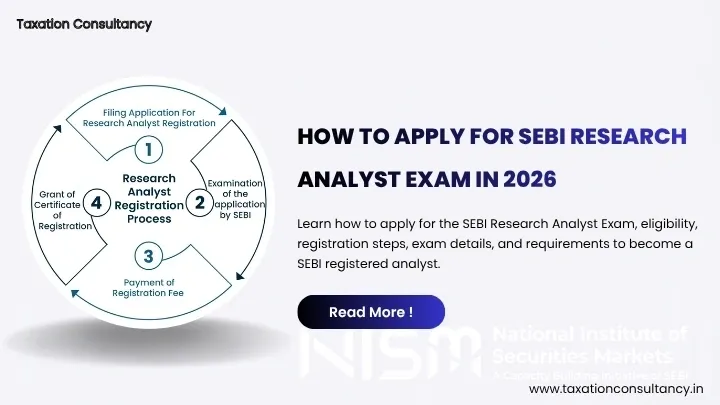
How to Apply for SEBI RA License Online (2026 Guide)

SEBI RA License Process 2026

How to Apply for SEBI RA License Online (2026 Guide)

If you are searching how to become sebi registered research analyst, the process is now simpler and fully online. Since December 2024, SEBI has shifted the registration system to the BSE (Bombay Stock Exchange) portal. Applicants can now create an account, upload documents, and track their applications easily without using the old SEBI intermediary platform.

At the same time, SEBI issued a consultation paper in August 2025 proposing further relaxation in educational qualifications and documentation. However, those changes are not yet implemented. The December 2024 process remains the valid procedure as of now.

What is a Research Analyst (sebi ra License)

The Research Analyst (RA) license allows professionals to provide investment research, publish analytical reports, and make recommendations to investors. The license ensures that public advice is given only by qualified and compliant professionals.

Starting the SEBI RA Registration Process

The current registration process begins on the BSE portal.

  1. Visit the official BSE portal and open the Research Analyst Registration section.
  2. Create an account using your PAN name, email address, and mobile number.
  3. Verify your identity through an OTP.
  4. Choose your applicant type – individual, partnership firm, or company/LLP.
  5. Fill the application form with your education details, NISM Series XV certification number, business plan, and contact information.
  6. Upload all required documents and pay the registration fee online.
  7. The application is then reviewed by BSE and SEBI. Once verified, you receive a registration number starting with INH.

Eligibility Criteria (As per December 2024 Framework)

To be eligible under the current process:

  • You must hold a graduation or post-graduation degree in Finance, Commerce, Economics, Business Management, or a related field.
  • No work experience is needed if you hold a finance-related qualification.
  • You must have a valid NISM Series XV Research Analyst certificate.
  • Instead of net worth, a fixed deposit in a bank account accessible to SEBI is required. The amount depends on your client base.

Documents Required For Sebi RA License

For individuals and partnership firms:

  • PAN and Aadhaar
  • Degree certificate
  • NISM Series XV certificate
  • Income tax returns for the past three years
  • Address proof (rent agreement or electricity bill)
  • Six-month bank statement
  • Business plan and internal policies
  • Required declarations

For companies and LLPs:

  • Company PAN and incorporation certificate
  • PAN and Aadhaar of directors or shareholders
  • GST certificate or declaration
  • Educational and NISM certificates of principal officers
  • Shareholding pattern
  • ITRs and bank statements for three years
  • Compliance and policy documents

Deposit Requirement

The deposit structure under the December 2024 rules is as follows:

  • 0–150 clients: Fixed Deposit of ₹1,00,000 (lien in favor of BSE)
  • 150–300 clients: ₹2,00,000
  • 300–500 clients: ₹5,00,000
  • Above 1,000 clients: ₹10,00,000 (maximum cap)

Fee Structure (2025)

  • Individuals and partnership firms: ₹10,000 for a five-year license
  • Companies and LLPs: ₹3,50,000 for three years or ₹5,50,000 for five years
  • 18% GST is applicable on all fees

Post-SEBI RA registration Responsibilities

Once registered, every Research Analyst must:

  • Renew the sebi ra license before expiry
  • Maintain updated disclosure documents
  • File regular compliance reports
  • Follow the SEBI Research Analyst Regulations, 2014

Proposed Changes (August 2025 Consultation Paper)

The consultation paper titled “Ease of Doing Business for Investment Advisers and Research Analysts” suggests:

  • Allowing graduates from any discipline to apply
  • Replacing supporting documents like CIBIL or infrastructure proofs with self-declarations
  • Continuing to use the BSE portal for applications

These are still proposals. Until SEBI releases an official notification, the December 2024 process and eligibility remain in force.

Comparison Between Current and Proposed Rules

  • Present system: Active on BSE portal, finance-related degree required, standard documentation.

Proposed system: Same portal, any graduate eligible, simplified documentation process.
Implementation dates are pending, so applicants must still follow existing guidelines.

Important Reminders

  • Graduation or post-graduation in finance, commerce, economics, or business management remains valid.
  • Non-finance graduates cannot yet apply.
  • NISM Series XV certification is compulsory.
  • Deposit requirement ranges from ₹1 lakh to ₹10 lakh based on client numbers.
  • Processing time varies depending on document verification and response speed.

Conclusion

If you wish to apply for a sebi ra license today, start through the BSE portal. Keep your finance-related degree, NISM Series XV certificate, and all documents ready. Submit the application as per the December 2024 process, pay the correct fee, and maintain the required deposit.

The current route through the BSE portal is valid until SEBI officially implements the new proposals. Once approved, the changes may allow graduates from any field to apply, but for now, the December 2024 process remains the correct and legal route for sebi ra registration.

FAQ'S

A SEBI RA License is an official authorization granted by the Securities and Exchange Board of India (SEBI) that allows individuals or firms to operate as Research Analysts (RA) and provide research-based investment recommendations to clients legally.

To apply for SEBI RA registration, you must visit the SEBI Intermediary Portal, fill out Form A, and submit the required documents like educational qualification, experience proof, and fee payment receipt. Once verified, SEBI issues the RA License with a unique registration number.

To obtain a SEBI RA License, an applicant must have:

  • A professional qualification such as CFA, MBA (Finance), or Postgraduate in Economics/Commerce.

  • Minimum five years of experience in financial analysis or research.

  • A valid NISM-Series-XV Research Analyst Certification.

The SEBI RA license remains valid until it’s voluntarily surrendered, suspended, or cancelled by SEBI. However, analysts must comply with ongoing regulatory and compliance obligations to maintain their license in good standing.

No, SEBI regulations do not permit holding both Research Analyst (RA) and Investment Adviser (IA) licenses simultaneously within the same entity. You must choose one registration based on your business model and service type.

How to Apply for SEBI Research Analyst Exam (NISM Series 15)

sebi research analyst exam

How to Apply for SEBI Research Analyst exam (Step-by-Step SEBI Guide 2026)

Becoming a SEBI-registered Research Analyst is a dream for thousands of finance aspirants in India. Whether you’re a student, a professional, or someone planning to build a research and advisory firm, the first and most important step is clearing the NISM Series 15 Research Analyst Exam.

This guide goes far beyond simple steps — it gives you a detailed, expanded, and beginner-friendly roadmap explaining who can apply, which documents you need, the latest SEBI updates, how to prepare efficiently, exam mistakes to avoid, SEBI exam syllabus, and complete registration instructions with screenshots-like clarity.

We have also included professional insights from TaxationConsultancy, India’s trusted consultancy partner for SEBI registrations, compliance, and legal support.

Introduction

If you are searching How to become SEBI registered research analyst , the first thing you need to do is pass the NISM Series 15 Research Analyst Examination. This exam is not just a requirement — it’s your foundation for entering India’s research industry professionally.

The process is simple, paperless, and entirely online through the official NISM portal. The exam fee is ₹1500, and the registration takes only a few minutes if you follow the steps correctly.

This article will help you with everything:

✔ How to sign up
✔ What documents you need
✔ How to study smartly
✔ Step-by-step registration
✔ Fee payment
✔ Important SEBI rules
✔ Post-exam SEBI registration guidance
✔ Errors people commonly make
✔ Expert insights from TaxationConsultancy

Our goal is to help you complete the entire journey smoothly — from exam registration to becoming a fully SEBI Registered Research Analyst.

Who Can Apply for the Research Analyst Examination

Anyone can apply for this exam. There are no strict eligibility rules. You can be a graduate, a student, or someone from a completely different background. Even if you only want to take the exam for learning purposes, you are allowed.

If your goal is to become SEBI registered, you need to pass specific exams. For Research Analyst registration, you must clear the NISM Series 15 Research Analyst Examination. For Investment Advisor registration, you have to pass NISM Series XA Level 1 and NISM Series XB Level 2.

Earlier, SEBI allowed only finance or commerce graduates to apply. After the latest SEBI update, candidates from any stream such as engineering, law, IT, or science can appear for this exam. You just need to pass the NISM Series 15 paper.

Additional expanded explanation:

SEBI’s purpose behind relaxing qualification rules is to encourage more analytical talent to enter the industry. Today, stock market analysis requires:

  • quantitative thinking

  • technology understanding

  • behavioral observation

  • industry-specific insights

That’s why SEBI now allows applicants from any educational background.

However, while the exam itself has no restrictions, SEBI registration later does require graduation, which we will explain in the later section.

Understanding the sebi research analyst exam

The sebi research analyst exam (officially NISM Series XV) is a certification you must pass before applying for the SEBI Registered Research Analyst license.

This exam confirms your understanding of:

  • financial markets

  • research methodology

  • company analysis

  • valuation methods

  • industry evaluation

  • SEBI regulations

  • ethical responsibilities

  • compliance duties

It is conducted online at authorized centers across India.

SEBI Exam Syllabus (NISM Series 15)

The exam covers these key areas:

1. Introduction to Research Analysis

Overview of markets, investment types, analyst roles, and the research workflow.

2. Basics of Financial Markets

Market functions, primary vs secondary markets, exchanges, and instruments.

3. Economic Environment

Macro indicators like GDP, inflation, interest rates, business cycles.

4. Company Analysis

Financial statements, ratios, business models, governance evaluation.

5. Industry Analysis

Market structure, competitive forces, sector dynamics.

6. Valuation Tools

DCF, PE, PB, EV/EBITDA, relative valuations.

7. Quantitative & Qualitative Analysis

Trend reading, interpretation, research models.

8. SEBI Regulations for Research Analysts

Compliance structure, reporting standards, ethical guidelines.

9. Code of Conduct

Integrity, transparency, avoidance of conflict of interest.

How to Prepare for the NISM Research Analyst Exam

You do not need to read the long 400 page NISM PDF. Focus on smart preparation. The Pass4Sure website is enough for study and practice. Most questions asked in the real exam come from there.

Just subscribe to Pass4Sure, practice the given questions two or three times, and you’ll easily pass the exam if you prepare well enough.

You need to get 60 marks out of 100 to clear it.
The exam has negative marking, so attempt carefully.

We do not provide any coaching because our focus is on SEBI registration, post-registration compliances, and legal support. But if you follow this plan, you can pass without coaching.

Step-by-Step Registration Process

Here is your complete guide:

Step 1: Visit the NISM Website

Your original text:
“Visit the NISM website… click Register for Certification Exam…”

Expanded guidance:

  • Search “NISM Series 15 Research Analyst Exam” on Google.

  • Always choose the result from nism.ac.in (official site).

  • Scroll down till you find the box: Register for Certification Exam.

  • Click to begin the registration.

Step 2: Make a New Account

You need:

 ✔ Passport-size photo
✔ PAN card
✔ Aadhaar card

Upload your documents correctly.

Expanded guidance:

  • Ensure your photo is recent, clear, and not blurred.

  • PAN card must be uploaded in correct orientation.

  • Aadhaar must show name & address clearly.

Fill in:

  • Name

  • Father’s name

  • DOB

  • Gender

  • Email (type twice to avoid mistakes)

  • Password and confirmation

Click Next.

Step 3: Enter Contact Information

Fill address, city, state, pincode, country (India).
Mobile number is mandatory — verify via OTP.

Expanded explanation:

Make sure your Aadhaar address and your NISM address are similar to avoid future confusion (though not mandatory for SEBI registration).

Step 4: Fill Educational Details

You must enter:

  • Highest qualification

  • University

  • Passing year

  • Percentage

  • Professional qualification (if any)

If you are still studying → Select Student.

Once all steps are done → Submit → Check email for OTP.

Your NISM account is now created.

Applying for the Research Analyst Exam

Login → Recommended Courses → Select Series 15 → Click Enroll Now.

Then:

  • Choose Examination
  • Choose Series 15 (NOT 15B)
  • Select exam city
  • Select exam center
  • Choose exam date & slot
  • Preview details carefully
  • Proceed to payment

No need to worry if NISM address ≠ SEBI address. They are handled separately.

Payment Process

(Your content preserved)

The total fee is 1500 rupees.

You can pay via:

  • Credit card

  • Debit card

  • Net banking

  • UPI

Once payment is successful, you’ll see:

“You are enrolled for the NISM Series 15 Research Analyst Certification Examination.”

Important Notes & Common Mistakes

  • Upload all documents clearly

Do NOT upload blurred Aadhaar.
Do NOT crop PAN card incorrectly.

  •  OTP Issues

Always check SPAM folder.

  • Account Locked

Wait 72 hours — NISM fixes it automatically.

  • Payment Failed

Raise a ticket from NISM Support — they respond quickly.

  • Choosing wrong exam (Series 15B)

This is one of the most common mistakes.

Quick Summary

  • Exam Fee: ₹1500
  • Passing Marks: 60/100
  • Negative Marking: Yes
  • Certificate Validity: 3 years
  • Mode: Online (center-based)

Follow these steps and you will complete your registration smoothly.

SEBI Registration After Passing the Exam (Very Important)

This part is crucial because passing the exam does NOT automatically make you a SEBI Registered Research Analyst.

To become officially registered, you need:

 ✔ Graduation (any stream)
✔ NISM Series 15 certificate
✔ Net worth certificate (CA-issued)
✔ Business plan
✔ Research process documentation
✔ Compliance manual
✔ Application form & declarations
✔ Fees payable to SEBI
✔ Website + disclosure structure
✔ Proper KYC, policies & conflict management

SEBI’s process is detailed and requires 100% accuracy.

This is where TaxationConsultancy becomes essential.

Why Choose TaxationConsultancy

If you need professional assistance with:

Then TaxationConsultancy is your trusted partner.

Why professionals choose TaxationConsultancy:

⭐ 100% accuracy in SEBI documentation
⭐ Fastest approval turnaround
⭐ Handles everything end-to-end
⭐ Experienced in SEBI-related legal filings
⭐ Trusted by analysts, advisors & PMS applicants across India
⭐ Avoids rejection due to compliance mistakes

SEBI registrations are complex, but with expert assistance, the process becomes smooth and stress-free.

Conclusion

This comprehensive 3000-word guide has covered every important step about the sebi research analyst exam, SEBI Exam Syllabus, and how to apply for the sebi registered research analyst exam.

If you follow the registration steps, avoid mistakes, prepare smartly, and follow the updated SEBI rules, you can clear the NISM exam Series 15 exam on the first attempt.

And once you’re ready for SEBI registration, TaxationConsultancy will guide you every step of the way.

Also Read : Investment Advisor Registration SEBI – Process, Fees & Eligibility 2026

FAQ'S

Not if you prepare smartly. With practice questions (e.g., Pass4Sure), it’s easy to clear.

Yes. Any student from any stream can apply.

The certificate is valid for 3 years.

Yes. This exam is compulsory under SEBI’s rules.

Yes. Once you receive your certificate, you can start the SEBI application.

How To Become SEBI Registered Analyst in 2026

SEBI Research Analyst Registration

SEBI Research Analyst Registration: Eligibility, Fees & Steps

 If you want to know how to become sebi registered analyst, what qualifications are required, how much deposit you need to pay, and how recent amendments have changed the rules — this guide gives you everything in one place.

SEBI has implemented some important updates regarding qualifications, client-based deposit requirements, fees, certification, and applicability. Many people remain confused about these changes, especially after the December 2024 amendment.

This comprehensive guide explains the entire SEBI Research Analyst registration process in simple language, with all the new rules included, compliance requirements, and expert guidance so you can avoid penalties and illegal advisory issues.

What SEBI Says: Who Must Register as a Research Analyst?

According to the SEBI Research Analyst Regulations:

Any person who prepares research reports or provides stock recommendations, buy/sell calls, trading tips, or investment opinions in exchange for consideration (fees) must obtain SEBI Research Analyst registration.

If you provide stock market advice for money — in any form — you fall under SEBI RA regulations.
Providing research or tips without registration is illegal, and SEBI can take strict action, including penalties, warnings, or even market bans.

What Is “Consideration” Under SEBI Rules?

The term consideration has legal meaning under the Contract Act, but for practical understanding:

If you receive money, fees, commission, subscription, or anything of value in exchange for stock market advice — it is considered a “consideration”.

That means:

  • Charging for calls
  • Paid stock recommendations
  • Subscription-based advisory
  • Research-based Telegram tips
  • WhatsApp, YouTube, or social media advice for money

ALL require SEBI Research Analyst (RA) registration.

If you are earning from stock tips — registration is mandatory.

Part-Time sebi research analyst registration Are Also Covered

Many people believe that SEBI Research Analyst Registration is needed only for full-time analysts.
But this is wrong.

Whether you are:

  • Doing a job
  • Running a business
  • Freelancing
  • Providing evening research services
  • Sharing research part-time

If you are giving advice and charging for it, you must obtain SEBI Research Analyst Registration.
There is no concept of “small-scale advising” or “side income tips” — SEBI applies uniform rules to all.

Can NRIs Become SEBI Research Analysts? (Updated Clarification)

A common question is:


“Can an NRI apply for SEBI Research Analyst registration?”

Here’s the clear interpretation:

  • SEBI laws do not explicitly allow NRIs to register.
  • SEBI laws do not explicitly restrict them either.
  • However, SEBI registration is not issued to individuals operating from outside India.

This means:

A person living outside India cannot directly obtain SEBI Research Analyst Registration.

But that does not mean NRIs cannot work in research.

Under Regulation 4:

Anyone residing outside India who prepares research reports on Indian securities must collaborate with a SEBI-registered Research Analyst or Research Entity based in India.

So NRIs cannot register independently, but they can work through a tie-up with an Indian RA firm.

This is a compliant and legally allowed way for NRIs to participate in the Indian market research ecosystem.

Qualification Required to Become a SEBI Registered Research Analyst

SEBI has removed the earlier experience requirement.
Now, experience no longer plays any role.

Current Qualification Requirement (2026)

You must have:

A graduate or postgraduate degree, or a professional qualification, in any of the following fields:

  • Finance
  • Accountancy
  • Commerce
  • Business Management
  • Economics
  • Capital Markets
  • Banking
  • Insurance
  • Actuarial Science
  • Or any related financial field

You are eligible if your degree is in any of these subjects.

Alternate Qualification Paths

If you don’t have the above degrees, you can still become a Research Analyst through:

  1. NISM Post Graduate Program (PGP) – 1-year full-time
  2. CFA Charter or CFA Level completion

These are acceptable qualifications under SEBI RA regulations.

What Changed After December 2024 Amendment?

Earlier, the rules were different:

Earlier:

  • Graduate degrees (any field) + 5 years experience made you eligible
  • Any postgraduate degree qualified you
  • Experience was accepted

Now (After Amendment):

  • Experience requirement removed entirely
  • Only graduates in specific subjects allowed
  • Postgraduate degrees in unrelated fields no longer eligible
  • Professional courses still valid (CFA, PGP)

Also:

Anyone working with you — sales staff, relationship managers, etc. — must also be graduates.

This improves the quality and accountability of research services.

Mandatory Certification: NISM Series XV (15)

To become a Research Analyst, you must have:

NISM Series XV Research Analyst Certification

This certification:

  • Is compulsory
  • Must be renewed periodically
  • Has a renewal module (no need to take full exam again)

Without NISM Series XV, you cannot apply for registration.

SEBI RA Deposit Requirement (New Rule Replacing Net Worth)

This is one of the biggest changes.

Earlier, individuals needed:
₹1 lakh net worth

Now SEBI has replaced this with a client-based deposit system.

  • 0–150 clients: ₹1,00,000 deposit
  • 151–300 clients: ₹2,00,000 deposit
  • 301–1000 clients: ₹5,00,000 deposit
  • 1000+ clients: ₹10,00,000 deposit

Instead of net worth certificates, SEBI now wants an FD or deposit maintained with a scheduled bank.

This ensures capital adequacy based on scaling.

Why This Matters?

Earlier, someone with just ₹1 lakh net worth could serve thousands of clients.
Now, if you want to serve more clients, your deposit must increase.

Many call this “ease of doing business,” but practically:

It feels more like the “fees of doing business.”

Still, it brings more accountability to analysts handling large client bases.

Validity of SEBI Registration

A major advantage in the new rules:

SEBI Research Analyst Registration Certificate is valid forever — unless suspended or cancelled by SEBI.

There is:

  • No expiry period
  • No need to reapply
  • No need to resubmit documents

To keep registration active, you must:

  • Pay renewal fee every 5 years
  • Maintain NISM certification
  • File compliance reports
  • Follow SEBI guidelines

Failing to follow compliance can lead to cancellation or suspension.

SEBI RA Fees: Application + Registration + Renewal

SEBI has not changed the fee structure.

1. Application Fee (Non-refundable)

  • Individuals: ₹2,000
  • Non-individuals: ₹20,000

2. Registration Fee

  • Individuals: ₹3,000
  • Non-individuals: ₹30,000

3. Renewal Fee (Every 5 Years)

  • Individuals: ₹1,000
  • Non-individuals: ₹5,000
  • Additional administrative fee (non-individuals): ₹5,00,000

Total Cost

  • Individuals: ~₹15,000 + GST
  • Companies/Firms: ~₹5,50,000 + GST

This cost does not include advisory setup, compliance, audit support, or documentation assistance.

Step-by-Step Process: How to Become SEBI Registered Analyst

Here is a simplified  step-by-step guide:

Step 1: Check Eligibility

Ensure you meet the qualification criteria or alternative pathways (PGP/CFA).

Step 2: Obtain NISM Series XV Certification

This is mandatory for all RAs.

Step 3: Prepare Documentation

You will need:

  • KYC documents
  • Qualification certificates
  • Experience (if any)
  • NISM certificate
  • Address proof
  • Deposit proof
  • Income tax details

Step 4: Open SEBI Intermediary Portal Account

Register on SEBI SI Portal.

Step 5: Submit Form A (RA Application Form)

Upload documents and pay the application fee.

Step 6: Make Required Deposit (FD/Deposit Slip)

Deposit amount must match your client capacity.

Step 7: SEBI Verification

SEBI examines your documents and may ask for clarifications.

Step 8: Approval & Certificate Issuance

Once approved, SEBI issues the RA Certificate with your registration number.

Step 9: Start Legal Research Activities

After approval, you can legally provide:

  • Research reports
  • Trading/investment analysis
  • Equity/derivative research
  • Buy/sell/hold recommendations

Consequences of Giving Advice Without Registration

Unregistered advisory is punishable under the SEBI Act.

SEBI may:

  • Send show cause notices
  • Impose penalties
  • Order refunds to clients
  • Ban the advisor from markets
  • Initiate legal action

Never provide paid tips without registration.

Summary: How to Get SEBI Registered

how to get sebi registered?, you must have a relevant graduate degree, mandatory NISM Series XV certification, and client-based deposit. Submit Form A on SEBI portal, pay fees, and follow compliance norms. Registration is valid permanently unless SEBI cancels it.

Need Professional Help to Get SEBI Registered? (Recommended)

If you want hassle-free SEBI Registration, be it:

  • Research Analyst (RA)
  • Investment Advisor (IA)
  • PMS Registration
  • Post-registration SEBI Compliance
  • Help with SEBI Show Cause Notices
  • Assistance with Unregistered Advisory Cases

Then TaxationConsultancy is your trusted partner.

Why Choose TaxationConsultancy?

  • Expert team specializing in SEBI registrations
  • Zero-error documentation
  • Fast approval assistance
  • Post-registration compliance support
  • Help with SEBI audits and legal notices
  • Support for both registered and unregistered advisory cases

TaxationConsultancy — Your Trusted Partner for SEBI Registrations, Compliance, and Legal Support.

Also Read : Investment Advisor Registration SEBI – Process, Fees & Eligibility 2026

FAQ'S

A graduate degree in finance, commerce, economics, business management, or a related field. CFA/PGP also qualify.

Yes. Without NISM Series XV, you cannot apply for registration.

₹1 lakh to ₹10 lakh depending on the number of clients.

No, NRIs living outside India cannot register directly. They may collaborate with an Indian registered RA.

It is valid permanently unless SEBI cancels or suspends it.

Yes. Even part-time research providers must register.

No. Experience requirement has been removed.

Usually 30–90 days, depending on document accuracy.

It is illegal, and SEBI can take strict action including penalties and bans.