
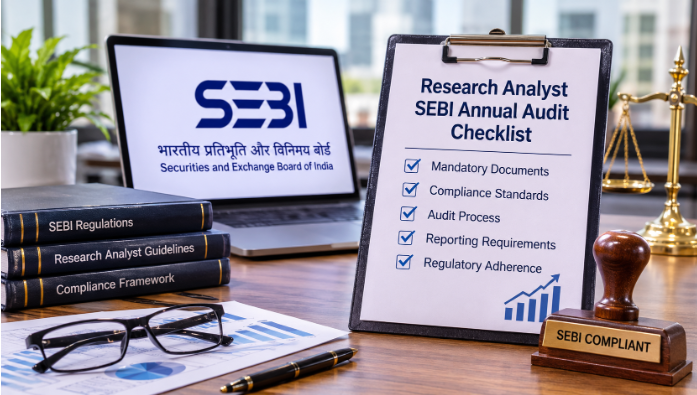
Navigating the regulatory landscape as a SEBI-registered Research Analyst (RA) requires rigorous attention to detail. Whether you are an individual practitioner operating full-time or managing a practice alongside another profession, the annual SEBI audit is a mandatory requirement that cannot be overlooked.
Failing to maintain proper documentation, client logs, and compliance records can result in serious regulatory penalties—or worse, license cancellation. To help you prepare your practice with absolute transparency, this comprehensive Research Analyst SEBI Annual Audit Compliance Guide & Checklist breaks down every document, record, and standard your auditor will inspect.
Explore Expert SEBI Compliance & Registration Consultancy Services ** *(CTA Button)* link to https://taxationconsultancy.in/sebi-registered-research-analyst/
1. Core Registration & Practitioner Verification Documents
Your annual audit begins with establishing your legal right and authorization to provide research services. Your auditor will inspect the following baseline credentials:
SEBI Registration Certificate: Your primary certification as a Research Analyst.
RA / Stock Exchange Endorsement: Your official registration or listing certificate issued by regulatory portals (such as BSE/RA).
Renewal Fee Receipts: Proof of payment for your 5-year SEBI registration renewal fee (₹10,000 for individuals) to ensure your status remains active and compliant.
Identity & Address Proof: Valid PAN card, Aadhaar card, and proof of registered office address.
Educational Qualifications & NISM Certification: Valid NISM Series-XV (Research Analyst) certification. Note that NISM certificates carry a 3-year validity and must be renewed via the NISM-15B continuing professional education (CPE) exam prior to expiration.
Employee & Associate Records: If you engage associates or junior analysts who interact with clients or assist in drafting research, their NISM-XV certifications and appointment records must be fully verified
2. Client Master Logs & Financial Year Tracking
Tracking client acquisition and client volume is critical, particularly following SEBI’s deposit-based net worth regulations. Be prepared to provide:
Day-Wise & Month-Wise Client Logs: Comprehensive Excel sheets tracking active clients throughout the financial year to determine peak client counts on any single day
Deposit Receipts & Lien Marking: Evidence of regulatory security deposits maintained based on client slabs, along with official acknowledgment and lien-marking proof from the exchange
Family-Wise Grouping & Limits: Records ensuring that combined fee collections across immediate family members do not exceed regulatory thresholds (e.g., ₹1.51 Lakhs + GST per family unit for individual RAs)
KRA KYC Verification: Up-to-date KYC records and KRA upload confirmation reports for every fee-paying client
3. Mandatory Disclosures, MITC, and Client Onboarding
One of the most common audit failure points is improper client onboarding and missing consent trails. Your auditor will strictly review:
Most Important Terms and Conditions (MITC): Evidence that the standardized MITC document was delivered to and acknowledged by the client *prior* to accepting any fee payment
Valid Consent Records: Date- and time-stamped consent logs using secure digital methods such as email OTP, physical signatures, or Aadhaar-based e-signatures
Renewal Consents: Proof that MITC disclosures and consent agreements are re-signed upon annual subscription renewals
AI Usage Disclosures: If AI writing or analytics tools (such as Claude or ChatGPT) are utilized in drafting research reports, clear disclosures detailing the extent of AI involvement must be integrated into your disclaimers
Fee Schedules & Rate Cards: Transparent documentation showing that individual client fees do not exceed the prescribed ₹1.51 Lakhs + GST cap per annum
4. Fee Collection, Bank Statements, and Prohibited Practices
SEBI enforces strict guidelines regarding how fees are collected and managed. Your audit file must reflect:
Dedicated Business Bank Accounts: Maintaining a separate bank account dedicated strictly to your RA practice to map invoices and payments cleanly
Zero Cash Acceptance: Written declarations and bank audits confirming that zero cash payments were accepted
Standardized UPI Compliance: Proof that all digital UPI collections utilize SEBI-validated and exclusive business UPI handles
Refund and Premature Termination Records: Transparent computation sheets and bank transfer proofs for any client refunds processed during the year
Prohibition of Free Bundled Services: Clear separation ensuring that complimentary services (such as portfolio reviews or unauthorized tips) are not bundled with regulated research subscriptions
5. Research Reports, Record Retention & Communications
Every piece of research, recommendation, and client interaction must be archived systematically:
Research Report Register: Maintained logs of all published reports and recommendations equipped with target prices, stop-loss levels, and Class-3 digital signatures.
Rating Framework Documentation: Clear definitions of rating categories (e.g., Buy, Hold, Sell, Accumulate) included within research reports
Communication Archives: Archived call recordings, registered email threads, and WhatsApp/Telegram chat logs demonstrating proper communication and mandatory disclosure of your RA status
5-Year Record Retention Policy: Evidence that all client records, consent forms, and research logs are securely preserved for the mandated minimum duration of 5 years
Frequently Asked Questions (FAQs)
Q1. Is an annual SEBI audit mandatory for all Research Analysts?
Ans. Yes. If your SEBI Research Analyst registration was active during the financial year (regardless of whether you had zero clients or active subscribers), an annual compliance audit conducted by a qualified independent auditor is strictly mandatory.
Q2. Can I pay a fee to an auditor to mark my non-compliant files as compliant?
Ans. No. Attempting to bypass compliance by paying auditors to falsify audit reports is a severe violation. Auditors and practitioners who submit false compliance filings face severe regulatory investigations, financial penalties, and potential license cancellation by SEBI [[01:52](https://www.youtube.com/watch?v=3-m_SO9bW6Y&t=112)].
Q3. What is the maximum fee an individual Research Analyst can charge an individual client?
Ans. For individual retail clients, the total fee charged across an individual and their family unit cannot exceed ₹1.51 Lakhs (plus applicable GST) per annum. Higher or negotiated fee structures are only permissible for qualified institutional or accredited corporate investors under specialized agreements
Q4. Are NISM Series-XV certifications renewable?
Ans. Yes. NISM-XV certificates are valid for 3 years. Upon expiration, analysts must clear the NISM-15B CPE (Continuing Professional Education) exam or retake the certification to remain eligible to provide research services